
 E-Paper



Commuting remains a challenge in a city slowly crawling back to life
As the national capital opens up from a lockdown in a phased manner amid the Covid-19 outbreak, commuting has become a hurdle for many. The Delhi Metro is yet to resume services and buses are operating only in limited numbers.

 Prefer HTon Google


After waiting for nearly 35 minutes at a Barakhamba Road bus stop, Neeraj Kumar (25), a resident of Moti Nagar, manages to get on to a Delhi Transport Corporation (DTC) bus headed towards his house. Three buses to his destination did not stop at the stand; they were full as per social distancing norms set by the Centre, he says.
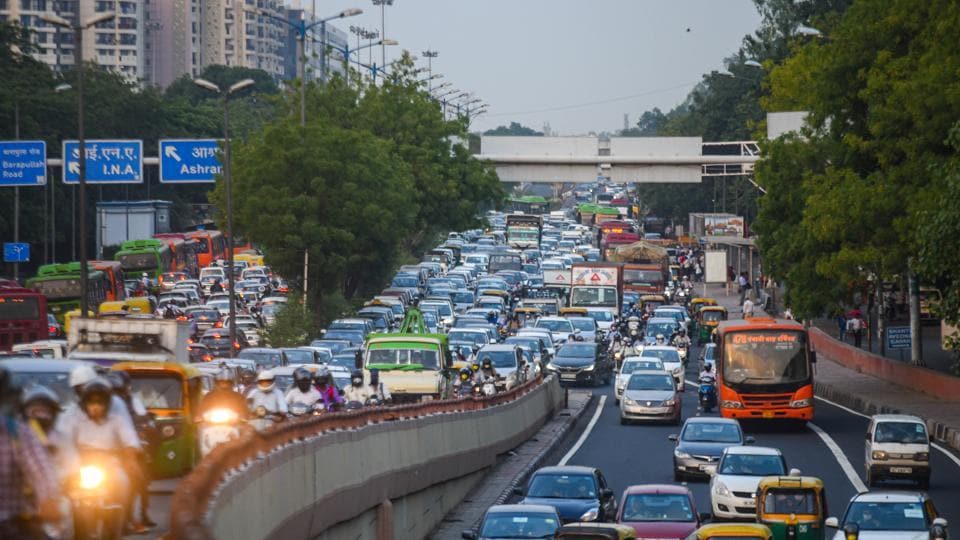
“This is the new normal. Commuting has become a big problem, as the Metro is not working and buses often don’t stop as they are full,” said Kumar, who works as a field agent with a chartered accountancy firm.
Anita Devi (45), a resident of Sultanpuri, said it took her two-and-a-half hours to reach the Lok Nayak Jai Prakash Narayan Hospital. While waiting at the bus stop outside the hospital, she said: “I came here after almost three months to get medicines, but neither could I meet the doctor nor get the medicines. I have been waiting for 45 minutes. But the buses are also not stopping at the stand.”
As the national capital opens up from a lockdown in a phased manner amid the Covid-19 outbreak, commuting has become a hurdle for many. The Delhi Metro is yet to resume services and buses are operating only in limited numbers. DTC has a fleet of 3,724 buses and the Delhi Integrated Multi-Modal Transit System (DIMTS) has 2,830 cluster buses. While DIMTS officials say that all its 2,830 buses are operating, DTC has been able to press into service only about 50% of its fleet.
With nearly six million passenger trips daily, the Delhi Metro is the transport lifeline of Delhi-NCR. With no word on when the Centre will allow the Delhi Metro Rail Corporation (DMRC) to resume operations, the state-run bus system is the only cost-effective option available to people.
According to a senior official in the transport department, close to 700 buses are on police and special duty. “Of the remaining 3,000, nearly 1,800 buses are plying on the roads. We have not received any complaints so far about shortage of buses,” the official said, asking not to be named.
When asked why fewer DTC buses were operating, the official cited multiple reasons. “There are many reasons. Some of our drivers are not able to come as they live in neighbouring states which have strict border restrictions. Some others are 55 and above in age. Some of our staff has also tested positive for Covid-19 due to which others had to be placed in home quarantine. But we are trying to work out a way so that sufficient numbers of buses are on the roads.”
Commuters say they now plan their work keeping in mind the time it takes to reach home, as there is a curfew in place after 9pm. “We now have to plan our work schedule according to the availability of buses,” said Mahinder Singh, an IT professional.
Due to the restrictions imposed to check the spread of Covid-19 — curfew from 9pm, limited number of passengers in buses and e-rickshaws and inadequate public transportation — Singh said commuting was proving to be a challenge.
“Earlier, I would visit 4-5 places for work. But now, I don’t take any assignments after 4pm, as I have to plan my trip back home. Now, we have to wait for a minimum of 30 minutes for buses. I can’t afford to take auto-rickshaw every day as I have to visit multiple locations,” said Singh, who lives in Rajouri Garden.
Transport expert Anumita Roychowdhury, executive director at the Centre for Science and Environment (CSE), said that efforts should be made to ensure availability of adequate public transport system so that people don’t switch to private vehicles. “People are switching to personal vehicles due to safety reasons and also due to a shortage of public transport. The capacity of buses has further gone down due to the restrictions of 20 passengers. Like they do during the odd-even scheme in peak pollution season, the government should pool resources to meet the requirement of public transport.”
A senior government official, who spoke on condition of anonymity, said: “So far, there is no plan to rope in private players. But we are trying to ensure that 90-95% DTC buses are out on the roads, especially during peak hours.”


