
 E-Paper



Delhi runs for cover as record July rain hits city
The Safdarjung, Delhi Ridge and Lodhi Road observatories recorded 74.8mm; 86mm and 81.2mm of rainfall respectively.

 Prefer HTon Google


The national capital, which was nearly parched since monsoon arrived in the city on June 24, received spells of “heavy” monsoon showers for around three hours on Sunday early morning, which threw traffic into disarray, led to the collapse of several shanties, and claimed at least two lives.
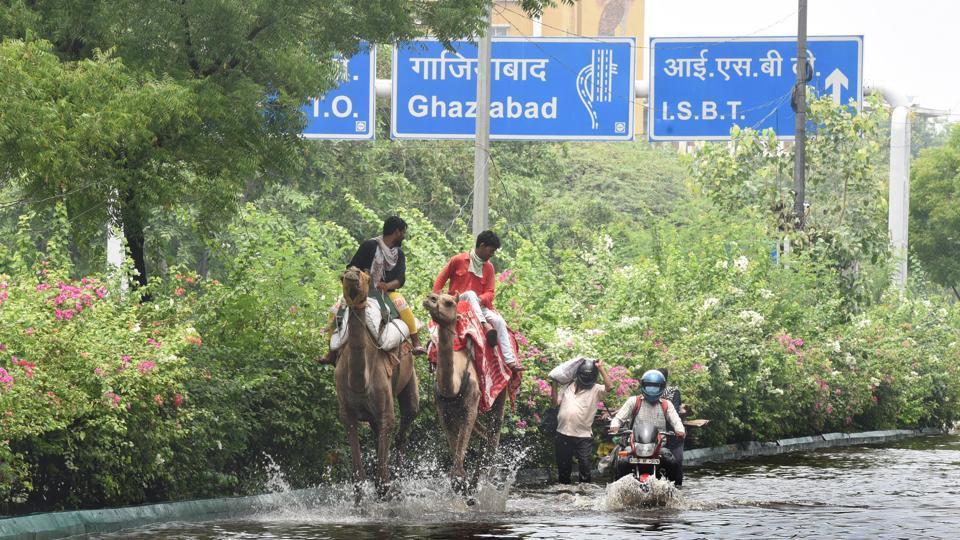
The Safdarjung, Delhi Ridge and Lodhi Road observatories recorded 74.8mm; 86mm and 81.2mm of rainfall respectively.
In fact, Safdarjung recorded the highest rain in a day for July in five years. On July 11, 2015, Safdarjung station had recorded 93.8mm rain. The all-time rain record for July in Delhi is 266.2 mm recorded on July 21, 1958, according to data with the Regional Weather Forecasting Centre, Delhi.
“Moderate category rain is expected again on July 20 night or July 21 early morning,” said Kuldeep Shrivastava, head, regional weather forecasting centre.
At least two deaths were reported due to Sunday’s rains.
A man died after falling into water in south-east Delhi, and another man drowned in the flooded Minto Road underpass.
The first death took place in Gandhi Camp in nearby Srinivaspuri. Jalil, 28, was standing outside the same shop when he suddenly fell into a pool of water.
“The rain had led to the accumulation of three feet deep water outside the shop,” said RP Meena, deputy commissioner of police (south-east). Jalil too was brought dead at a hospital.
“The reason behind his death is not clear. We’ll know more after we receive his autopsy result,” said the DCP, adding that inquest proceedings have been initiated.
An eight-year-old boy was reported to have drowned in the Yamuna, but the police could not immediately confirm if the death was due to the rains.
Reports emerged from across the city of at least 20 trees being uprooted, shanties collapsing, and vehicles being submerged, slowing down traffic to a crawl on major stretches.
Six people were evacuated from Zakhira underpass in southwest Delhi, after a cluster bus and a tempo submerged there. Two buildings collapsed in east Delhi’s Laxmi Nagar and Shanti Mohalla in Gandhi Nagar.
Shanties, trees, shops along the banks of a storm water drain in ITO near the World Health Organization building were washed away in the flow of water.
The Delhi Traffic Police reported heavy waterlogging at Minto Road, Azadpur underpass, South Avenue Road, Pul Prahladpur underpass, Azad market, Moolchand underpass and near Batra Hospital among others.
Many residents shared on social media videos and pictures of rainwater gushing into their houses and vehicles wading through waterlogged roads.
Police officers said one of the three domes of the 197-year-old Mubarak Begum mosque in Hauz Qazi collapsed around 7am on Sunday. “It got damaged due to the rain. No one was around it when it happened, and there have been no injuries due to the damage,” said an officer who asked not to be named.
Deputy chief minister Manish Sisodia said the Delhi government is closely monitoring the situation following waterlogging in parts of the city and appropriate steps will be taken to cover the losses due to heavy rains.
“The situation is being constantly monitored and we are in touch with our engineers and taking the report,” he told reporters.
Experts said that while the rain on Sunday in Delhi was “heavy” but the damage it caused was disproportionate to the amount and intensity of rain.
“The topography of Delhi is such that we should never see flooding here. It is west of Yamuna river and the topography is undulating, making it favourable for drainage. The reason we see such flooding even after a couple of hours of rain is because we are not allowing the water to find its own path. We have not taken care of the natural drainage — there are people living right on the drain. So when the drain overflows it will damage the houses in its way. It’s also a sad commentary on the state of housing for urban poor. What happened to Delhi’s drainage master plan? Crores have been spent on it. Why is it not being implemented?” asked Manoj Mishra, convenor of the Yamuna Jiye Abhiyan.
After the rains, Safdarjung observatory has got 122.7 mm rainfall in July so far, 8% more than the normal of 114.1mm, according to IMD data. The Lodhi Road station has recorded 137.1 mm rainfall in July so far, 20% more than the normal.
IMD has issued an orange category warning for all of northwest India on July 20 and 21. An orange warning implies that disaster management and local authorities should prepare for heavy rain or flooding related emergencies.


