
 E-Paper



Delhi’s air quality bad this year, but better compared to 2016 and 2017
Experts said that while anti-pollution measures taken this year have shown some results, Delhi could hope for even better air quality in 2019, if they are implemented with stringency and rigor throughout the year.


The year might have ended with Delhi’s air quality reading in the ‘severe’ zone on its last day (with an Air Quality Index value of 420), marking this December’s air the foulest since 2015, but Delhi’s overall air quality in 2018 was better than in 2016 and 2017.
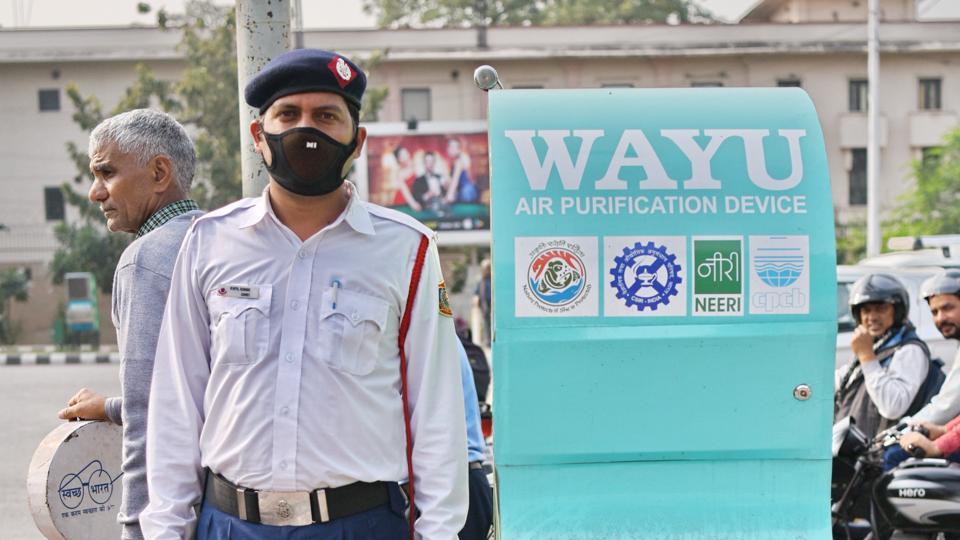
Experts said that while anti-pollution measures taken this year have shown some results, Delhi could hope for even better air quality in 2019, if they are implemented with stringency and rigor throughout the year.
Data available with the Central Pollution Control Board (CPCB) — the country’s apex pollution monitoring body — shows that the number of days with ‘good’, ‘satisfactory’ and ‘moderate’ air quality has gone up, while the number of days with ‘poor’, ‘very poor’ and ‘severe’ air quality has declined.
“The city’s air quality has improved because of a series of anti-pollution measures that were taken in Delhi and the National Capital Region (NCR). We hope to see further improvement in 2019,” a senior official of the CPCB said.
In 2018, a series of measures were taken, such as shifting from using BS-IV fuel to BS-VI fuel, shutting down the Badarpur power plant, launching the air quality early warning system, taking pre-emptive measures to control pollution levels, banning polluted fuels such as coal and kerosene in Delhi and cracking down on industries.
“The efforts taken this year have reflected well in the overall air quality, which has improved marginally. If we can sustain these efforts throughout the year, 2019 would be much better,” Chandra Bhushan, deputy director general of Centre for Science and Environment, said.
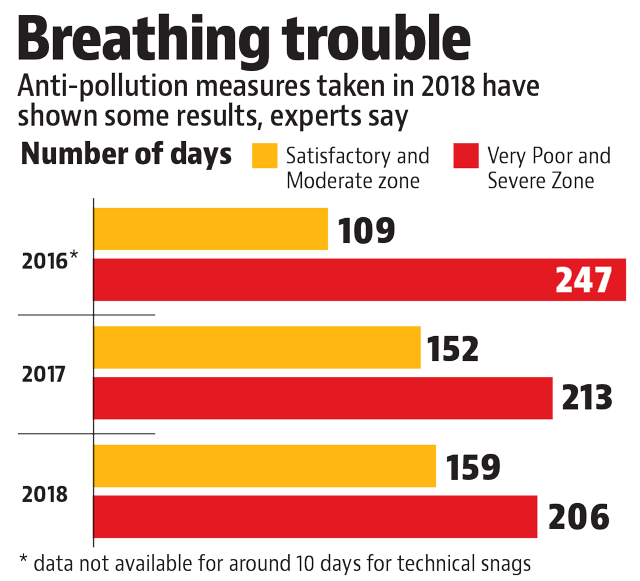
But even though overall air quality in 2018 was better than previous years, this December, Delhi encountered one of its longest spells of severe air—four continuous days. Data available with the CPCB shows that Delhi encountered at least eight days of ‘severe’ air quality this December. While in 2015, there were no such days, in 2016 there were at least six such days. In 2017, Delhi encountered only one ‘severe’ air quality day in December,” an official of Delhi Pollution Control Committee said.
In 2016, severe pollution spells didn’t last for more than two consecutive days. The intensity of pollution was also higher this December than in 2016. While the highest air quality index value recorded in December 2016 was 427, this year it touched 450 (December 23). It dropped to 448 the next day.
“Such high levels of pollution are rarely encountered in December. They are usually seen in November around Diwali, stubble burning is on, and meteorological factors aren’t favourable. Meteorology has played a very crucial role in pushing up pollution levels in December 2018,” D Saha, former head of the air quality laboratory of the CPCB, said.

Stay updated with all top Cities including, Bengaluru, Delhi, Mumbai and more across India. Stay informed on the latest happenings in World News along with Delhi Election 2025 and Delhi Election Result 2025 Live, New Delhi Election Result Live, Kalkaji Election Result Live at Hindustan Times.


