
 E-Paper



Delhi’s dimly lit, stinking subways keep pedestrians away
Road safety experts said the subways in the city are built in a way that they provide a smooth passage to the motorised traffic and not the pedestrians.

 Prefer HTon Google


Holding her newborn tightly in her arms, Naziya Sheikh tries to stop the traffic on the busy Asaf Ali Road outside Lok Nayak hospital so that she and her husband could cross over to the other side
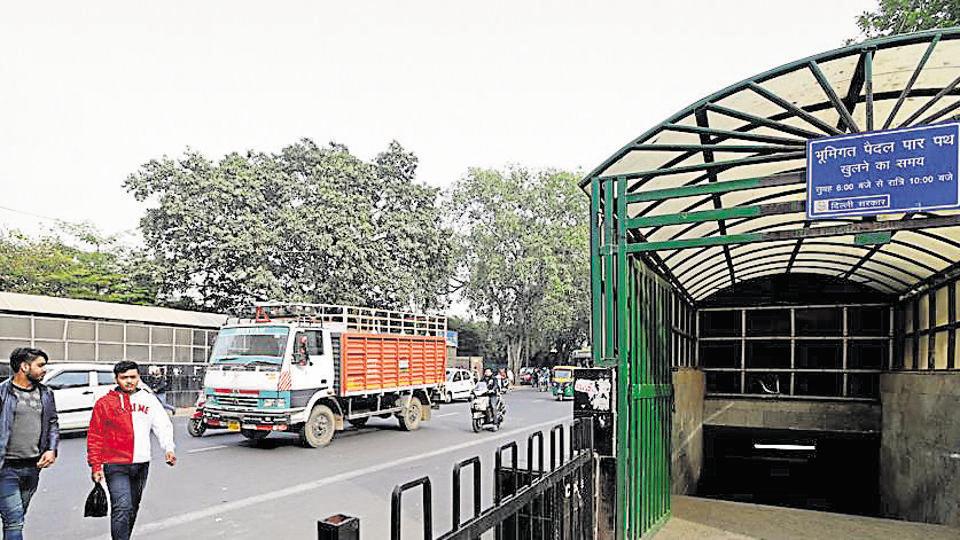
Though there is a subway right outside the hospital, Sheikh said she prefers to cross the road like that, risking an accident, than using the subway. “We have a lot of bags. It is difficult to climb the stairs with luggage. It is convenient to cross the road,” said Sheikh, a resident of the Walled City.
Every day thousands of patients and their relatives from Delhi’s two big government hospitals — Lok Nayak and GB Pant — risk their lives to cross the busy Asaf Ali Road to buy medicines from chemist shops located on the opposite side. Despite being located near hospitals, the subway does not have escalators, elevators or ramps. It is also poorly lit and stinks as people urinate there. The subway remains open between 6am and 10pm to “prevent encroachment by anti-social elements”.
The condition of most of other subways in the city is pretty similar with pedestrians choosing to cross the road on the surface than choosing them. The city has 65 subways, most of which are on the arterial roads and maintained by the Delhi government’s public works department (PWD). Some others are managed by the New Delhi Municipal Council (NDMC).
A senior PWD official said, “We will look at problems with the subways under PWD’s jurisdiction and fix them on priority.”
HT visited several subways across the city and found that they are grossly underutilised due to several concerns.
Poor upkeep and safety
One of the main reasons why people, especially women, avoid using the subway is lack of safety. Anjali Singh, 20, a resident of Lajpat Nagar who is preparing for civil services, said she preferred to cross the road on the surface to reach her coaching centre in Lajpat Nagar-IV rather than using the subway on the Ring Road. “I avoid using it especially during the evening hours. It is dimly lit and always has some drug addicts lurking in a corner,” she said.
The situation was no different in the subway located on the Ring Road at Andrews Ganj. The roof of the subway was badly damaged and the fibresheet, covering the entrance was missing. Except two lights, all other electrical fittings were either missing or not working. “I don’t know why they don’t fix the lights. It’s better to wait and cross the road than risk one’s safety,” said Anu Solanki, a businesswoman.
The one at the All India Institute of Medical Sciences (AIIMS), which has been converted into a night shelter till March, has ramps and is widely used. However, it stinks of urine and has stray dogs.
Constructed at a cost of Rs 3-5 crore, most subways in the city are not accessible to all. While the government has provided escalators at most foot overbridges, not all subways have elevators or escalators. This discourages people from using them. A newly built subway, connecting South Extension part-I and II has a shining glass boundary but HT found it covered with dust. Here too, there were no elevators or ramps.
Agencies have been trying to make the facilities safe, especially for women by hosting exhibitions in them and renting space to shops but they have failed to resolve the problems.
Experts Speak
Road safety experts said the subways in the city are built in a way that they provide a smooth passage to the motorised traffic and not the pedestrians.
“World over, crossings are made diagonally, where traffic from all sides stops for a duration allowing pedestrians to move. Subways in Delhi have a serious accessibility problem as they don’t have lifts or escalators,” said, Mukti Advani, senior scientist, Centre for Road Research Institute.


