
 E-Paper



House-to-house Covid-19 screening begins in Delhi
The screening exercise involves checking people for signs of flu such as fever, sore throat, cough and asking them about their travel history to map coronavirus.

 Prefer HTon Google


Government officials in at least five revenue districts of the Capital started house-to-house screening of people across neighbourhoods on Friday, according to a five-point Covid-19 management plan chalked out after a meeting chaired by Union home minister Amit Shah last Sunday.
Click here for full Covid-19 coverage
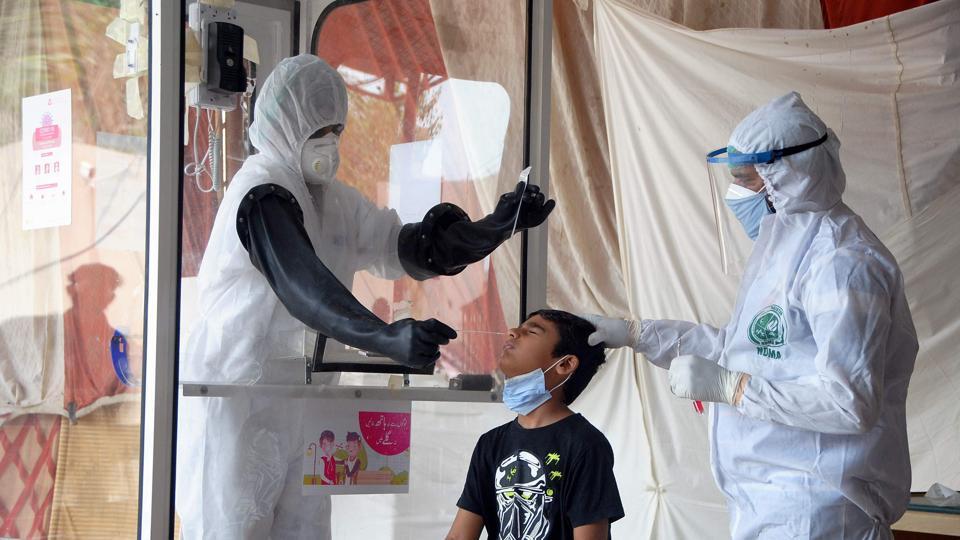
The screening exercise involves checking people for signs of flu such as fever, sore throat, cough and asking them about their travel history to map the virus. The aim is to identify people with Covid-like symptoms, create a comprehensive database and then get them tested.
While the health survey is scheduled to be completed by July 6, several district officials still await a clear standard operating procedure (SOP).
For now, the districts that have kick-started the exercise are largely relying on protocols prepared by magistrates and chief medical officers concerned, at least until an SOP is issued, senior government officials said.
Delhi has around four million households, according to the records of the government’s planning department.
For the screening exercise, the district officials have roped in civil defence volunteers, accredited social health activists (Asha), auxiliary nurse midwife workers, booth level officials (BLO) and municipal staff, including domestic breeding checkers, licensing inspectors and sanitation workers—apart from the government health workers who have experience on the job. With time, primary school teachers and clerical staff from zonal offices are likely to be roped in as well, a senior government official said.
On Friday, the survey was conducted in neighbourhoods such as Karol Bagh, Keshav Puram and Civil Lines, among others. HT followed several such teams throughout the day.
GROUND REPORT
Around 11 am, over 30 DBC (domestic breeding checkers)—who play a major role in anti-dengue and anti-malaria drives — gathered at Dev Nagar dispensary in Karol Bagh zone to check people. After a short briefing about the process by the nodal officer, workers headed towards Reghar Pura nearby to start the campaign.
People surveying households in containment zones wore PPE (personal protective equipment) kits, while those in non-containment zones wore basic safety gear such as masks and gloves. .
In several households, residents cooperated and provided all details. But there were many where residents were unwilling to share any details.
“Not every resident is cooperative. There are people living as tenants and do not want their landlords to know about any illness in their family because they fear losing their place of residence. We have to convince that it’s a public welfare exercise and a government order and they have to follow it,” a worker engaged in the survey said.
Till 3 pm, the workers had covered nearly 1,100 houses in the area. Similar surveys were carried out in Bapa Nagar, Inderpuri, Kirti Nagar and Civil Lines on Friday.
All wards have been attached to nearby dispensaries for necessary guidance. The information collected at the end of the exercise will be compiled by the chief district medical officer. At the ward-level, a nodal officer has been appointed to monitor the door-to-door screening. The nodal officer has to divide the jurisdiction into sectors and appoint a survey officer in each sector.
The three municipal corporations have 5,500 mosquito breeding checkers and 71,000 sanitation workers. In the days to come, they are likely to be deployed in all 272 wards. The district administration, however, is yet to finalise a comprehensive manpower plan for the survey.
QUESTIONS ASKED
The workforce conducting house-to-house survey has a definite set of questions such as name, age, address, contact numbers.
The questionnaire seeks specific information about any illness or flu-like symptoms or Covid-19 symptoms, travel history, information about elderly people and children. People were asked if they had been using the Aarogya Setu mobile application.
The teams red flag houses where people with serious medical conditions live.
Some districts used an app called ‘SS Corona’ wherein volunteers fill in answers to multiple-choice questions asked in each household.
“By using this app, an excel sheet is prepared automatically each evening, and the report is sent to the state integrated disease surveillance programme,” said another district official. The data can then be used to map out areas that are reporting more fever cases and help in further surveillance activities, the official said.
SOP AWAITED
Districts that have initiated the drive have developed their own protocols. Several district officials said they were awaiting the SOPs.
“In a joint meeting of the state and the central government held on 21 June (Sunday), the union home ministry had proposed a master plan to screen and survey every household in Delhi. The Centre had assured they have a ten-day strategy in their master plan. But the state government is waiting for detailed guidelines for a week now and has received none so far. Officials across the city are yet to see a uniform SOP,” said a senior government official.
The plan is to be implemented by the Delhi Disaster Management Authority (DDMA) chaired by lieutenant governor Anil Baijal, who reports to the Union home ministry. Its vice-chairman is chief minister Arvind Kejriwal.
SYSTEM FOLLOWED
“This exercise is similar to one we had earlier done in different containment zones and other areas where Covid-19 cases had emerged. We will give this information to the nodal officer who will pass it on to the area medical officer. The area medical officer will contact the concerned health officers to test those with flu-like symptoms,” a municipal official supervising the survey said.
He said the target is to cover over 2,500-3,000 houses per day in one locality. He said it was the first day of the campaign so the first-day target could not be achieved.
“The teams have been given a thermal gun to check temperatures. If anyone has signs of the infection, they are asked to go to the nearest testing centre. This will help the government recognise cases of Covid-19 early on—ensuring they reach the hospital on time or are isolated so that they do not spread the infection to others,” said one of the doctors from Delhi’s East district, on condition of anonymity.
An official from the New Delhi district said their teams have been screening houses even outside the containment areas for a few days and there wouldn’t be any trouble in finishing the survey by the July 6 deadline. “We have intensified the survey and increased manpower from the civic bodies. The problem is that we have been asked to screen houses within the containment zones every day. This would be impossible given the current manpower we have,” the official said.


