A first-time buyer’s guide. What 3 to 4 weeks down the sewing-machine rabbit hole taught me, and how I compared eight machines from Usha, Singer and Brother
Maa is past 75 and she still loves her silai. Sewing is not something she is winding down; it is something she genuinely enjoys. That made a new machine feel like the right kind of Dasara gift: useful, personal, and something she would actually use every week. I thought buying one would take an afternoon. Pick a good brand, pay the price, done.
Usha Janome
That was three to four weeks ago. I am not a sewing person. I could not have told you the difference between a zigzag and a straight stitch, and the first spec sheet I opened was full of words like “free arm”, “drop feed” and “spm”, with no explanation anywhere. I kept going, and the afternoon turned into a proper rabbit hole: reading manufacturer pages, comparing retailer listings that contradicted each other, building a scoring sheet, and then arguing with my own scoring sheet.
This document is what came out of it. It is written for the person I was a month ago: not a specialist, buying a silai machine for the first time, for someone they love, and wanting a sensible decision without having to become an expert. I have kept all of the comparison, the benchmarks, the spec sheets and the charts. But I have also written down the thinking behind them, because the thinking is what I would have wanted to see on day one.
One honest note before we begin. I have not had these machines in my hands. Everything here comes from published specifications, brand pages and retail listings. That makes it a careful desk comparison, not a lab test, and I say so again where it matters. Maa will be the real test, which is why the last part of this piece looks at the machines through her eyes and not only through a spreadsheet.
The short version
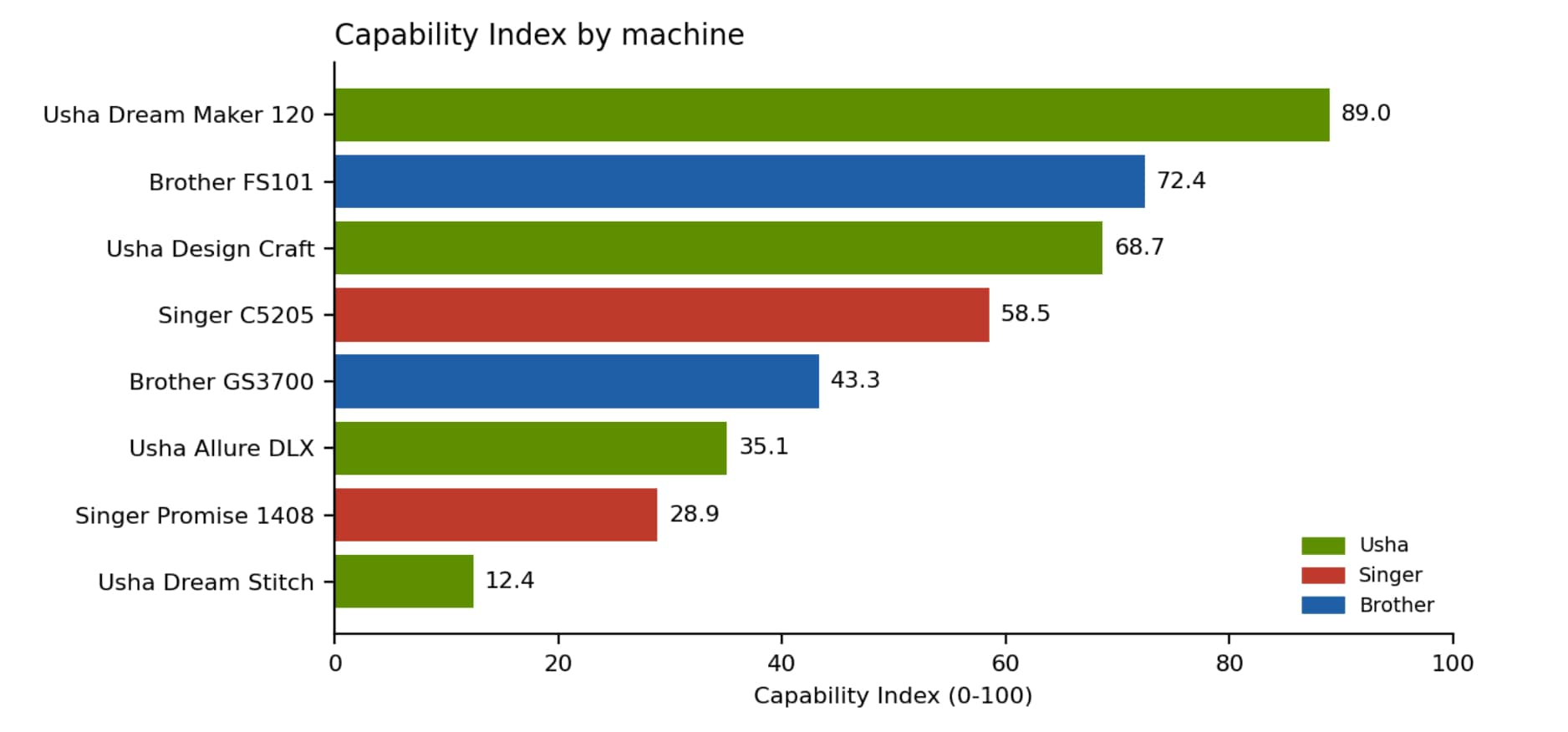
• On a pure feature scorecard, the Usha Janome Dream Maker 120 wins (89 out of 100) and the Brother FS101 is the best value (72, at about ₹23,100).
• But the scorecard rewards features and stitch range. For a first silai machine for a user past 75, ease matters more, so I added a separate Maa test. There the Brother GS3700 and the Usha Janome Allure DLX tie at the top.
• My shortlist for Maa is therefore those two, with the Allure DLX slightly ahead in my head because of Usha’s warranty and service reputation. Before I pay, I want her to sit at both and sew a seam.
• The four I might actually buy, and why, are in Section 8, at the end.
• List prices (MRP) are not what people pay. Street prices run 5% to 35% lower depending on the model, so always compare the price you will actually be charged.
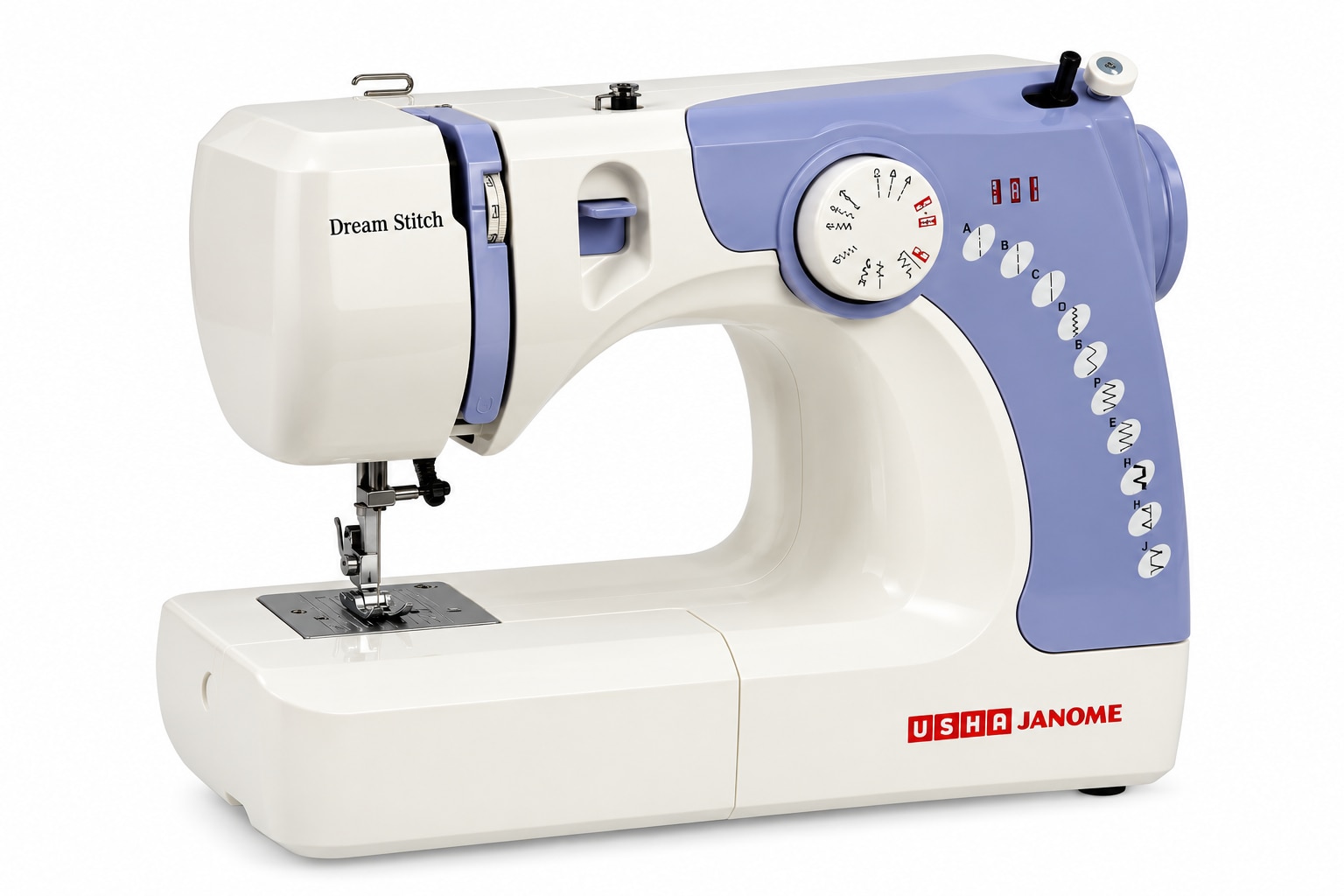
Usha Janome Dream Stitch Machine
1. How I went about it
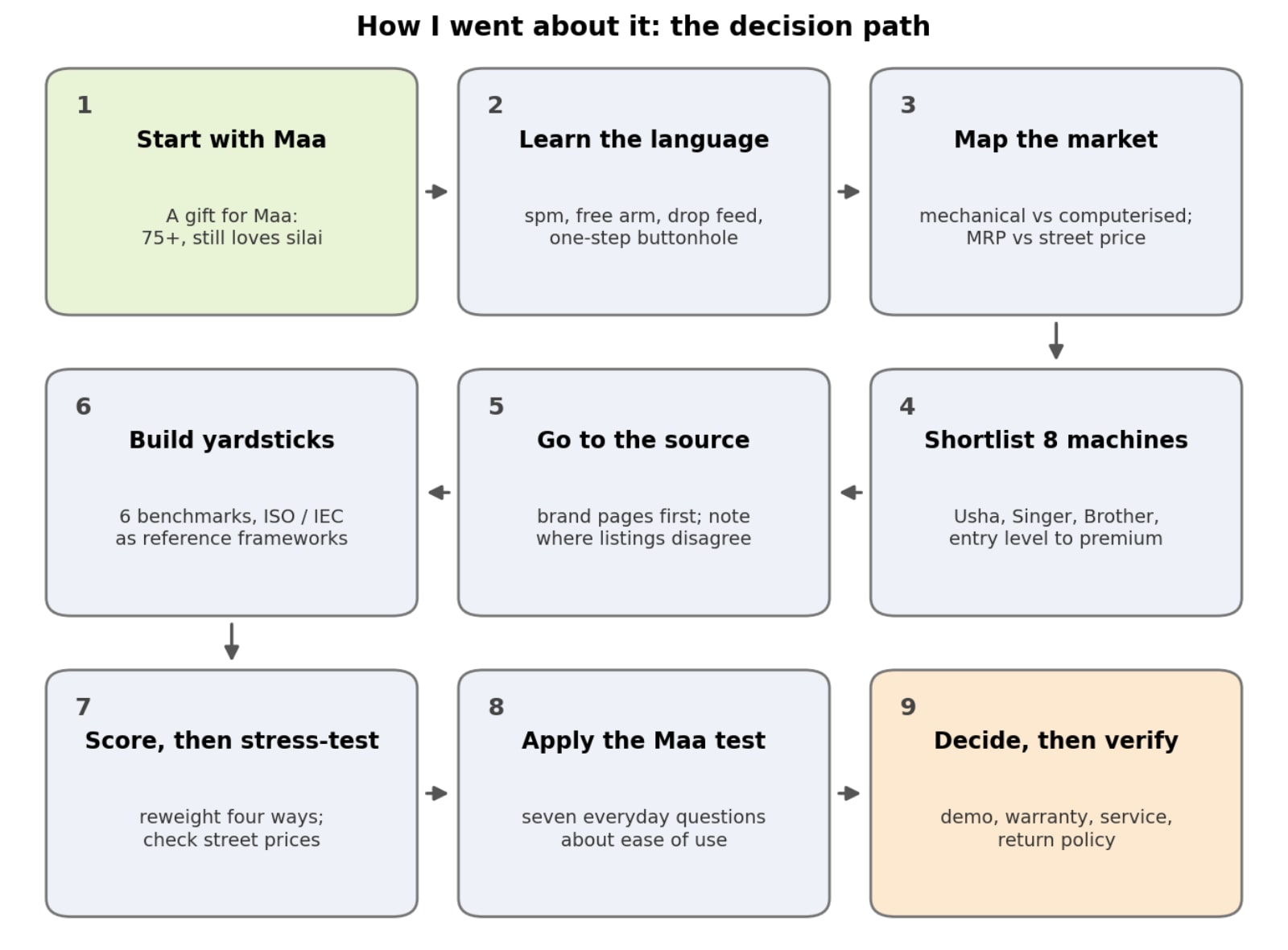
When I started I had no method, only a gift idea. Over the weeks a method emerged, and I think it is the most useful thing I can pass on. Here is the path in order, with what I did at each step and why. The chart after the steps puts it on a single page.
Step 1. Start with the person, not the product. I wrote down who the machine is for: Maa, past 75, loves silai. Then I listed what that implies for a machine: easy threading, good light, simple controls, light enough to move, and no menus to get lost in. Why: a sewing machine is a daily tool, not a trophy. Specs that look impressive can be irrelevant to the person using it.
Step 2. Admit what I don’t know and learn the vocabulary. I started by simply decoding terms: spm (stitches per minute), free arm, drop feed, one-step versus four-step buttonhole, feed dog. Why: spec sheets are written for people who already know. Until I could read one, every machine sounded equally good.
Step 3. Map the market. I learned there are two broad families: mechanical machines, operated with dials, and computerised machines, with an LCD and push buttons. Computerised machines carry more stitches and automation, and cost more. I also noticed that the MRP printed on a brand’s page and the price on Amazon or Flipkart are often very different. Why: without this I would have compared the wrong numbers.
Step 4. Shortlist eight machines. I picked machines from Usha (Janome technology inside), Singer and Brother, from about ₹15,000 to ₹60,000, so that I could see what each extra rupee buys. Why: these three brands dominate Indian catalogues and best-seller lists, and a spread of prices shows where the value is.
Step 5. Go to the source. I took specifications from the manufacturer’s own pages first and used retailer listings only to fill gaps. Where they disagreed, I noted it and picked the manufacturer. For example, the Dream Stitch is 550 stitches a minute on Usha’s page but 860 on some retailer listings. Why: the internet is full of confident, contradictory numbers.
Step 6. Build yardsticks. I defined six benchmarks (stitch range, speed, zigzag width, automation, control and construction) and weighted them. I used ISO 4915 for stitch classification and IEC 60335-2-28 (sewing machine safety) as reference frameworks. Why: I did not want to be swayed by the biggest number on the box.
Step 7. Score, then try to break the scores. I reweighted the benchmarks four ways and re-ran value using street prices. Why: a ranking that falls apart when you nudge the weights is not worth trusting. This one held: the top and bottom machines never changed.
Step 8. Apply the Maa test. I went back to my day-one list and asked seven plain questions of each machine (for example: does it thread the needle itself, and does it avoid menus?). Why: this is where the answer changed. The best machine on paper was not the best machine for her.
Step 9. Decide, then verify in person. I decided what no spec sheet can settle: how it feels to use, and what happens when something goes wrong. That means a demo, the warranty terms in writing, and the service arrangements. Why: a gift that is frustrating on day three is worse than no gift.
The decision path
What surprised me
Coming in as an outsider, a few things surprised me, and I suspect they will surprise other first-time buyers too.
• More stitches is not better. I assumed it was. Then I realised that most households use a handful of stitches, and that the machine with 100 stitches and the machine with 37 can both be perfectly right depending on what you sew.
• Computerised does not mean easier. I assumed an LCD would make things simpler. For a user who prefers a dial, it can do the opposite. Several of the most automated features (needle threader, thread cutter) also exist on dial machines.
• The same machine has different numbers in different places. Speed, weight, even the number of stitches vary between listings, because retailers copy, round and sometimes mix up models.
• MRP is a conversation starter, not a price. The gap to street price ran from about 5% to about 35% in my set.
• The cheapest machine was not the best value. The Dream Stitch is the lowest priced and came last on value, because it automates almost nothing.
What I was looking for: the Maa test
Here are the seven questions I ended up asking of every machine. They come from my own assumptions about what makes a first machine easy for someone past 75; threading a needle, for instance, is the sort of job that tends to get harder with age for most people. They are my judgement and not a clinical standard, and the point is to check them with Maa herself.
• Does it thread the needle by itself?
• Is there a bright LED sewing light?
• Are the controls simple dials, with no menus to navigate?
• Is the buttonhole one-step?
• Does it have a built-in thread cutter, so she is not hunting for scissors?
• Can it be started with a button instead of only a foot pedal?
• Is the street price at or under ₹20,000?
2. The eight machines
I chose eight machines across the three brands and four rough tiers. Prices below are list prices (MRP) where one is published, with street prices in the spec sheets.
Machine
Brand
Tier
List price
Stitches
Usha Janome Dream Stitch
Usha
Entry, mechanical
₹15,500
7
Singer Promise 1408
Singer
Entry, mechanical
₹15,700
8
Brother GS3700
Brother
Entry, mechanical
₹17,290
37
Usha Janome Allure DLX
Usha
Mid, mechanical
₹21,000
13
Brother FS101
Brother
Computerised
₹23,100 (street)
100 + 55 characters
Singer C5205
Singer
Computerised
₹35,000
80
Usha Design Craft
Usha
Computerised
₹35,625
50 + 1 font
Usha Janome Dream Maker 120
Usha
Premium, computerised
₹60,000
120
Why these eight, and what I left out. Juki, Pfaff and Bernette models also show up on Indian price trackers, but the Juki HZL-K85 is listed as discontinued by a US dealer and its Indian listings contradict each other, and the European imports are niche. I also left out Usha’s Memory Craft embroidery machines and all industrial machines, since Maa’s silai is domestic work. On “latest”: Usha’s catalogue pages were retrieved on 19 October 2026, but I found no dated 2026 launch for any Usha sewing machine. So “latest” here means the current catalogue; the Usha computerised machines appear to date from around 2021, which is an inference from image dates on Usha’s site.
Where the data came from. Manufacturer pages first (Usha, Singer India’s store, Brother’s brochure and product pages), then retailers and price trackers for street prices and gaps. Where listings conflicted I used the manufacturer’s figure. Where no source stated a figure, I either left it out or, in one case (the Allure DLX’s speed), scored the midpoint of conflicting listings and flagged it.
3. How I thought about the scoring
Numbers can make a decision look more scientific than it is. So before any scores appear, this section explains how I built them: which yardsticks I chose, why, how I turned each into points, and what an experienced sewist might say about it. I want to be upfront about one thing. I came to this as a first-timer. The “how an expert might see it” paragraphs below are not my own experience. They reflect the general knowledge of sewing teachers and technicians, and the kind of questions they typically ask of a machine, so treat them as a prompt to check with a dealer or technician, not as a verdict.
How a first-timer should approach it
When you know nothing about sewing machines, the temptation is to compare the numbers printed on the box. The trouble is that boxes shout the wrong numbers: stitch count and speed. A better way to start is with three plain questions. What will be sewn? (mending, clothes, blouses, curtains, or bigger projects). Who will sit at the machine? (someone confident, or someone who wants things to just work). What do I want to avoid? (fiddly threading, confusing menus, a repair that takes weeks). Every metric I chose is an attempt to turn one of those questions into something I could check against a specification page.
If you want the five-minute version of my method, it is this: check that the needle threads itself, check whether the buttonhole is one-step or four-step, find the street price (not the MRP), read the warranty, and make the person who will use it sit at the machine before you pay. The rest of this section is the longer version.
Five rules I set myself
• Score only what I can verify from published specifications. If no source states it, I do not guess; I count it as absent and say so.
• Turn everything into a 0 to 10 scale, so that unlike things (stitches per minute, millimetres, yes-or-no features) can be added together.
• Weight by importance to everyday home use, not by what looks impressive on a box. • Keep price out of the capability score. A ₹60,000 machine should out-score a ₹15,000 one on features, so price is handled separately as value.
• Try to break the result. If a ranking collapses when I nudge the weights, it was never worth trusting.
The six yardsticks and their weights
Benchmark
What is measured
Scale (0–10)
Weight
Stitch repertoire
Built-in stitches
Square-root scale against 120 stitches
15%
Speed
Maximum stitches per minute
500 spm = 0; 900 spm = 10
10%
Zigzag width
Maximum width in mm
3 mm = 0; 7 mm = 10
10%
Automation
Auto needle threader, thread cutter, one-step buttonhole, needle up/down, start/stop button, speed control
Metal frame, drop feed, multi-row feed, rotary or quiet hook, triple-strength stitch, extra presser lift
1.67 per feature (6 features)
15%
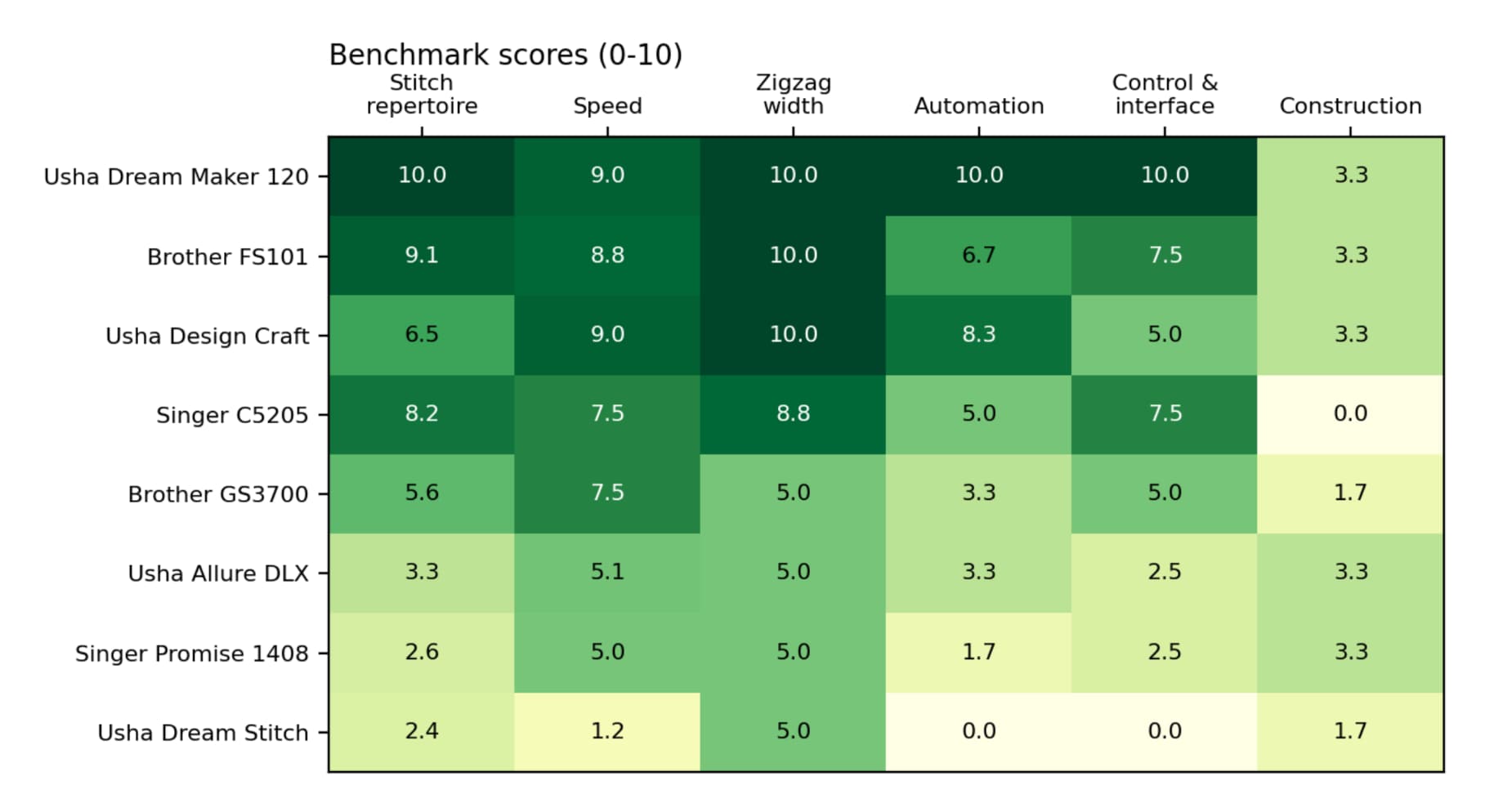
The Capability Index is the weighted sum of the six scores, scaled to 100. Each machine’s scorecard in Section 4 shows the exact evidence and points behind its index. The index is relative to these eight machines: a score of 43 for the Brother GS3700 does not make it a poor machine, only one that sits in the lower half of this field on measurable features.
Benchmark 1. Stitch repertoire (15%)
Why a first-timer should care. It is the biggest number on the box, so it is the first thing a newcomer notices. It tells you how many patterns are built in: straight, zigzag, stretch and decorative. For most home sewing (hems, seams, buttons, repairs) a handful of stitches does nearly all the work, so I wanted this to count without letting it dominate.
How I scored it. I used a square-root scale: score = 10 × √(stitches ÷ 120). That gives 7 stitches a score of 2.4, 37 stitches 5.6, 80 stitches 8.2 and 120 stitches 10. The reason for the root is diminishing returns. The first dozen stitches add far more usefulness than the last fifty, and a straight scale would have rated the 120-stitch machine seventeen times higher than the 7-stitch one, which no real user would experience. I counted only built-in stitches, not “stitch functions” (which count variants such as different lengths) and not character stitches.
How an expert might see it. An expert would shrug at the headline number. They would ask how even the straight stitch is, how clean the zigzag looks and whether tension holds across fabrics. Decorative stitches are pleasant, but they are rarely why a professional picks one machine over another. An expert would probably weight this lower than I did. I kept it at 15% because for someone who sews for pleasure, variety is part of the enjoyment.
Benchmark 2. Speed (10%)
Why a first-timer should care. Stitches per minute (spm) is how many stitches the machine can make at full speed. To a newcomer it sounds like horsepower. In reality it is a ceiling, not a working speed, and for a careful sewer or a beginner, being able to go slowly and stay in control matters more than going fast.
How I scored it. I stretched the scale across the band where these machines actually fall: 500 spm scores 0 and 900 spm scores 10, so 550 spm earns 1.25, 700 earns 5, 800 earns 7.5 and 860 earns 9. Anything wider would have bunched all the machines together. I weighted it at only 10% because it separates the machines without telling you much about how pleasant they are to use.
How an expert might see it. An expert cares about control at low speed and the feel of the pedal, not about top speed. They would also point out that maximum-speed claims are measured differently by different brands and are rarely reached in real sewing. They would probably give this even less weight than I did.
Benchmark 3. Zigzag width (10%)
Why a first-timer should care. Width is how far the needle swings from side to side in a zigzag, measured in millimetres. Think of it as the width of a paintbrush: a wider swing allows broader decorative and finishing stitches. A newcomer rarely thinks about it, yet it is one of the few measurable differences between entry machines and computerised ones.
How I scored it. I scored 3 mm as 0 and 7 mm as 10, so the 5 mm machines earn 5, the 6.5 mm Singer C5205 earns 8.75 and the 7 mm machines earn 10. One caution: Singer does not state the Promise 1408’s width in the sources I reviewed, so I scored it at 5 mm, the entry-level norm, and flagged it. It carries 10% because width only matters if you use wider stitches.
How an expert might see it. For an expert, 5 mm is adequate for general work, and 7 mm is a bonus for satin stitch, appliqué and decorative finishing. What they check is whether the width can be adjusted, since being able to narrow the zigzag matters more than the maximum.
Benchmark 4. Automation (30%)
Why a first-timer should care. These are the jobs the machine does so that you do not have to: threading the needle, cutting the thread, sewing a buttonhole in one go, stopping with the needle down, starting from a button instead of a pedal, and controlling speed. For a beginner, each one removes a moment where things commonly go wrong, which is why I gave this benchmark the largest weight.
How I scored it. I listed six features and gave each one-sixth of the score, 1.67 points: automatic needle threader, thread cutter, one-step buttonhole, needle up/down, start/stop button, and speed control. A machine with none scores 0 and a machine with all six scores 10. Only features a source actually lists count.
How an expert might see it. Experts can do every one of these by hand, so they treat automation as convenience rather than capability, and would weight it lower than I did. They would add a caution: an automatic threader or cutter is only as good as its mechanism, so test it with the thread you actually use. They would, however, agree that one-step buttonholes give more uniform results and that needle up/down is a genuine help for turning corners accurately.
Benchmark 5. Control and interface (20%)
Why a first-timer should care. This asks how much of the stitch you can change and how easily you can see what you have set: stitch length, stitch width, an LCD that shows the settings, and a memory for saved patterns. A beginner learns on the machine itself, and being able to adjust length is how you cope with thin, thick and stretchy fabrics.
How I scored it. Four features at 2.5 points each: length control, width control, an LCD display and pattern memory. For two computerised machines (the Usha Design Craft and Dream Maker 120), length and width control are not itemised on Usha’s pages but are implied by their class and published maximum values; I scored them as present and marked them ✓* in the matrix.
How an expert might see it. Stitch length and tension are the first things an expert adjusts for a fabric, so they would call length control essential, arguably more important than any decorative stitch. An LCD is a convenience. Memory matters mostly for repeated decorative sequences and monogram work.
Benchmark 6. Construction (15%)
Why a first-timer should care. This is the hardest to judge from a product page: a metal frame, how the fabric is fed (drop feed, the 7-point feed), the hook that carries the bobbin thread, and how high the presser foot lifts for thick fabric. I included it because durability is what you pay for over years.
How I scored it. Six features at 1.67 points each: metal frame, drop feed, multi-row feed, rotary or quiet hook, triple-strength stitch and extra presser lift. I could only score what is published, which understates machines with thin spec pages. The Singer C5205 scores zero here purely because no source describes its build, so I kept the weight modest at 15%.
How an expert might see it. This is where experts spend most of their attention: the internal frame, the feed system, the hook type, motor torque, how the machine handles several layers, and noise and vibration. None of this is reported consistently on a spec sheet, which is a limit of any desk comparison. An expert would say this deserves a heavier weight than I gave it, and would insist on trying the machine on denim or a thick seam.
Value (reported separately)
Why a first-timer should care. A ₹60,000 machine will always out-score a ₹15,000 machine on features, so capability alone misleads. I divide the index by price in units of ₹10,000, which answers “how many points of capability am I getting for every ₹10,000?” I calculate it on MRP and on street price, because they differ so much.
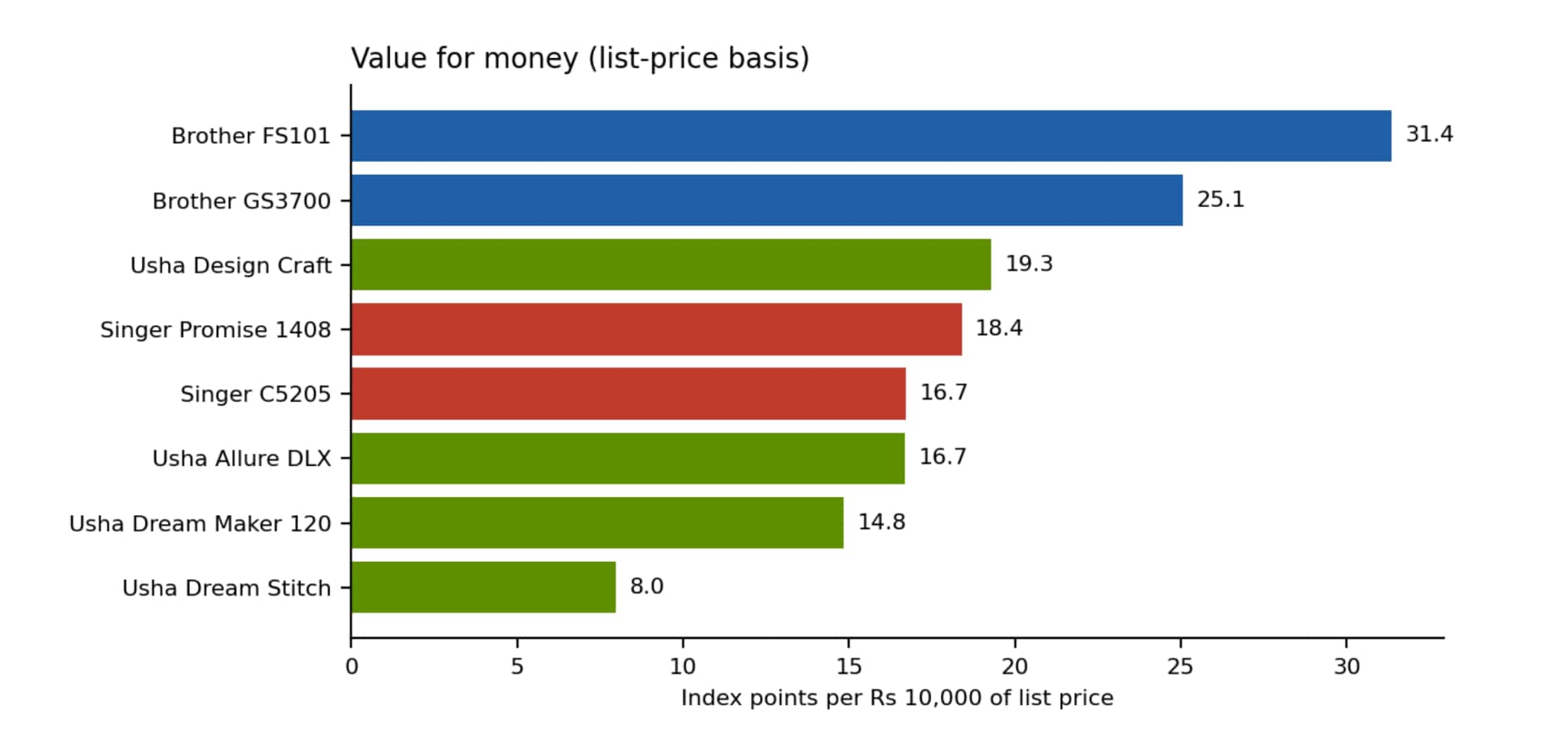
How I scored it. Value = index ÷ (price ÷ ₹10,000). The Brother FS101 scores 31.4 and the Usha Dream Stitch 8.0 on list prices. Value is shown beside the index and never added to it.
How an expert might see it. An expert would add running costs, parts availability, servicing and resale value to the idea of value, and would often rank a strong service network above a longer feature list.
Why these weights, and how an expert might rearrange them My reasoning. I weighted by how often a feature touches the user. Automation (30%) and control (20%) are felt on every seam. Stitch range and construction (15% each) matter regularly or over the long run. Speed and width (10% each) matter occasionally. This is a newcomer’s logic: what will I notice, every time I sit down?
The expert’s likely rearrangement. An experienced sewist would probably put construction and sewing quality first, control second, and automation lower, and would say that decorative stitch count and top speed are the least important numbers on the box. I tested the effect of that kind of change in Section 5, with beginner-heavy, creative-heavy and equal weightings. The ranking barely moved: the Dream Maker 120 stayed first and the Dream Stitch last every time. So the argument about weights matters less than it seems. The expert’s bigger point, that construction and real sewing quality cannot be measured from a desk, matters more, and I come back to it in the limits.
What the index cannot tell you
Stitch quality on different fabrics, motor strength, noise, durability, how easy the machine is to repair, and how good the dealer is: none of these appear in the index. That is why I added the Maa test in Section 6, which asks a different question, not “which machine has the most?” but “which machine is easiest for this person?”
4. The machines, one by one
Each machine below gets a short write-up in my own voice, a strengths and weaknesses table, a few takeaways and its spec sheet. In the spec sheets, “n/s” means not stated in the sources I reviewed, and warranty periods are as listed by retailers or brand stores, so confirm them at purchase.
Usha Janome Dream Stitch
Usha Janome Dream Stitch
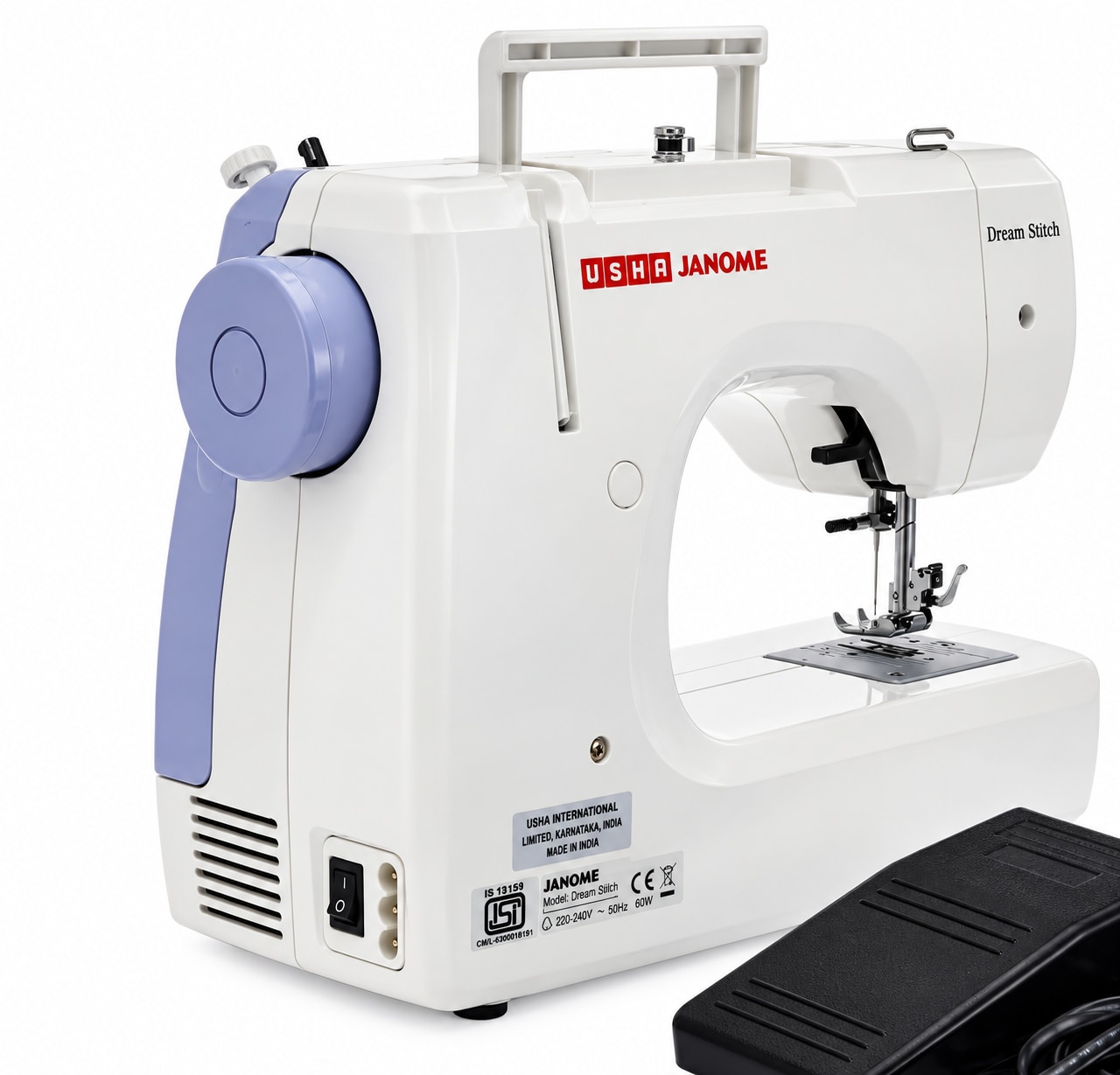
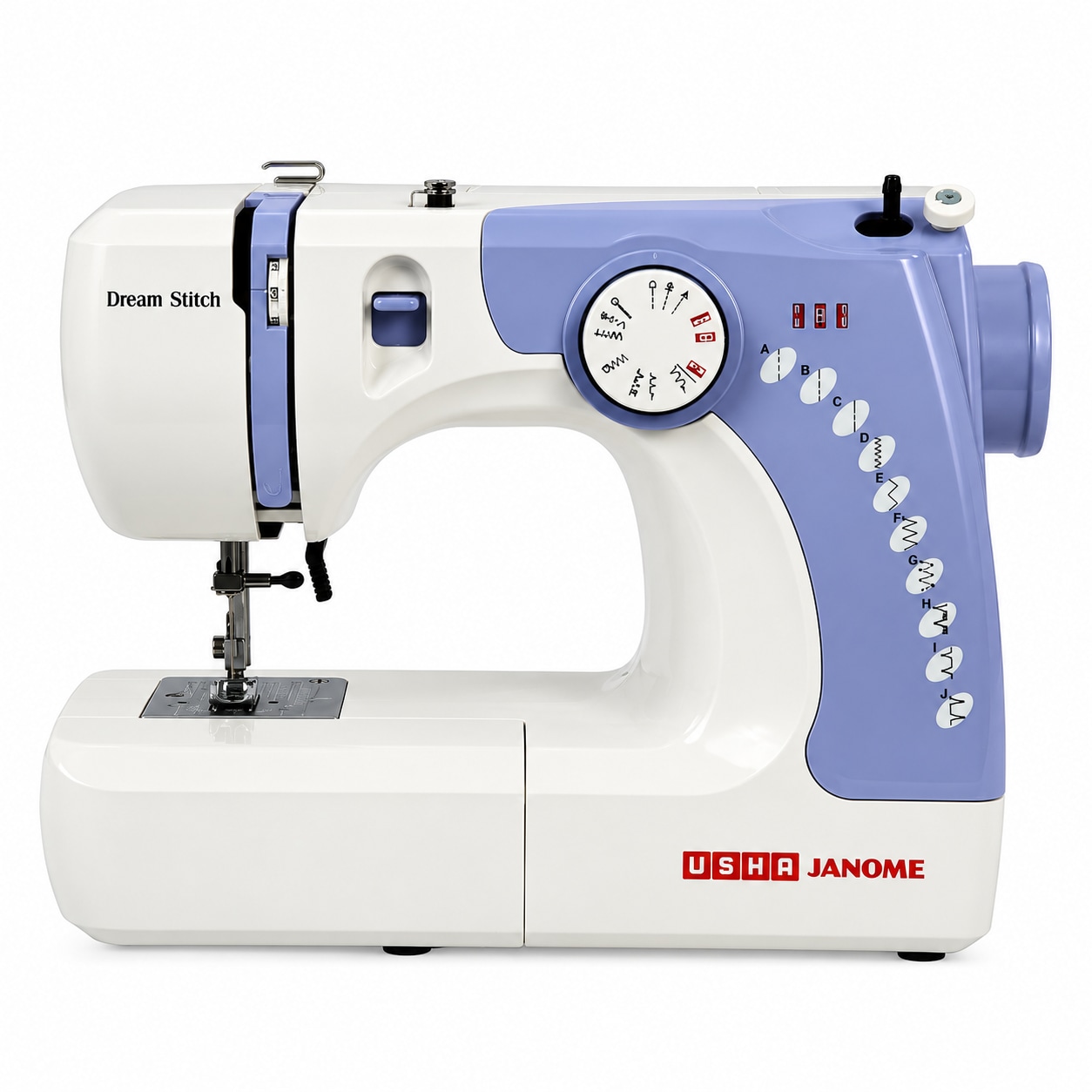
Entry, mechanical | list ₹15,500 | Capability Index 12.4/100 (rank 8 of 8) | Value 8.0 on list price, 12.4 on street price The Dream Stitch is where I began, because Usha is the brand most people in India associate with silai machines. It has Janome technology inside, and on Amazon it was selling for about ₹10,000 against a list price of ₹15,500. On paper it is the simplest machine in my set. There is one dial, seven built-in stitches (the “14 stitch functions” on the box count variants), a four-step buttonhole, a carry handle and a weight of around 6 kg. My first reaction was “seedha-saadha, perfect for Maa.” Then I read the specification page line by line, and the shine wore off a little.
Threading is manual, there is no stitch-length control, there is no thread cutter, and the listed speed is 550 stitches a minute. A slower machine might even suit a careful sewer, but it leaves little room to grow. In my scoring it came last, at 12.4 out of 100. That is not a verdict that it is a bad machine. It is an honest measure that this is the least automated machine in the field, and that at ₹15,500 you would be paying a lot for it. At its street price the picture is kinder, though still last on value.
Through an expert’s eyes. An experienced sewist would not mind manual threading, but would flag the missing stitch-length control as the real limit, since length is among the first things adjusted to suit a fabric. At 550 spm and with no extra controls, they would see this as a learning or mending machine. They would also ask about the motor and how well it handles thicker layers, which the spec page does not say. At its street price, an expert might accept it as a backup machine; at MRP, probably not.
Strengths
Weaknesses
• Familiar brand with Janome technology
• Compact, portable, with a carry handle
• Simple single-dial stitch selection
• Two-year warranty on retail listings
• Low street price (about ₹10,000)
• Manual needle threading
• No stitch-length or width control
• No thread cutter; four-step buttonhole
• Slowest in the field at 550 spm
• MRP is far above street price
Takeaways
• Buy it only near street price, never at MRP.
• Fine for mending and basic seams; you will outgrow it.
• Manual threading is the feature I would worry about most for a user past 75.
How the points were earned
Benchmark
Evidence used
Score /10
Weight
Points
Stitch repertoire
7 built-in stitches
2.4
15%
3.6
Speed
550 spm (Usha page)
1.2
10%
1.2
Zigzag width
5 mm
5.0
10%
5.0
Automation
None of the six: manual threading, four-step buttonhole, no cutter
0.0
30%
0.0
Control & interface
None: no length or width control, no LCD, no memory
0.0
20%
0.0
Construction
Extra presser lift only
1.7
15%
2.5
Capability Index
100%
12.4
Spec sheet: Usha Janome Dream Stitch
Spec sheet
Usha Janome Dream Stitch
Class
Mechanical, dial-operated free-arm zigzag
List price
₹15,500 (MRP). Street: about ₹9,999–11,299 on Amazon India
Built-in stitches
7 (14 stitch functions)
Max speed
550 spm (Usha page); some retailers state 860
Max zigzag width
5 mm
Stitch length / width control
No / No (per Usha page)
Needle threading
Manual
Buttonhole
4-step
Thread cutter / LCD / extension table
No / No / No
Weight
About 5.9 kg (listings range 5.9–7.6 kg)
Made in
Thailand
Warranty
2 years (retail listing)
Notable
Handle for carrying, raised presser-foot position for thicker layers, self-tripping bobbin
Sources: ushasew.com/dream-stitch; Amazon India and retailer listings.
Singer Promise 1408
Entry, mechanical | list ₹15,700 (implied by store discount) | Capability Index 28.9/100 (rank 7 of 8) | Value 18.4 on list price, 25.6 on street price
Singer is probably the first brand name anyone in India thinks of for a sewing machine, so I could not skip it. The Promise 1408 is the machine Singer’s own store pushes at the entry level: eight built-in stitches (24 functions), a four-step automatic buttonhole, 700 stitches a minute, an LED light and, unusually at this price, a metal frame and a built-in thread cutter. Singer’s store showed it at ₹11,299, which they present as 28% off, and a marketplace listing says it is made in India.
What it does not have is an automatic needle threader, and it has few controls to adjust, which is why it scored only 28.9 on the index. I liked it more than the number suggests: it feels like the machine that will simply keep running. It also carries a two-year warranty. One buyer review I read complained about slow after-sales response, which is a single data point, but it is the kind of thing I would ask a dealer about before buying.
Through an expert’s eyes.An expert tends to like a metal internal frame, because it helps keep the mechanism aligned over years, and would count that in its favour. They would also note that Singer’s own pages list standard class 15 transparent bobbins, which are easy to find and let you see how much thread remains. What they would check is the straight-stitch quality and feed on several fabrics, and whether service is reachable, because one buyer reports delays.
Strengths
Weaknesses
• Metal frame and built-in thread cutter at an entry price • LED light and snap-on presser feet
• Two-year warranty, made in India
• Store price of ₹11,299 is attractive
• No automatic needle threader
• Only eight stitches and four-step buttonhole • Few controls; width not stated
• One reviewer reports slow service
Takeaways
• A sturdy basic machine for repairs and simple garments.
• Best entry-level build; but threading is manual.
• Ask about service response before buying.
How the points were earned
Benchmark
Evidence used
Score /10
Weight
Points
Stitch repertoire
8 built-in stitches
2.6
15%
3.9
Speed
700 spm (Singer India)
5.0
10%
5.0
Zigzag width
Not stated; 5 mm entry norm assumed
5.0
10%
5.0
Automation
Thread cutter only
1.7
30%
5.0
Control & interface
Length adjustable per one listing
2.5
20%
5.0
Construction
Metal frame, extra presser lift
3.3
15%
5.0
Capability Index
100%
28.9
Spec sheet: Singer Promise 1408
Spec sheet
Singer Promise 1408
Class
Mechanical, dial-operated zigzag
List price
₹15,700 (MRP implied by ₹11,299 store price after ₹4,401 discount)
Built-in stitches
8 (24 stitch functions)
Max speed
700 spm (Singer India)
Max zigzag width
n/s
Stitch length / width control
Length adjustable per one listing; Singer India lists presets
Needle threading
Easy-thread (manual)
Buttonhole
4-step automatic
Thread cutter / LCD / extension table
Yes / No / No (accessory drawer converts to free arm)
Weight
n/s (described as light, with handle)
Made in
India (marketplace listing)
Warranty
2 years
Notable
Metal frame, raised presser-foot lift, LED light, snap-on feet
Entry, mechanical | list ₹17,290 (Flipkart MRP) | Capability Index 43.3/100 (rank 5 of 8) | Value 25.1 on list price, 30.9 on street price
Brother was the surprise of the whole exercise. I had not expected a Japanese brand with less presence in my mental picture of Indian silai to leave the others behind at the entry level. The GS3700 has 37 stitches, an automatic needle threader, a one-step buttonhole, adjustable stitch length and width, a metal chassis and an LED light. On Flipkart its list price is ₹17,290, and it sells around ₹14,000. For a machine you operate with dials, that is a lot of convenience.
It scored 43.3, the best of the four mechanical machines, and its value of 25.1 on list price (30.9 at street price) is second only to the FS101. The catches are real. There is no thread cutter and no drop feed, the warranty is not stated in the sources I could verify, and several buyers complain about Brother’s service and warranty handling. So the GS3700 is the machine I would buy on specifications alone, and the one where I would most want a dealer’s service promise in writing.
Through an expert’s eyes.An expert would not be moved by 37 stitches. They would value the metal chassis, the drop-in bobbin and the adjustable length and width, and would observe that the lack of a drop feed limits darning and free-motion work. A one-step buttonhole gives consistent results, which they would appreciate. The open question for an expert is service and warranty, since they depend on a machine being repairable.
Strengths
Weaknesses
• 37 stitches, far more than other entry machines • Automatic needle threader and one-step buttonhole • Length and width control; metal chassis
• Strong value, about ₹14,000 street
• No thread cutter and no drop feed
• Warranty not confirmed in my sources
• Buyer complaints about service
• Weight not stated
Takeaways
• Best entry-level pick on specs and value.
• Insist on written warranty and service terms.
• A good machine to grow into dressmaking.
How the points were earned
Benchmark
Evidence used
Score /10
Weight
Points
Stitch repertoire
37 built-in stitches
5.6
15%
8.3
Speed
800 spm (most listings)
7.5
10%
7.5
Zigzag width
5 mm
5.0
10%
5.0
Automation
Auto threader, one-step buttonhole
3.3
30%
10.0
Control & interface
Length and width control
5.0
20%
10.0
Construction
Metal chassis
1.7
15%
2.5
Capability Index
100%
43.3
Spec sheet: Brother GS3700
Spec sheet
Brother GS3700
Class
Mechanical, dial-operated free-arm
List price
₹17,290 (Flipkart MRP). Street: about ₹13,999–14,100
Built-in stitches
37
Max speed
800 spm (most listings)
Max zigzag width / length
5 mm / 4 mm
Stitch length / width control
Yes / Yes
Needle threading
Automatic
Buttonhole
1-step
Thread cutter / LCD / extension table
No / No / No (optional wide table sold separately)
Weight
n/s
Drop feed
No (Brother brochure)
Warranty
n/s; some buyers report service difficulty
Notable
Metal chassis, drop-in bobbin, LED light, DVD tutorial included
Mid, mechanical | list ₹21,000 | Capability Index 35.1/100 (rank 6 of 8) | Value 16.7 on list price, 17.6 on street priceThe Allure DLX is Usha’s feature-rich mechanical machine, and the one I kept returning to. It has an automatic needle threader, a thread cutter on the face plate, a lever to drop the feed for embroidery, triple-strength stitch, an LED light and a skeleton-style body that weighs 6 kg. It is operated with two dials, with no menus. There are 13 built-in stitches and a four-step buttonhole. The list price is ₹21,000 and the street price I found was about ₹19,950.
On the index it ranks only sixth, at 35.1, because the stitch range is small and the buttonhole is four-step. It also costs more than the GS3700, which scores higher. But this is the machine whose strengths line up with the Maa test: it threads itself, trims thread, has a bright light and no menus. One caveat: Usha’s page does not state its speed, and listings range from 550 to 860 stitches a minute, so I scored the midpoint of 705.
Through an expert’s eyes.An expert would single out the drop-feed lever and triple-strength stitch as genuinely useful, and the face-plate thread cutter as a time-saver, though a simple one. A four-step buttonhole would not bother an experienced user, who may even prefer the control. They would want
the speed confirmed, since Usha’s page does not state it, and would point out that 13 stitches is plenty for practical sewing.
Strengths
Weaknesses
• Automatic needle threader and thread cutter • LED light, dial controls, no menus
• Drop-feed lever and triple-strength stitch
• Two-year warranty on the Allure line; Usha service reputation
• Only 13 built-in stitches
• Four-step buttonhole
• Costs more than the GS3700 for fewer stitches • Speed not stated by Usha
Takeaways
• Weak on paper, strong on everyday ease.
• Priced above the GS3700, so the service advantage must justify it.
• A top contender for Maa.
How the points were earned
Benchmark
Evidence used
Score /10
Weight
Points
Stitch repertoire
13 built-in stitches
3.3
15%
4.9
Speed
705 spm (midpoint of conflicting 550–860 listings)
5.1
10%
5.1
Zigzag width
5 mm
5.0
10%
5.0
Automation
Auto threader, thread cutter
3.3
30%
10.0
Control & interface
Length dial; width not stated
2.5
20%
5.0
Construction
Drop feed, triple-strength stitch
3.3
15%
5.0
Capability Index
100%
35.1
Spec sheet: Usha Janome Allure DLX
Spec sheet
Usha Janome Allure DLX
Class
Mechanical, two-dial zigzag
List price
₹21,000 (MRP). Street: about ₹19,950 (Sept 2026 listing)
Built-in stitches
13 (21 functions per retail listing)
Max speed
n/s on Usha page; listings range 550–860 (705 scored)
Sources: ushasew.com/allure-dlx; IndustryBuying; Outlook India.
Brother FS101
Computerised | street ₹23,100 (MRP not found) | Capability Index 72.4/100 (rank 2 of 8) | Value 31.4 on list price, 31.4 on street price
The FS101 was my first real encounter with a computerised machine, and I was nervous that an LCD screen would be intimidating. It has 100 utility and decorative stitches plus 55 character stitches, eight one-step buttonholes, an automatic needle threader, a 7-point feed, and a monochrome LCD that shows the settings. It runs up to 850 stitches a minute and costs about ₹23,100 on Amazon India. I could not find a printed MRP.
It scored 72.4 and the best value at 31.4, which makes it the standout of the numbers. Its gaps are the lack of a thread cutter and an extension table. For Maa the question is whether she wants an LCD and push buttons. It has a start/stop button and speed control, which would help if a foot pedal is tiring, but 850 spm is quick and the stitch menu is more to learn. For a confident sewer it is excellent; for a first gift I would want her to try it.
Through an expert’s eyes.An expert would be sceptical of the 100-stitch headline but would like the 7-point feed, which grips fabric more steadily, and the presser-foot levelling button for uneven seams. The missing thread cutter and extension table would not trouble them much. They would want to know how the machine handles heavier fabrics, which the sources do not say, and would test the buttonhole sizing.
Strengths
Weaknesses
• 100 stitches plus 55 characters
• LCD, one-step buttonholes, auto threader
• Start/stop and speed control
• Best value of the eight
• No thread cutter or extension table
• MRP not found; price relies on Amazon
• LCD and buttons are more to learn
• Warranty not stated in my sources
Takeaways
• The best computerised value for most people.
• More stitches than Maa is likely to use.
• Let her try the LCD before you commit.
How the points were earned
Benchmark
Evidence used
Score /10
Weight
Points
Stitch repertoire
100 built-in stitches (plus 55 character)
9.1
15%
13.7
Speed
850 spm
8.8
10%
8.8
Zigzag width
7 mm
10.0
10%
10.0
Automation
Auto threader, one-step buttonhole, start/stop, speed control
6.7
30%
20.0
Control & interface
Length, width, LCD
7.5
20%
15.0
Construction
7-point feed, presser levelling
3.3
15%
5.0
Capability Index
100%
72.4
Spec sheet: Brother FS101
Spec sheet
Brother FS101
Class
Computerised
List price
₹23,100 (Amazon India street price; MRP not found)
Built-in stitches
100 utility and decorative plus 55 character stitches
Max speed
850 spm
Max zigzag width
7 mm
Stitch lenth / width control
Yes / Yes (shown on monochrome LCD)
Needle threading
Automatic
Buttonhole
8 one-step styles
Thread cutter / LCD / extension table
No / Yes / No
Weight
6 kg
Start/stop and speed control
Yes / Yes
Warranty
n/s (marketplace shows a 10-day replacement window)
Notable
7-point feed, presser-foot levelling button, drop-in bobbin, LED light
Computerised | list ₹35,000 (implied) | Capability Index 58.5/100 (rank 4 of 8) | Value 16.7 on list price, 25.1 on street priceThe C5205 is Singer’s computerised option, and its price is the most confusing in my set. Singer’s store shows ₹32,810 after a ₹2,190 discount, which implies an MRP of ₹35,000, while price trackers show an average of ₹23,271 and a low of ₹18,999. The machine itself is well equipped: 80 stitches, an LCD, a 70
W motor, an automatic threader, a thread cutter on the face plate, an extension table, 13 needle positions and eight presser feet, at 800 stitches a minute.
The index puts it at 58.5, but its value is only 16.7 at the MRP, and about 25 at the tracker average. One quirk: its construction score is zero only because no source describes the build, which understates it. For a buyer who can find it near ₹23,000 it is a strong rival to the FS101, especially for the cutter and the table. At ₹35,000 I would buy the Design Craft instead.
Through an expert’s eyes.An expert would be interested in the 70 W motor, the 13 needle positions and the set of eight feet including the roller foot and blind-hem foot, because those are practical tools. They would point out that the build is not described, so they would open the machine and check the frame. And they would shop around, because the price swings from about ₹19,000 to ₹35,000.
Strengths
Weaknesses
• Thread cutter and extension table included
• 80 stitches, 6.5 mm width, LCD
• Eight presser feet; 70 W motor
• Two-year warranty on a listing
• List price far above street price
• Build features not published
• LCD-driven; more to learn
• No start/stop or speed control stated
Takeaways
• Check the price you will really pay.
• Near ₹23,000 it competes with the FS101.
• At MRP, other machines beat it.
How the points were earned
Benchmark
Evidence used
Score /10
Weight
Points
Stitch repertoire
80 built-in stitches
8.2
15%
12.2
Speed
800 spm
7.5
10%
7.5
Zigzag width
6.5 mm
8.8
10%
8.8
Automation
Auto threader, thread cutter, one-step buttonholes
5.0
30%
15.0
Control & interface
Length, width, LCD
7.5
20%
15.0
Construction
None published, so scored 0
0.0
15%
0.0
Capability Index
100%
58.5
Spec sheet: Singer C5205
Spec sheet
Singer C5205
Class
Computerised
List price
₹35,000 (MRP implied by store price ₹32,810 after ₹2,190 off). Trackers: average ₹23,271, low ₹18,999
Built-in stitches
80
Max speed
800 spm
Max zigzag width / length
6.5 mm / 4.5 mm
Stitch lenth / width control
Yes / Yes (variable width button)
Needle threading
Automatic
Buttonhole
6 one-step types including eyelet
Thread cutter / LCD / extension table
Yes (face plate) / Yes / Yes
Motor
70 W
Needle positions / presser feet
13 / 8 (includes invisible zipper, blind hem, roller, overcast)
Computerised | list ₹35,625 | Capability Index 68.7/100 (rank 3 of 8) | Value 19.3 on list price, 19.3 on street priceThe Design Craft is Usha’s balanced computerised machine, and it is made in Taiwan. It has 50 built-in stitches and a monogram font, a top-loading rotary hook that runs quieter than older designs, a built-in thread cutter, a one-hand needle threader and a 7 mm zigzag width. It also has a start/stop button, a speed slider, lock-stitch, reverse and needle up/down buttons, and it comes with an extension table and 17 accessories. It runs at 860 stitches a minute.
It scored 68.7, behind the FS101 on the index and well behind on value (19.3), because it has half the stitches at a higher price. Usha’s page also does not list an LCD or itemise length and width controls, so I could not score those. I found no street price, so my value figure is at MRP and could be better in a shop. If you want Usha’s service network in a computerised machine, this is the sensible step up.
Through an expert’s eyes.An expert would like the top-loading rotary hook, which generally runs quietly and smoothly, and the needle up/down button for accurate pivoting. They would find 50 stitches more than enough. They would ask whether length and width are adjustable and whether there is an LCD, since Usha’s page does not itemise either. The 17 accessories and extension table add practical value.
Top-loading rotary hook, which runs more quietly than older hook designs
Source: ushasew.com (Design Craft page).
Usha Janome Dream Maker 120
Premium, computerised | list ₹60,000 | Capability Index 89.0/100 (rank 1 of 8) | Value 14.8 on list price, 14.8 on street priceThe Dream Maker 120 is the flagship of my set, and the machine I would buy for myself if I were sewing for a boutique. It has 120 stitches including seven one-step buttonholes and alphabets, a touchpad LCD, memory for up to 50 stitch combinations, mirror editing, a 7-piece feed dog, drop feed, a thread cutter, an extension table and variable speed with start/stop. It is made in Taiwan and lists at ₹60,000.
It topped the index at 89.0 and is the only machine to score full marks on both automation and control. It is also second-last on value, at 14.8. Usha’s page does not state its speed (retail listings say 860 spm), and I found no street price. As a gift it carries a risk of overwhelming its owner: there is a lot to learn, and a lot of price to justify. I would only choose it for someone who will use the memory and monogramming regularly.
Through an expert’s eyes.An expert would value the programmable memory, mirror editing, 7-piece feed dog, drop feed and thread cutter, and would say the real value of the 120 stitches lies in the lettering and combinations, not the count. They would want to test the motor on thick layers. They would also note that for production sewing, an industrial machine would be a better tool, but for a boutique or serious hobbyist it is a strong domestic choice.
Strengths
Weaknesses
• Highest capability: 120 stitches, full automation • Touchpad LCD, memory for 50 combinations • Extension table, drop feed, thread cutter
• Seven one-step buttonholes
• ₹60,000 is 2.6 times the FS101’s price
• Lots to learn; more than a first machine needs • Speed not stated by Usha; no street price found • Weight not stated
Takeaways
• The most capable machine of the eight.
• About 81% of its capability is available in the FS101 for 39% of the price.
• Right for boutique use, probably too much for a gift.
How the points were earned
Benchmark
Evidence used
Score /10
Weight
Points
Stitch repertoire
120 built-in stitches
10.0
15%
15.0
Speed
860 spm (retail listings)
9.0
10%
9.0
Zigzag width
7 mm
10.0
10%
10.0
Automation
All six features
10.0
30%
30.0
Control & interface
Length and width implied, LCD, 50-pattern memory
10.0
20%
20.0
Construction
Drop feed, 7-piece feed dog
3.3
15%
5.0
Capability Index
100%
89.0
Spec sheet: Usha Janome Dream Maker 120
Spec sheet
Usha Janome Dream Maker 120
Class
Computerised, premium
List price
₹60,000 (MRP)
Built-in stitches
120 including 7 one-step buttonholes, plus alphabets
Max speed
860 spm (retail listings; not stated on Usha page)
Max zigzag width / length
7 mm / 5 mm
Stitch length / width control
Implied by LCD and published maximums
Needle threading
One-hand needle threader
Thread cutter / LCD / extension table
Yes / Yes (with touchpad) / Yes
Programming
Stores up to 50 stitch combinations; mirror editing; remembers needle up/down setting
Feed
7-piece feed dog, drop feed
Power / made in
35 W (retail listing) / Taiwan
Warranty
2 years (retail listing)
Notable
Variable speed with start/stop, lock-stitch button, monogram lettering
With each machine understood, here is the comparison in one place. Start with the feature matrix. A tick means published as present, a cross means published as absent, a dash means not stated in my sources (scored as absent), and ✓* means implied by published maximums or the computerised class.
Machine
Auto
thread
Cutter
1-step
hole
LCD
Length ctl
Width
ctl
Ext.
table
Needle ↑↓
Start/
stop
Speed
ctl
Metal
frame
Drop
feed
Usha Dream Stitch
✗
✗
✗
✗
✗
✗
✗
✗
✗
✗
–
✗
Singer Promise
1408
✗
✓
✗
✗
✓
✗
✗
–
–
–
✓
–
Brother GS3700
✓
✗
✓
✗
✓
✓
✗
–
–
–
✓
✗
Usha Allure DLX
✓
✓
✗
✗
✓
–
–
–
–
–
–
✓
Brother FS101
✓
✗
✓
✓
✓
✓
✗
–
✓
✓
–
–
Singer C5205
✓
✓
✓
✓
✓
✓
✓
–
–
–
–
–
Usha Design Craft
✓
✓
–
–
✓*
✓*
✓
✓
✓
✓
–
–
Usha Dream Maker 120
✓
✓
✓
✓
✓*
✓*
✓
✓
✓
✓
–
✓
Only the Dream Maker 120 and the Design Craft combine an automatic threader, a thread cutter, needle up/down and a start/stop button. At the other end the Dream Stitch has no automated function at all. Construction features not in the matrix (rotary hook, multi-row feed, triple-strength stitch, presser lift) are in the spec sheets and in the construction score.
Capability Index by machineBenchmark ScoresValue for money
On list prices the Brother FS101 and GS3700 lead on value, and the Dream Stitch trails because its low price does not offset how little it automates. The Singer C5205 scores 16.7 at its ₹35,000 MRP, but at the ₹23,271 tracker average it would score about 25, and at the ₹18,999 low about 31, which puts it level with the FS101.
Stress-testing the ranking
I did not want to trust one set of weights. Equal gives each benchmark one-sixth. Beginner emphasises ease (automation 40%, control 25%, construction 20%, the rest 5% each). Creative emphasises range (stitches 35%, width 20%, control 20%, automation 15%, speed 5%, construction 5%). Index values are shown with ranks in brackets.
Machine
Base
Equal
Beginner
Creative
Usha Dream Stitch
12.4 (8)
17.2 (8)
7.7 (8)
19.9 (8)
Singer Promise 1408
28.9 (7)
33.5 (7)
25.9 (7)
30.7 (7)
Brother GS3700
43.3 (5)
46.8 (5)
38.2 (5)
49.0 (5)
Usha Allure DLX
35.1 (6)
37.6 (6)
33.0 (6)
35.7 (6)
Brother FS101
72.4 (2)
75.6 (2)
66.0 (2)
83.0 (2)
Singer C5205
58.5 (4)
61.5 (4)
51.0 (4)
72.3 (3)
Usha Design Craft
68.7 (3)
70.2 (3)
65.2 (3)
71.3 (4)
Usha Dream Maker 120
89.0 (1)
87.2 (1)
86.2 (1)
96.2 (1)
The Dream Maker 120 is first and the Dream Stitch last under every scheme. In 2,000 random reweightings that never changed, and the full order matched the base case in about 83% of runs. The only change across my four schemes is that the Singer C5205 (72.3) edges past the Usha Design Craft (71.3) under the creative weighting. Under the beginner weighting, the GS3700 slips to 38 but still beats the Allure DLX (33).
Machine
List
price
Street
price used
Street price source
Value
(list)
Value
(street)
Usha Dream Stitch
₹15,500
₹10,000
Amazon India, Jul 2026 ( ₹9,999)
8.0
12.4
Singer Promise 1408
₹15,700
₹11,299
Singer India store
18.4
25.6
Brother GS3700
₹17,290
₹14,000
Flipkart ( ₹13,999)
25.1
30.9
Usha Allure DLX
₹21,000
₹19,950
IndustryBuying, Sep 2026
16.7
17.6
Brother FS101
₹23,100
₹23,100
Amazon India (also list basis)
31.4
31.4
Singer C5205
₹35,000
₹23,271
Price-tracker average
16.7
25.1
Usha Design Craft
₹35,625
₹35,625
No street price found; MRP used
19.3
19.3
Usha Dream Maker
120
₹60,000
₹60,000
No street price found; MRP used
14.8
14.8
On street prices the GS3700 (30.9) almost matches the FS101 (31.4), the Promise 1408 moves from fourth to third on value, and the C5205 rises to fourth. The Dream Stitch improves from 8.0 to 12.4 but stays last. I found no street prices for the Design Craft and Dream Maker 120, so their street-basis values equal their list-basis values and might improve in a shop.
Two 2×2 views
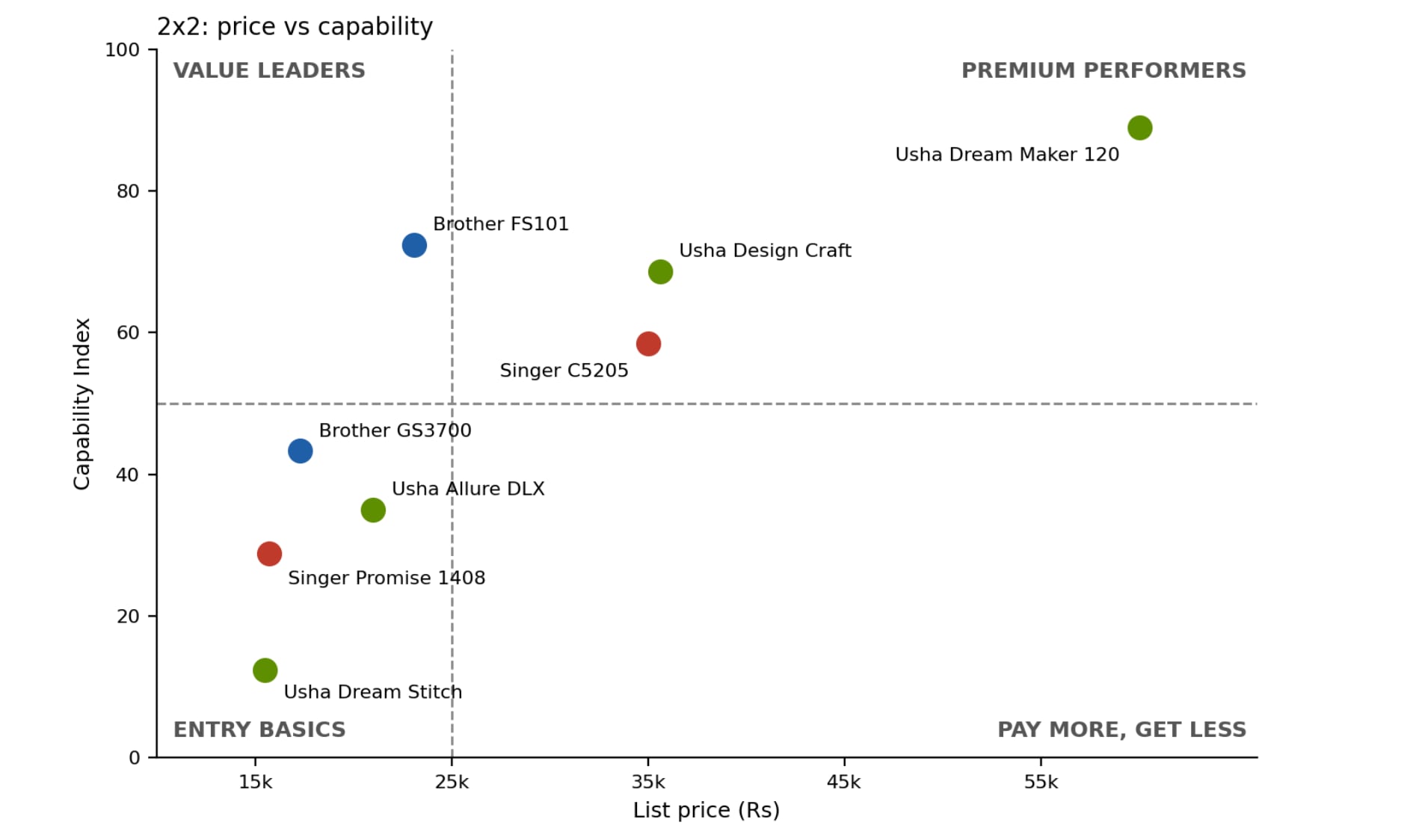
Price versus capability. The dashed lines sit at ₹25,000 and an index of 50. The top-left quadrant, high capability at a low price, holds only the Brother FS101, which is why it wins on value. The premium quadrant holds the three computerised machines listed at ₹35,000 or more: the Singer C5205, Usha Design Craft and Usha Dream Maker 120. The bottom-left quadrant holds every mechanical machine, including the Allure DLX, which costs more than the Promise 1408 and GS3700 yet scores below the GS3700. No machine falls in “pay more, get less”, but the C5205 is closest at list price.
2x2: price vs capability
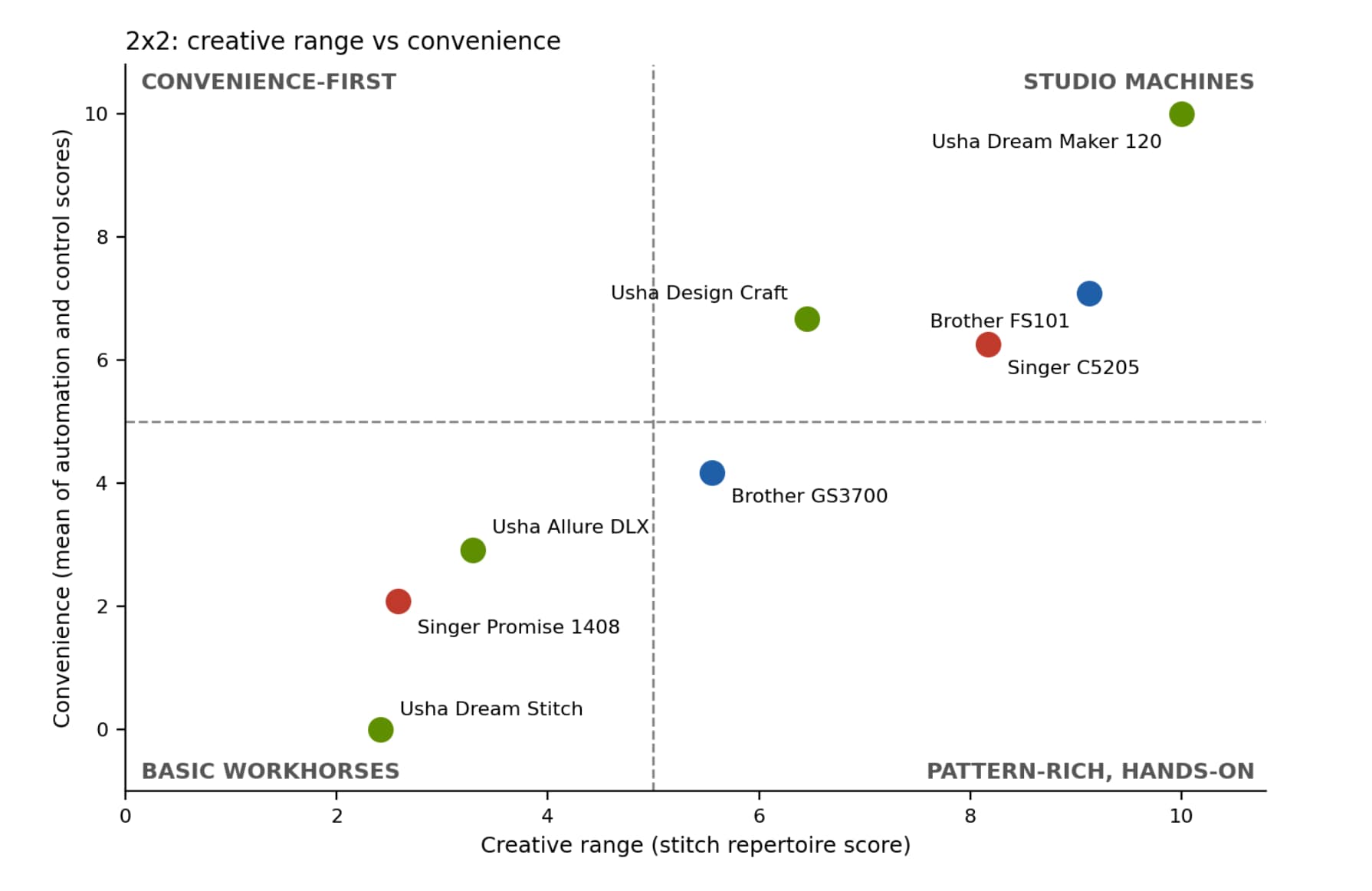
Creative range versus convenience. This view separates machines with many stitches from machines that save effort. Four machines are “studio machines”, high on both. The GS3700 alone sits in the pattern-rich but hands-on quadrant. The Dream Stitch, Promise 1408 and Allure DLX are basic workhorses. The convenience-first quadrant is empty, because no machine offers heavy automation with a small stitch range.
2x2: creative range vs convenience
6. The Maa test
Everything so far measures machines against each other. This section measures them against Maa. I took the seven questions from earlier and answered each from the published specifications. As before, a dash means the sources do not say, and I counted it as a no. The questions and the answers are my judgement, and the real test is her at the machine.
How I built the Maa test
The index asks which machine has the most. The Maa test asks which machine is easiest for one particular person. I built it the same way I built the index: start from what the user will actually experience, then turn each experience into something checkable. Each question gets one point if the published specifications say yes. A dash (nothing stated) scores zero, and every question carries equal weight, because for a given person any one of them could be the deal-breaker. The table gives, for each question, why a first-timer buying for an older user should care and what an experienced sewist might say.
Question
Why it matters for a first-time buyer
How an expert might see it
Threads itself?
Threading is the job that tends to get harder with age for most people, and it happens every time the thread runs out or breaks.
Experts can thread by hand, so treat it as a convenience. Test it with the thread you actually use.
LED light?
Seeing the needle area clearly reduces mistakes, and LED bulbs stay cool and do not need replacing often.
Even, shadow-free light matters more to them than the bulb type.
Dials, no menus?
Fewer things to learn means less chance of being stuck; a dial shows its setting at a glance.
Comfortable with menus; sees dials as robust but less flexible.
One-step
buttonhole?
A four-step buttonhole means remembering a sequence; a one-step does it from a single setting.
One-step gives consistent size; four-step offers manual control that some experts prefer.
Thread cutter?
Saves reaching for scissors after every seam; a small convenience used constantly.
A time-saver in volume work, though built-in cutters are often basic.
Start/stop button?
Holding a foot pedal is tiring for some people; a button allows sewing without one. (This is my assumption and worth asking Maa about.)
Pedals give finer speed control, which many experts prefer; the button helps slow, precise work.
Street price ≤
₹20,000?
A gift that turns out to be the wrong fit is cheaper to correct at a lower price.
Price matters less to them than reliability and service.
These questions and their answers are my judgement, drawn from the published specifications. They are not a clinical or ergonomic standard, and the best check is to ask Maa and let her try the machines.
Machine
Threads
itself
LED light
Dial
controls,
no menus
One-step
buttonhol
e
Thread
cutter
Start /
stop
button
Street
price ≤
₹20k
Score
Usha Dream Stitch
✗
✓
✓
✗
✗
✗
✓
3/7
Singer Promise
1408
✗
✓
✓
✗
✓
✗
✓
4/7
Brother GS3700
✓
✓
✓
✓
✗
✗
✓
5/7
Usha Allure DLX
✓
✓
✓
✗
✓
✗
✓
5/7
Brother FS101
✓
✓
✗
✓
✗
✓
✗
4/7
Singer C5205
✓
✓
✗
✓
✓
✗
✗
4/7
Usha Design Craft
✓
✗
✗
✗
✓
✓
✗
3/7
Usha Dream Maker 120
✓
✗
✗
✓
✓
✓
✗
4/7
The Brother GS3700 and the Usha Allure DLX tie at 5 out of 7. That is a very different picture from the capability index, where they ranked fifth and sixth. The Dream Maker 120, first on the index, scores 4, because its strengths (stitch range, memory, an LCD) do not help the simple, everyday jobs the test asks about. This is the clearest lesson of the whole exercise: the best machine on paper and the best machine for a particular person can be different machines.
Why I lean to the Allure DLX. Between the two, the GS3700 is cheaper (about ₹14,000 against ₹19,950), has far more stitches (37 against 13) and a one-step buttonhole. The Allure DLX has the built-in thread cutter, the drop-feed lever and a warranty I can see in a listing. It also comes with Usha’s service and demo network, which Usha has advertised in earlier press releases (several years old, so I will confirm it is still offered). For someone who will use the machine daily and might need help, I put service ahead of 24 extra stitches. If Maa tries both and prefers the GS3700, I will happily buy that, with its warranty in writing.
Category winners
Category
Winner
Why
Overall capability
Usha Dream Maker 120
Index 89; 120 stitches, LCD, memory, full automation
Value for money
Brother FS101
31.4 index points per ₹10,000; 100 stitches, LCD, 850 spm
Best entry-level (list ≤ ₹18,000)
Brother GS3700
37 stitches, auto threader, one-step buttonhole, length and width control
Stitch repertoire
Usha Dream Maker 120
120 built-in stitches
Speed (published)
Usha Design Craft / Dream Maker 120
860 spm each
Zigzag width
FS101, Design Craft, Dream Maker 120
7 mm each
Automation
Usha Dream Maker 120
6 of 6 benchmark features
Control & interface
Usha Dream Maker 120
Length, width, LCD, pattern memory
Maa test
Brother GS3700 / Usha Allure DLX (tie)
5 of 7 each
Best Usha for most buyers
Usha Design Craft
Highest Usha value score (19.3) among the computerised machines
7. What I will do before I pay
Specifications can narrow the field, but they cannot tell me how a machine feels to use or what happens when it needs a repair. So before I buy, I will do the following, in this order.
• Let Maa try the top two. Ask a dealer to let her thread, stitch and make a buttonhole on both the Allure DLX and the GS3700. Her reaction will tell me more than any score.
• Get the real price. Ask for the street price in writing and compare it with Amazon and Flipkart. MRPs are not what people pay.
• Read the warranty. Confirm the period, what is covered and whether service comes to the house. For the GS3700 I could not confirm warranty terms from my sources.
• Check service in my city. Find the nearest authorised service centre and how long repairs take, since buyers of Brother and Singer machines report slow responses.
• Confirm the return policy, so that a wrong choice can be fixed within a few days. • Look at the bundle. Ask what is in the box: feet, bobbins, a cover, and whether a table is included.
Which machine for whom
If you want…
Choose
Reason
Repairs and basic stitching at the lowest cost
Singer Promise 1408 or Usha Dream Stitch (at street price)
Both about ₹10,000–11,300 at street prices; the Promise adds a metal frame and thread cutter
A first machine you will grow into
Brother GS3700
37 stitches, auto threader and one-step buttonhole for about ₹14,000 street
The easiest everyday machine for an older user (my test)
Usha Allure DLX or Brother GS3700
Tie at 5 of 7; trade the Allure’s thread cutter and warranty against the GS3700’s price and stitches
Best computerised value
Brother FS101
Highest value score; second-highest capability
Accessories and a larger table
Singer C5205 (if bought near ₹23,000)
Extension table, thread cutter, 8 feet; weak value at the ₹35,000 MRP
Speed and automation within Usha
Usha Design Craft
860 spm, five automation features, extension table
Boutique or serious creative use
Usha Janome Dream Maker 120
Full automation, memory and 120 stitches
Ten things I learned
• Start with the user, not the machine.
• Learn five terms before you read a single spec sheet: spm, free arm, drop feed, one-step buttonhole, feed dog.
• More stitches is not better; most people use a handful.
• Computerised is not automatically easier.
• MRP is not the price you pay; street prices ran 5% to 35% lower in my set.
• The same machine can have different numbers on different websites. Trust the manufacturer’s page first.
• Automation (threading, cutting, buttonholes) matters more in daily use than speed.
• Service and warranty can matter more than a few extra stitches; ask for them in writing.
• Rank machines for the person, not for the spreadsheet: my index and my Maa test disagreed.
• Whatever the numbers say, let the person who will use it try it first.
8. My takeaways: the four I might buy, and why
After all the weeks of reading, scoring and arguing with myself, here is where I have landed. I am not going to pretend that one machine wins on every count, so these four are chosen by a mix of things: the Capability Index, the Maa test, the price I would actually pay, and what could go wrong after purchase. They are in the order I would currently lean towards, and the order may change the moment Maa sits at a machine.
#
Machine
Price I would pay
Index / Maa test
Why it is on my list
What I would watch
1
Usha Janome
Allure DLX
About ₹19,950 (MRP ₹21,000)
35.1 (rank 6) / 5 of 7
Threads itself, trims thread, bright light, plain dials with no menus. The warranty is visible in a listing and Usha
has a service and demo network.
Only 13 stitches and a
four-step buttonhole; costs more than the GS3700;
Usha does not state the speed. Confirm the service and home-demo offer is current.
2
Brother
GS3700
About ₹14,000 (MRP ₹17,290)
43.3 (rank 5) / 5 of 7
Cheapest of the top pair, with 37 stitches, a one-step buttonhole, an automatic threader and length and width control. Best
entry-level value.
No thread cutter or drop feed; warranty not
confirmed in my sources; some buyers report slow service. I would want the
warranty and service terms in writing.
3
Brother FS101
About ₹23,100 (street; MRP
not found)
72.4 (rank 2) / 4 of 7
The best value of all eight. 100 stitches, eight one-step buttonholes, and a
start/stop button that lets her sew without a foot
pedal.
LCD and buttons are more to learn; 850 spm is quick; no thread cutter. Right only if Maa likes buttons and a screen.
4
Usha Design
Craft
MRP ₹35,625
(no street price found)
68.7 (rank 3) / 3 of 7
Usha’s step up if she wants more automation: thread cutter, one-hand threader, start/stop, speed slider, needle up/down, extension table.
Only 50 stitches for the
price; LCD and length and width controls are not
itemised on Usha’s page; I would ask a dealer for a real price.
Usha Janome Dream Stitch
Why this order
Number one, the Allure DLX. It is the machine whose strengths line up most closely with the simple, everyday things I assumed Maa would care about, and it comes with a service name I trust more than a marketplace listing. On paper it is not the best machine, and I have accepted that. Number two, the GS3700. If Maa tries both and prefers it, I will buy it without hesitation: it is cheaper and has far more stitches. My only condition is the warranty and service terms in writing. Number three, the FS101. This is my stretch option. If she is the sort of person who enjoys a screen and buttons, it gives more for the money than anything else here. Number four, the Design Craft. It is the Usha option for someone who wants more automation and a bigger table, and it earns its place only if the dealer’s price is sensible.
The ones I would skip for her
• Usha Dream Stitch: manual threading and almost no automation; hard to justify at MRP. • Usha Dream Maker 120: the most capable machine, but at ₹60,000 and with that much to learn, it is more than a gift needs.
• Singer C5205: a strong machine, but at its ₹35,000 MRP it loses to the Design Craft. I would only look at it if I found it near ₹23,000.
• Singer Promise 1408: a good, sturdy budget machine at ₹11,299. I would pick it only if budget were tight and threading by hand were fine.
What would change my mind
• If Maa finds an automatic threader unnecessary, the Promise 1408 at ₹11,299 becomes a sensible, sturdy choice.
• If a dealer cannot show me Brother’s warranty and service arrangements in writing, the GS3700 drops off my list.
• If Maa is drawn to lettering, monograms or decorative work, the FS101 and the Design Craft move up.
• If a dealer offers the Design Craft or the C5205 at a much lower street price, I will re-check the value numbers.
Beyond the spec sheet
Choosing four machines out of eight felt like the end of the work. It was not. Somewhere around the third week I noticed that I had stopped looking at these machines as products and started looking at them as mechanisms, and that quietly changed how I felt about the whole exercise.
Consider what happens every time a sewing machine makes a single stitch. A needle carrying the top thread pushes down through the cloth. Beneath the plate, a hook catches a loop of that thread and carries it around the bobbin, so that the top thread and the bobbin thread lock together inside the fabric. That is the lockstitch, the ISO class 301 stitch that sits at the foundation of every machine in this report. A lever draws the loop snug, the needle rises, and the feed teeth slide the cloth forward by exactly one stitch length. All of it has to be timed to a fraction of a second, and on the machines I compared it happens somewhere between nine and fourteen times every second, depending on whether the machine runs at 550 or 860 stitches a minute. None of it is visible unless you slow down and look, and almost nothing about it is accidental.
The history moved me more than I expected. The breakthrough was not a bigger motor or a fancier mechanism. It was moving the eye of the needle from the top to the point. That idea is credited to Elias Howe, whose 1846 patent paired a curved, eye-pointed needle with a shuttle to lock two threads together. Isaac Singer’s 1851 machine then gave the needle a vertical stroke, added a presser foot to hold the cloth and a treadle to leave both hands free, and produced the basic layout we still recognise. Nearly two centuries later, the heart of the Usha, Singer and Brother machines on my table is still that idea. Engineers have a word for a design that survives that long: they call it right.
What differs between my eight machines is how that one stitch is controlled. In the dial machines, cams and levers decide the pattern, which is why a mechanical dial feels so direct under the fingers. In the computerised machines, as I understand it, electronics take over those decisions, which is how a machine can remember fifty stitch combinations or sew a monogram. The mechanics underneath are essentially the same. What has changed is the intelligence on top of them.
What I learned about buying mirrors what I learned about engineering. Good design is a set of trade-offs, and no machine escapes them: more stitches or fewer things to learn, a metal frame or a lighter body, a screen or a dial. The best machine on paper and the best machine for a person are different questions, and I only discovered that by asking the second one. I started out believing that a bigger number meant a better machine. I ended up trusting a built-in thread cutter, an automatic needle threader and a plain dial more than 120 stitches. I learned to read a spec sheet sceptically, to treat MRP as an opening bid, and to ask for service terms in writing.
Mere paas Maa hai. After all the spreadsheets and scorecards, that is still the sentence that matters. As a dutiful son, I have done my due diligence: I learned a new vocabulary, compared eight machines, tested my own scoring until it held, and written down what could go wrong. But the decision is hers. She will sit at the machines, thread a needle, sew a seam, and tell me what feels right. Whatever she likes is the machine I will buy for her this Dasara. Someone who loves silai understands, in her hands, what I have only learned from spec sheets.
I keep returning to a line from Leonardo da Vinci, an artist who earned his living as a military engineer at the Sforza court and who filled his notebooks with machines. Under the heading “Of Mechanics”, he wrote:
“Mechanics are the Paradise of mathematical science, because here we come to the fruits of mathematics.”
— Leonardo da Vinci, The Notebooks (Richter translation, 1883)
A sewing machine is a small, humble place where that paradise sits on a table, waiting for a pair of hands.
9. Limits of this piece
The scores come from published specifications and not from bench tests: stitch quality on different fabrics, noise, motor strength, durability and breakdown rates are not measured, and I have not handled these machines. Retail listings often contradict manufacturer pages, and I note the conflicts where they matter. The benchmark weights and the seven Maa-test questions are my judgement. Prices were gathered in mid-to-late 2026 from brand stores and price trackers and will change, especially around festive sales. The comparison cannot capture dealer and service coverage, parts availability or demonstration quality, which may matter more to a long-term owner than a few extra stitches. Please verify price, warranty and service terms before buying.
A few Hindi words, for the record
Word
Meaning
silai
Sewing; stitching work.
seedha-saadha
Simple and uncomplicated.
paisa vasool
Good value for the money paid.
jugaad
A clever, improvised workaround.
bharosa
Trust; confidence in something.
Maa
Mother.
Glossary of sewing terms
Term
Meaning
spm
Stitches per minute: the machine’s maximum sewing speed.
Free arm
A removable section that exposes a narrow arm for sleeves, cuffs and trouser legs.
Drop feed
A lever that lowers the feed teeth so fabric can be moved freely for embroidery and darning.
Feed dog / 7-point feed
Toothed pieces that move fabric under the needle; more rows give steadier feeding.
Triple-strength stitch
A reinforced stitch used where a seam needs extra strength or stretch.
One-step vs four-step
buttonhole
One-step machines sew a complete buttonhole from one setting; four-step machines need the dial turned through each side.
Rotary hook
A bobbin mechanism that runs more smoothly and quietly than older designs.
Needle up/down
A setting that stops the needle in the fabric or raised, useful for pivoting at corners.
ISO 304
The ISO 4915 stitch type for zigzag; ISO 301 is the plain lockstitch.
Sources
• Usha International: ushasew.com pages for Dream Stitch, Allure DLX, Design Craft, Dream Maker 120 and the automatic zigzag catalogue (retrieved 19 Oct 2026)
• Singer India store: shop.singerindia.com (Promise 1408; C5205)
• Price and spec aggregators: MySmartPrice, Pricee, PriceDekho, Smartprix, price-history.in, IndustryBuying, MagicDrop, Moglix, Outlook India, Flipkart listings
• Standards referenced: ISO 4915 (stitch types); IEC 60335-2-28 (safety of sewing machines), cited from general knowledge, not retrieved during this research
Appendix A. Inputs and scores
Raw inputs used for scoring. Automation is out of 6 features, control out of 4 and construction out of 6. The Allure DLX speed (705) is the midpoint of conflicting listings.
Machine
List price
Stitche s
Speed
(spm)
Width
(mm)
Autom .
Contr
ol
Const
r.
Index
Value
Usha Dream Stitch
₹15,500
7
550
5
0/6
0/4
1/6
12.4
8.0
Singer Promise 1408
₹15,700
8
700
5
1/6
1/4
2/6
28.9
18.4
Brother GS3700
₹17,290
37
800
5
2/6
2/4
1/6
43.3
25.1
Usha Allure DLX
₹21,000
13
705
5
2/6
1/4
2/6
35.1
16.7
Brother FS101
₹23,100
100
850
7
4/6
3/4
2/6
72.4
31.4
Singer C5205
₹35,000
80
800
6.5
3/6
3/4
0/6
58.5
16.7
Usha Design Craft
₹35,625
50
860
7
5/6
2/4
2/6
68.7
19.3
Usha Dream Maker
120
₹60,000
120
860
7
6/6
4/4
2/6
89.0
14.8
Sub-scores are on a 0–10 scale: stitch repertoire = 10×√(stitches/120); speed = 10×(spm−500)/400; width = 10×(mm−3)/4; automation, control and construction = share of features present × 10. The index = 10 × the weighted sum (weights 15, 10, 10, 30, 20, 15 per cent), and value = index ÷ (list price / ₹10,000).
Stay updated with the latest Technology News, gadget launches, app updates, artificial intelligence and digital trends. Find reviews, comparisons and useful insights from the world of tech.

 E-Paper