E-Paper



Satellite-tagged Amur falcons complete round-trip migration across 23 countries, return to Manipur
Satellite-tagged Amur falcons Apapang and Alang have returned to Manipur after covering nearly 20,000 km across 23 countries on their round-trip migration.

 Prefer HTon Google


After travelling across 23 countries and covering nearly 20,000 km, two satellite-tagged Amur falcons, Apapang and Alang, have returned to Manipur, completing a round-trip migration that included a six-day, non-stop flight of nearly 6,000 km between northeast India and Somalia in Africa, Union environment ministry officials said on Friday.
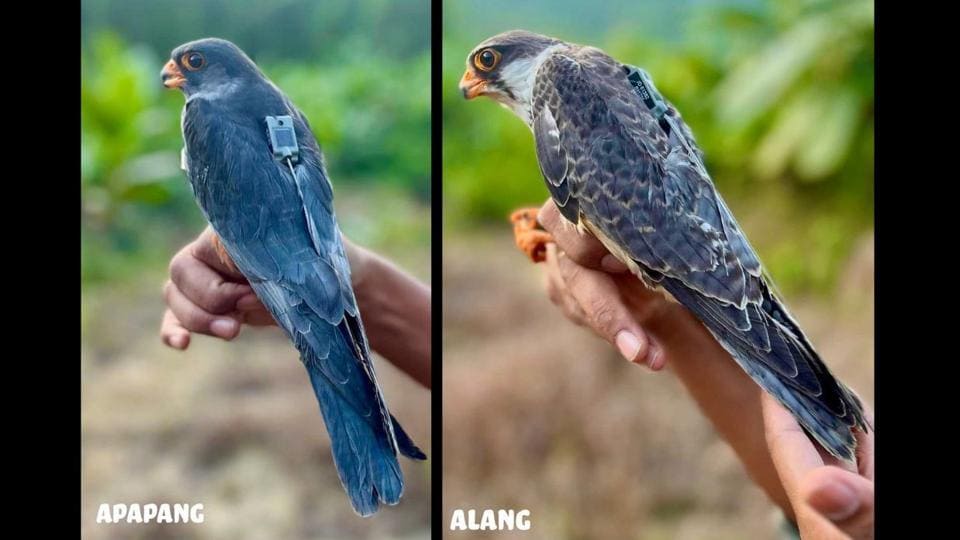
The birds, which were tagged by Wildlife Institute of India scientists in November 2025, arrived from China on Thursday and are expected to spend the next two to three weeks at selected sites in the mountainous tracts of Tamenglong district before embarking on their next long-haul flight.
Manipur, along with other parts of northeast India, serves as an important stopover for the migratory birds, which feed on termites to accumulate fat reserves for their next leg of the journey — a nearly 6,000-km flight to Somalia, including a 3,000-km crossing over the Arabian Sea.
Apapang and Alang, along with a third falcon named Ahu, were fitted with satellite transmitters by scientists from the Wildlife Institute of India (WII) at the Chiuluan roosting site in Tamenglong district in November 2025. While tracking signals from Apapang and Alang confirmed their return to Manipur, scientists lost contact with Ahu somewhere in Somalia earlier this year.
“The two Amur falcons are expected to now make a two to three week stopover at select sites in the beautiful mountainous tracts of Tamenglong district in Manipur, where local people now eagerly wait for their return year after year and protect the falcons,” environment minister Bhupender Yadav said in a post on X on Friday.
Yadav said the successful completion of the birds’ full round-trip journey marked an important milestone.
“The two Amur falcons are expected to now make a two to three week stopover at select sites in the beautiful mountainous tracts of Tamenglong district in Manipur, where local people now eagerly wait for their return year after year and protect the falcons,” said Yadav on X.
Amur falcons typically spend their winter in southern Africa, reaching there between November and December and staying until March or April before returning to their breeding grounds in northern China and Siberia by April and May. They are primarily insectivores, feeding on termites, ants, locusts and beetles, but can also consume mice, smaller birds and lizards.
Officials at the Union environment ministry said the Amur falcon tracking project began in 2013, initially in Nagaland, as a conservation effort to address the issue of hunting at stopover sites in northeast India. Ramesh Pandey, additional director general of forests at the environment ministry, said that, with the active participation of local people, the project provides unique insights into the species, particularly their non-stop, long-distance flights of nearly 6,000 km in six days from northeast India to Somalia.
“With the falcons returning back a year later and few making round-trip journeys multiple times to the stopover sites in Nagaland, this created the desired awareness among local people and a sense of ownership began. This also resulted in hunters turning protectors, leading to complete protection of this migratory falcon,” he said.
Pandey said that, to continue the conservation efforts, another phase of satellite tagging was carried out in 2016 across stopover sites in Nagaland. The success of the initiative spread to neighbouring Manipur and Assam, where Amur falcons began to receive protection at the stopover sites as well.
Amur falcons have been tagged in 2019, 2024 and 2025, with the latest tagging taking place in November 2025, when three such falcons were tagged in Manipur.
“The successful tracking of Amur falcons has provided much needed information on where and how long they stop over in northeast India, and also as to how super-abundant termite prey availability in and around the stopover sites has shaped their migration strategies,” Pandey said.
He added that in southern Africa, in the southern hemisphere, the Amurs spend nearly three months during the southern summer in Botswana, Zimbabwe and South Africa. Similarly, their breeding sites in northeastern China and the Russian Far East are also well mapped, he said.