
 E-Paper



India Gate road cave-in: Why do Delhi roads crumble?
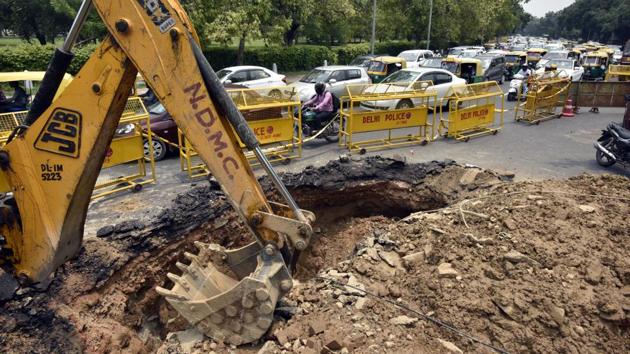
A part of the road caved in at India Gate’s C-Hexagon bringing the traffic to a crawl during peak hours.


The road cave-in at C-Hexagon at India Gate on Wednesday was due to an old communication line, which had loosened the soil and resulted in the incident, officials said.
But why do these incidents take place?
One possible reason behind portions of roads caving in is damage to water or sewer lines beneath roads.
In April 2016, a large stretch of the Kasturba Gandhi Marg caved in as heavy leakage from an underground pipeline had caused water to accumulate under the road, leading to the mishap.
“When water seeps in, the lower sub layer becomes soft. After some time, it can’t bear the load and the section collapses. These are caused due to sewage and water pipe leakage or burst of an old pipe. For this particular case at India Gate, there might be some other reasons, too, which need to be investigated upon,” K Sitaramanjaneyulu, a scientist at Central Road Research Institute, said.
Most roads have been laid on water pipelines. Before a road is built, the water or sewerage pipeline should either be shifted underneath a footpath or to the side. The pipeline should be covered in concrete so that leakages don’t take place. In most cases, the concrete cover is missing.
Officials also blame depletion of the groundwater table for making the soil beneath roads hollow. “During the rainy season, the water table rises. The pressure of water pushes away the soil underneath and this layer gets eroded, making the road vulnerable,” a council official said.
In August last year, a portion of road from India Gate towards Ashoka Road caved in following incessant rains, disrupting traffic on the route.
Another issue might be bad road laying techniques. According to SM Sarin, former CRRI director, one of the reasons why these incidents take place is that the road layers are not properly consolidated during the construction process.
“They are soft, not properly rolled and the lower layers haven’t been compacted properly. As soon as water gets in or any sort of overload happens, the portion caves in. Lack of quality control, at the time of construction, leads to these gaps. The engineers need to monitor quality,” he said.

Stay updated with all top Cities including, Bengaluru, Delhi, Mumbai and more across India. Stay informed on the latest happenings in World News along with Delhi Election 2025 and Delhi Election Result 2025 Live, New Delhi Election Result Live, Kalkaji Election Result Live at Hindustan Times.


