
 E-Paper



Covid-19 update: On empty buses, city goes the extra mile
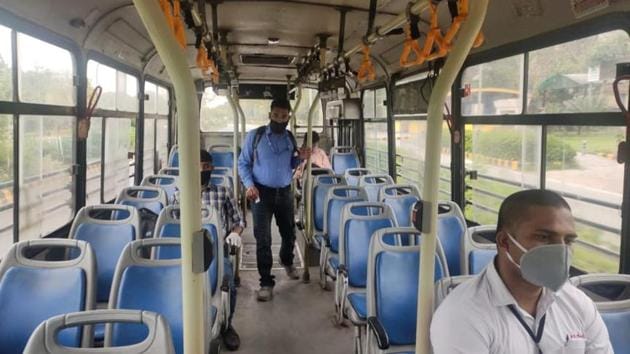
Coronavirus update: The Delhi Transport Corporation (DTC) buses are the only public transport allowed to ply, its strength cut by half during the lockdown period — only 2,600 buses are operating now.


Among the dozen passengers on bus number 473 on Thursday afternoon were Dharmendra Singha and Rakesh Kumar, the only ones who cannot legally travel on it during the lockdown.
The buses are allowed to transport only essential service providers. Singh and Kumar were causal labourers.
“One of them is physically challenged. I couldn’t ignore them,” says Bablu Sharma, the marshal in the bus, rubbing his hands with sanitiser.
The labourers had changed multiple buses from Peeragarhi in west Delhi to Ashram Chowk before hopping into this bus that will drop them at Badarpur Border. From there, they plan to walk to their homes in Agra -- 200 km away.
“Someone has told us that if we keep to the Mathura Road, we’ll reach Agra,” says Singh, his face masked with a gamcha (towel).
On Thursday, Hindustan Times boarded two Delhi Transport Corporation (DTC) buses. DTC buses are the only public transport allowed to ply, its strength cut by half during the lockdown period — only 2,600 buses are operating now.
Bus no. 473 (From New Friends Colony to Badarpur Border)
There are just five passengers inside at 1.30pm, all destined for Badarpur Border.
One among them is 60-year-old Jai Prakash, a private security guard, who is headed from his workplace in New Friends Colony to his home in Jasola village. “On Tuesday night, I couldn’t find a bus. I walked five kilometres,” said Prakash.
Two rows behind, Bharat Singh, a peon with the health department in Vikas Bhawan, is hoping someone would offer him a lift to Ballabhgarh once he deboards. “Otherwise I will have to walk 40 km,” says Singh.
On Wednesday evening, he had walked for a kilometre into Haryana before giving up and returned to Badarpur Border to sleep at a friend’s home. “But my son is ill and I need to get to my home today.”
Outside Apollo Hospital, a policeman, a lab technician and a private security guard board the bus. Their faces are masked. The lab technician also has donned hand gloves. Driver Dinesh Kumar Sharma checks their ID cards.
Conductor Dildar and the marshal Bablu, stand near Sharma and question everyone who signals the bus to stop.
The conductor’s hand touches that of the passengers each time he takes money and issues a ticket. “I sanitise my hands every 10 minutes. I hope my face mask will be useful each time I inadvertently try to touch my face,” says Dildar.
Passengers keep to themselves, occupying seats away from each other.
Near the National Thermal Power Corporation (NTPC), a little ahead of Badarpur Border, the driver is slow in responding to a man who had waved the bus to stop and stops some distance away. Rama Sah runs to catch the bus.
“I have walked for 20 minutes to reach the bus stop. My bicycle is parked at the border and I’ll pedal for five kilometres to reach home,” says Sah, an employee with the NTPC heading to Faridabad.
Soon, the rickety bus reaches Badarpur. All the passengers had already de-boarded by then. The driver, conductor and marshal sanitise their hands while a sanitation worker begins spraying disinfectant inside the bus.
Bus No. 433 (Badarpur Border to New Delhi Railway Station)
Driver Ram Singh and conductor Prakash are the only ones in it as the bus begins its journey at 2.30pm.
The first to hop in is Payal Gupta who works at a dispensary in Molarband and is headed home in Srinivaspuri. She walks to sit in a corner and the conductor walks to hand over her ticket. “I had to walk 30 minutes to reach the bus stop. I’ll have to again walk 15 minutes to home,” said Gupta.
The driver doesn’t speak throughout the ride and the conductor looks occupied with his thoughts.
Carpenter Vinod Kumar Sharma hops in at the next stop. He doesn’t have an ID card, but needed to get medicines for his daughter who suffers from liver ailments, he explains to the driver. “Three buses refused to let me in before this,” Sharma says.
A little before Okhla, a nursing inspector who didn’t want to reveal his name boards the bus. He is wearing protective equipment over his face, hands, arms and head. His will be a short ride till the ESI Hospital in Okhla.
“I live in Uttam Nagar, but have taken a room on rent nearby to be easily available at the hospital. Travelling in this lockdown has been difficult,” he said.
At the ESI Hospital, more people hop in and the bus moves ahead only to come to a sudden stop a little ahead for a group of three women.
“Two buses before this did not stop for us. We thought it will be a third day of walk to home (in Govindpuri),” says nurse Rajni, trying to catch her breath.
Rajni has been kind enough to share her home with her colleague, Rekha Devi, whose own rented home is in Jaitpur. “My house owner asked me not to move out till the situation normalised. He fears the building could be sealed. Rajni let me live with her so that my husband and children are not kicked out,” says Devi.
The third woman, also a nurse, hops out of the bus at the next stop, before she was issued a ticket. That has mildly annoyed the driver and conductor.
When a truck driver with just his Aadhar to show as proof boards at the next stop, they refuse to go ahead till he alighted. “I need to visit my family...I promise I won’t board any more buses after this,” the man pleads.
“No brother, please leave. The police will penalise us for letting you in,” the driver insists. The man drudgingly hops off.
The next passenger is Shubham Kumar, a young doctor employed at ESI Hospital in west Delhi’s Basai Darapur. This is the third bus he is hopping into to reach his rented home in Gautam Nagar near Jor Bagh.
“Rarely does a doctor board a DTC bus,” conductor Prakash looks amused.
“I usually take lift from a senior doctor, but today he left earlier than usual. I don’t own a vehicle” the doctor quickly tells Prakash. “The hospital is supposed to arrange cabs for us, but that has not happened yet.”
When the next passenger hops in on the Safdarjung Road, the bus driver lets him in without question. The conductor does not issue a ticket either.
The man is in tattered clothing, he didn’t seem to have bathed for days. “I live in Bawana and sell pens at traffic junctions,” says the man, Shankar Chaudhary, occupying a corner seat in the last row of the bus.
He had hopped into many buses to come to this part of Delhi to meet a friend who works for the Delhi Metro. He doesn’t own a mobile phone and says has no money. “I couldn’t find his home, so I am returning to Bawana,” says Chaudhary.
As the bus nears the New Delhi Railway Station, Chaudhary offers a smile to conductor Prakash and deboards.
Prakash reveals why he was lost in thought. He has no personal vehicle and may have to walk to his home in Jaitpur, five kilometres from the bus stop, when his duty ends at night. “I don’t know if the government will pay me for the fewer days of work during the lockdown,” said Prakash who is a contractual worker.
“What can I say,” he adds with a wry smile.
Stay updated with all top Cities including, Bengaluru, Delhi, Mumbai and more across India. Stay informed on the latest happenings in World News along with Delhi Election 2025 and Delhi Election Result 2025 Live, New Delhi Election Result Live, Kalkaji Election Result Live at Hindustan Times.


