
 E-Paper



Villagers divided over revival of Najafgarh lake
The Delhi government hopes that the revival of Najafgarh lake will help address water needs in west Delhi.

 Prefer HTon Google


The Delhi government’s plan to revive Najafgarh lake and declare it a notified wetland has triggered a debate in the villages abutting the water body. While some residents have welcomed the plan, others are apprehensive that it will cause flooding during monsoon.
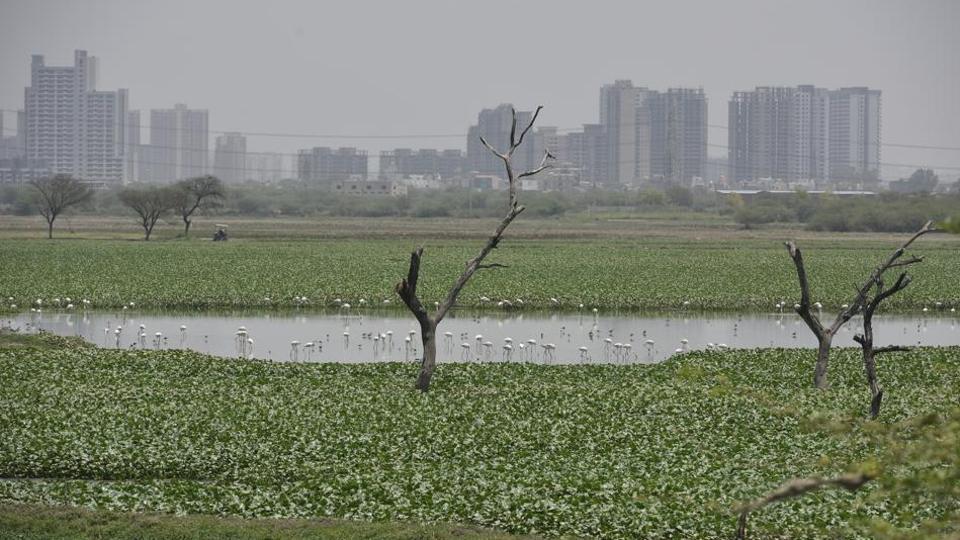
HT reported on Monday that Delhi’s chief secretary has ordered a survey of the area and the government hopes that the lake’s revival will help address water needs in west Delhi. Once the survey is done, the revenue department will negotiate with the farmers to lease or acquire land for the project.
‘Generation Gap’
In Shikarpur, one of the villages near the lake, octogenarian Ramphal Tyagi and his 42-yearold son Rajeev Kumar are divided in their opinion over the utility of the project. Tyagi recounts that the lake would flood their fields and homes during monsoon but his son want the lake revived in the larger good and is in fact ready to part with some of his land, if the need arises.
“This is generation gap. There is a lot of difference between then and now. Then there was a route for water to enter the village and to drain as well. Now, water is scarce. It would be good if the lake is restored,” said Rajeev, a DTC bus driver.
Experts cited a Central Ground Water Board report in favour of the lake’s revival. As per the report, water table in southwest Delhi is under the ‘semi-critical’ category.
“The presence of a large water body in the area would bring down the temperature by a few degrees. Once the water body is revived the soil in that area would be able to hold more moisture, which would, in turn, help the growth of trees. It would also help to prevent runoff during heavy rains and prevent flooding,” said environmentalist CR Babu, while citing the example of Yamuna Biodiversity Park, which has a large water body stretching more than 1.8 km in length.
Tyagi, however, is not convinced. He says the lake has been there since 1807 and it would cause floods every year. “We had to escape and take shelter at a temple for days at a stretch,” he said.
After the lake dried up in 1960s, locals started farming on the lake bed.
NGT Directions
In March this year, the National Green Tribunal (NGT) directed the governments of Delhi and Haryana to report on the action taken to declare the Najafgarh lake as a water body and restore it.
The direction came in response to a PIL filed by the NGO, Indian National Trust for Art and Cultural Heritage (INTACH) in 2014 to seek the revival of the lake which had at one point in time occupied close to 220-250 square kilometres.
“Even though the Delhi Gazetteer (1884) records that the jheel sprawled over 220 sq km, at present, it has been shrunk to just around two sq km. But once it is restored it would measure around seven sq km. Even if we go by conservative estimates, the revived lake would be able to recharge the groundwater table by at least 14 million litres per day,” said Manu Bhatnagar, INTACH’s principal director, Natural Heritage division.
After the lake flooded Tilak Nagar and Janakpuri in west Delhi in 1977, Delhi constructed a supplementary drain to carry the flood discharge into the Yamuna. Since then, the villages on the Delhi side of the lake have seen a gradual depletion of water level, eventually exposing the land upon which they now carry out agriculture. The villages on the Haryana side still gets flooded and the farmers complain of poor agricultural produce.
Restoration Requirements
Restoring the water body would require the governments of Delhi and Haryana to acquire agricultural lands of 7-10 villages.
At present untreated and undertreated wastewater including industrial effluents make their way into the jheel and drain.
This polluted water is contaminating the groundwater too making it non-potable.
“This lake has been here since the time I was born. But now it has gotten worse because all the drains of the nearby villages empty into it. Even if there is no rainwater, the dirty water from the drains are flowing into this land,” said Bheem Singh, a resident of Daulatabad village in Haryana.
On Delhi side, villages of Rawta, Ghumanhera, Jainpur, Shikarpur and Jhatikra are situated around the lake.
‘Potent Ecosystem’
Experts, however, say that the revival of the lake would provide a potent ecosystem to Delhi and Gurugram, helping the twin cities to recharge groundwater, acting as a buffer against extreme weather, a carbon sink and a habitat hosting birds like flamingos and pelicans.
“It is one of the best places in Delhi to locate water birds. But the authorities should proceed with caution so that it does not become a garden with a lake. If it loses its wilderness, the birds would be gone,” said ornithologist Nikhil Devasar.
The revival of existing lakes and water bodies for recharging groundwater has been on the agenda of the Delhi government. It has planned to revive around 300 water bodies and construct at least five artificial lakes.
“The revival of the Najafgargh lake would benefit the locals and south-west Delhi as a whole,” said Diwan Singh, an environment activist living in Dwarka, adding, “Not only would the water table be recharged but it would also save a big habitat for birds.”
“The governments have to come up with a good compensation package before they start acquiring land from the farmers,” he said.


