
 E-Paper



When Delhi politics gets into auto mode
Reviled by people, auto-drivers are assiduously courted by political parties before the elections. A story of how and when they drove into the city’s political arena

 Prefer HTon Google


Shiv Kumar Pandey, 56, an auto driver, who lives in south Delhi’s Sangam Vihar, says that in the past few days he has had to twice remove large stickers put on the back of his vehicle by supporters of different political parties.
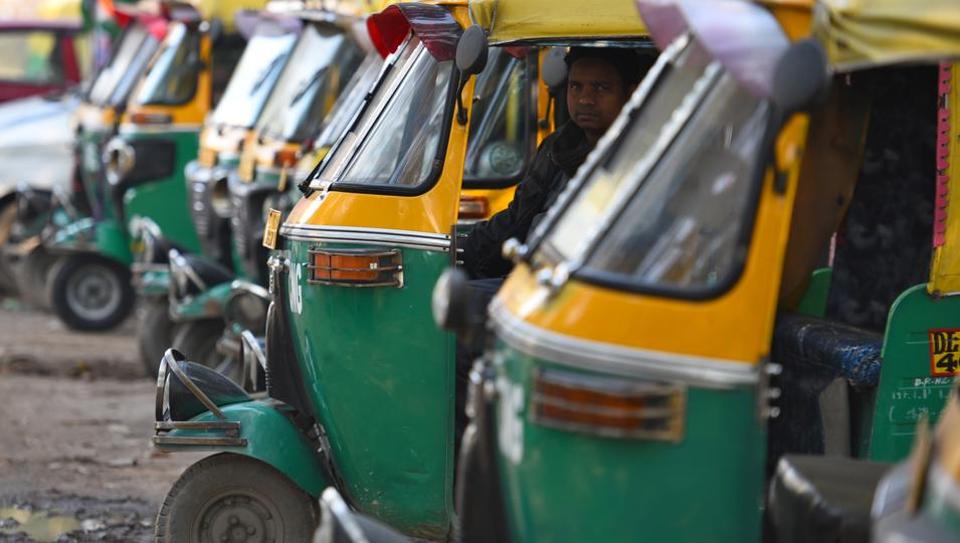
“I requested them not to do so, but they did not listen; everyone feels that we are a good source of free advertising,” says Pandey, who hails from Gonda district in Uttar Pradesh, and has been driving an auto in the city since 1991. “Political parties have always taken us for a ride,” he adds.
A total of 1918 autorickshaw drivers were prosecuted between January 6 and January 31 for violating the model code of conduct which came into force with the announcement for the Delhi elections. One of them was fined ₹10,000, for carrying ‘I love Kejriwal’ message. The matter has since reached the high court.
Reviled by people for refusing routes and overcharging, the city’s auto drivers have, over the years, been assiduously courted by political parties before the elections.
Last year, the Aam Aadmi Party (AAP) government announced a slew of measures including an 18.75 per cent hike on existing auto fares, waived the vehicle’s fitness test fee and significantly scaled-down various charges, including penalties. The moves were seen as a measure to woo the city’s auto drivers before the elections.
Even Delhi Bharatiya Janata Party (BJP) president Manoj Tiwari has been zealously courting auto drivers in the past couple of years — earlier this month he arrived at a press conference in an auto-rickshaw; besides, he has been seen in the auto driver’s seat; and distributing anti-pollution masks to auto drivers.
Driving into the political arena
There are about 100,000 auto-drivers in the city – but they are more than just a vote bank. In the past decade, they have actively canvassed for political parties, have taken part in rallies and meetings. While AAP used autos extensively during its campaign in 2013 and 2015, other parties have also run anti-AAP messaging on autos.
The leaders of the auto drivers unions — there are about two dozen of them, all affiliated with one or other political party — will have you believe that their role in driving election campaigns has been “underappreciated”.
“We are not merely a source of cheap and effective advertising, but also of valuable information for political parties. During the Lok Sabha elections last year, our union had deployed about 10,000 autos to read the mood of the voters in parts of Delhi, especially in east Delhi,” says Rajendra Soni, general secretary, Delhi Auto Rickshaw Sangh, which has ties with Bhartiya Mazdoor Sangh, an RSS-affiliate trade union. “Our drivers engage their passengers in conversation in order to understand who they are going to support or oppose and why, helping the political party we support devise its pool strategy accordingly.”
Soni talks boastfully about his ability to “tip the scales in favour of any political party”.
“It was auto drivers who played a key role in AAP’s victory in 2015, rising above their political affiliations. They travel to every nook and corner of the city, interacting with people from varied age-groups and backgrounds. No one knows the political pulse of the city better than us,” says Soni, 62, claiming that his organisation has about 20,000 auto drivers under its umbrella. “I was with the BJP before I joined the union on the suggestion of late Madan Lal Khurana in 1993. I had led a delegation of auto drivers to meet him soon after he became chief minister to urge him to sort out their problems,” he adds. But has he ever been an auto driver? “I used to drive a taxi in the mid-1990s between Dehradun and Delhi.”
A symbiotic relationship
Kishan Verma, president, All Delhi Auto Taxi Transport Congress Union, who claims to be associated with the Congress party, makes no bones about why auto unions’ are affiliated with one political party or other. “See, it is a give and take relationship. They use us for free publicity, mobilising people and bringing them to rallies in autos. In return we expect the party we support to resolve our issues if it comes to power,” says Verma, who also works as a property dealer in west Delhi.
Verma, who claims to have the support of about 15,000 auto drivers, admits that with the Congress having been out of power in the state, his union’s influence has diminished considerably. But that is hardly a cause for concern for him. “We rise above party politics when it comes to the interests of auto drivers, ” he says.
Verma’s point about auto drivers of all unions being part of a fraternity is supported by Mohammad Sakhawat Mansoori, general secretary, Rashtriya Rajdhani Kshetra Tipahiya Chalak Union Delhi. “ We are a Communist Party of India (CPI)- affiliate organisation. We often meet at each other’s offices, where the interests of the auto drivers, not ideological issues, are discussed. We raise our demands together, and organise the strikes together,” says Mansoori. His union , he claims, has the support of over 5000 auto drivers in the city.
The rising influence
Chunni Lal, 68, who drove an auto from 1980 to 2015 in the city and is now secretary of Taxi Auto Rickshaw Driver Sangharsh Samiti, says that auto drivers did not always have to curry favour with political parties. “In 1980, when I started, there were only 6,500 auto-rickshaws in Delhi, and those days we never had to go on strike. Prime Minister Indira Gandhi was favourably disposed towards us . Every time there was a hike in fuel prices, the fares were reasonably revised and the new rates were published in the newspapers. Once I was part of our union leaders’ meeting with her at her residence, and she was very receptive to our demands,” says Lal.
He points out that auto driver became politically important by late 2000 as their numbers increased, with a majority of drivers being migrants from Bihar and UP. “ Until the mid-1990s most auto drivers were Punjabis, living in west Delhi areas such as Patel Nagar, Tilak Nagar, Rajouri Garden, Bhogal. Now most are from Bihar and UP, and live in east Delhi colonies such as Seelam Pur and Shahdara. Seventy per cent of them drive rented vehicles,” says Lal. “In the 1980s, we would make Rs 40 a day and were happy, we never refused a ride, and never overcharged. There have been a fall in the standards of drivers, a lot of whom, I admit, are dishonest and rude.”
From Phat- Phat to autos
Phat-Phat, modelled from Harley Davidson’s WLA motorcycles, was the precursor to autos in Delhi. It was the ingenuity — “Jugaad” — of a Delhi businessman who modified Harley Davidson, mass-produced during the Second World War, into a goods vehicle.
“My father’s elder brother Sham Sundra had imported Harley Davidson motorcycles in 1946, and they were not selling well. He modified one of them into a three-wheel goods carrier for his own business. That gave an idea to a few people who bought Harley Davidson motorcycles, and converted them into passenger vehicles that could ferry as many as eight passengers. It came to be called Phat- Phat because of the thumping sound of its engine,” says Satish Sundra , who runs Ram Chander & Sons, the country’s oldest toyshop in Connaught Place.
Phat- phat, Sundra says, was an instant hit; used mainly for travelling between Regal to Old Delhi railway station in those days when public transport in Delhi was scarce, with most Delhiites depending on Great Northern Indian Transport buses, whose numbers were not enough to meet the demand of the city’s rising population. “Harley Davidson motorcycles eventually turned out to be a hugely profitable business. He later went on to set up Kelvinator India, the iconic refrigerator brand, ” says Sundra of his uncle.
While the first autos — mostly API Lambretta — arrived in the city in the 1980s, becoming an instant hit because they provided point-to-point transport across the city at low fares, Phat- Phat remained on the roads till late 1990s, plying mostly in Daryaganj.
“Phat-phats were not used for advertisements or political campaigning. There were no unions in those early days of the alternative transport system. Auto drivers’ rude behaviour, I think, has to do with patronage and pampering they receive from political parties,” says Sundra.
Autos faced an existential threat when, in 2010, then chief minister Sheila Dikshit announced in the state assembly that her government wanted to phase out auto-rickshaws from the capital. “Auto-rickshaws are not a good option — they are uncomfortable and pollute the environment. Also, auto-rickshaw drivers are unruly and harass passengers,” Dikshit said. There was a hue and cry from the auto unions and opposition BJP. The chief minister soon retracted her statement.
The wheels of controversy
During the 2013 assembly elections, the city saw a bitter fight between the Congress and Aam Aadmi Pary (AAP) over advertisements on the back of three-wheelers, with Nyay Bhoomi, an NGO, which claimed to be working with 10,000 auto-rickshaw drivers extending its support to the AAP.
Talk to auto drivers and they say that while they listen to their union leaders, they make their own choices when it comes to supporting a political party. Most claim to have supported AAP in both 2013 and 2015.
While the AAP government, they say, has resolved many of their issues, it has failed to rein in app-based services, has not created enough parking stands, and has not set up the promised welfare board for drivers.
“We had already lost business to Ola and Uber, and with DTC bus rides being made free for women, there has been a further dent in our business. My earning has come down from ₹900 to ₹600 a day, ” says Ramesh Kumar, an auto driver in Mayur Vihar. “Besides, the government’s increasing emphasis on e-rickshaws further threatens our business.”
Admitting that autorickshaw drivers have been an integral part of the AAP’s campaign for years now, the party’s Delhi convener Gopal Rai, said: “The AAP government has worked for the welfare of auto-rickshaw drivers - from fare rate revisions to significantly slashing down annual charges on updating meters and GPS facility, among other things. Autorickshaw drivers reciprocated with support and around 15,000 of them across the city voluntarily joined the I Love Kejriwal campaign last year. Still, if there are complaints, we assure auto-rickshaw drivers that we will resolve all issues in the days to come.”
But the city’s auto drivers, much- sought- after by political parties, are keeping their cards close to their chest as they claim ‘betrayal’ by all political parties.


