
 E-Paper



New Delhi vs Beijing: Whose air is worse?
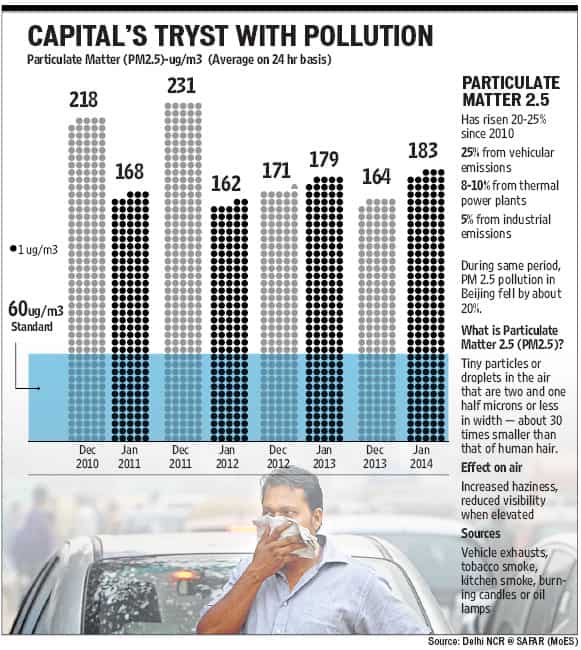
A scientific and political battle has broken over reports that Delhi’s air quality is worse than the global poster-child for pollution, Beijing. A Yale study reported by Hindustan Times concludes that it does, while local officials insist that it does not, citing their own data from monitoring stations on the ground. Capital's tryst with pollution


A scientific and political battle has broken over reports that Delhi’s air quality is worse than the global poster-child for pollution, Beijing. A Yale study reported by Hindustan Times concludes that it does, while local officials insist that it does not, citing their own data from monitoring stations on the ground.

Which claim is true? And how can citizens and policy makers best navigate the crucial question of just how bad the air of the capital is? Much of it boils down to the quality of the available data and its interpretation.
The Yale University study has used satellite-driven data to show peak levels for particulate matter regularly exceeding dangerous levels. Indian government officials, however, have been anxious to stress that according to their data, average levels are lower.
Angel Hsu, lead author of Yale’s Environment Performance Index 2014, said they used satellite data in absence of reliable ground station data, especially from Delhi. "New Delhi’s air quality reporting is not as consistent or transparent, making direct comparison on basis of on ground stations impossible," she said and added that Delhi has a hand in how it makes air quality information available to its citizens.
Gufran Beig of the Indian Institute of Tropical Meteorology (IITM) contested the claim saying satellite data for India cannot be relied upon.
"The satellite-based sensors cannot record particulate matter (PM) content during cloudy days. So, there will be no particulate matter data for three months of the monsoon. The PM pollution level during monsoon is lowest in the year because of the wash down effect of rains. From this we can say that Yale University reached its comparative conclusion on basis of data of nine worst pollution months for cities like Delhi," he added.
Yale University officials were, however, not available for their reaction to this claim about limitations of the satellite data from Canada-based Dalhousie University. They had earlier expressed eagerness to study India’s on-ground pollution data.
Both Delhi and Beijing have on-ground particulate matter monitoring stations, except they disclose it in different formats. While Beijing reports PM 2.5 microns pollution on hourly basis, Delhi provides it either on minute-to-minute or daily basis.
HT did a comparison of PM 2.5 pollution data of two national capitals provided by Beijing for the past two months and found that on some days Delhi had higher pollution levels and some other days Beijing’s air quality was worse. On many days the two cities had similar level of average PM 2.5 pollution level. The Central Pollution Control Board on Friday, however, said that the comparison of pollution level between two cities may not reflect the correct picture.
Although this may have triggered a debate on which city is more polluted but has also brought to fore the point that air quality in national capitals of two of the world’s biggest economies are very bad. "It is an issue of debate for us scientists. But, we cannot deny the fact that air quality in the two cities is bad and it needs to be improved," said Beig, whose institute runs pollution monitoring stations in the National Capital.
While this debate would continue in the scientific corridors, health experts are unanimous that high pollution levels, irrespective of which city earns the dirty air tag, adversely impact’s one health.
"Prolonged exposure to polluted air, irrespective of the level, leads to inflammation of the airway, chest congestion, persistent cough, sore throat, burning sensation in the eye and cardiac diseases," said Dr Randeep Guleria, professor and head, department of pulmonology and sleep medicine, All India Institute of Medical Sciences (AIIMS).
Unlike Delhi, Beijing has woken up to the emerging health hazard and its steps have resulted in reduction in particulate matter pollution. On the other hand, Delhi’s particulate pollution has risen by 20-15% since 2010 mostly because of increase in vehicles and expansion of the power general capacity of thermal power plants. "We have failed to take corrective steps to check rising in air pollution," Anumita Roy Chaudhary of Centre for Science and Environment said.
Two things are certain. Delhi’s air quality is among the worst in the world, and the capital is urgently in the need of robust policy and enforcement solutions to clean the air.

Stay updated with all top Cities including, Bengaluru, Delhi, Mumbai and more across India. Stay informed on the latest happenings in World News along with Delhi Election 2025 and Delhi Election Result 2025 Live, New Delhi Election Result Live, Kalkaji Election Result Live at Hindustan Times.


