
 E-Paper



Waste treatment capacity down by 40%, Yamuna getting more sewage than ever
The functional capacity of Delhi’s sewage treatment plants (STPs) has come down by 40% because of blocked trunk sewers and large parts of the city being outside the sewerage network.



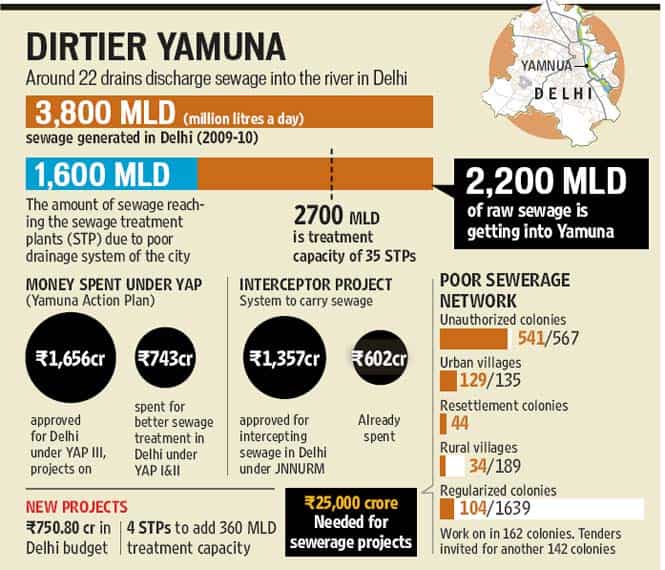
The functional capacity of Delhi’s sewage treatment plants (STPs) has come down by 40% because of blocked trunk sewers and large parts of the city being outside the sewerage network, the Centre has said.
This means that more than 57% of the 3,800 MLD (million litres a day) of raw sewage and untreated industrial pollutants that Delhi generates is flowing directly into the Yamuna, reducing the once fabled river — which meets Delhi’s 70% water needs — into a noxious black thread.
“Despite having a capacity of 2,742 MLD, the STPs are receiving flow of only around 1,590-1,635 MLD and are being underutilised,” Union environment minister Prakash Javadekar has informed Rajya Sabha. More raw sewage goes into the river when STPs themselves do not function sometimes.
The river, pollution watchdogs reports say, is extremely polluted, not fit even for bathing. H uge quantities of untreated waste is often found to be floating in it.
The under utilisation of STPs — from 2,700 MLD to 1,600 MLD — has only meant that damage to the water body has peaked.
While presenting Delhi’s budget on Friday, Union finance minister Arun Jaitley allocated `750.80 crore for better sewerage systems, stating that four new STPs will add 360 MLD treatment capacity to the city .
Manoj Misra of NGO Yamuna Jiye Abhiyan said, “The sewerage management in Delhi is a shame. No wonder the river in the city is what it is — a canal to carry a toxic cocktail of sewage and industrial waste. Authorities must explain and defaulters brought to book as to why the sewerage infrastructure remains underutilised”.
“The dream to build a world-class city will never come true by merely building more STPs unless the sewerage of the whole city is improved properly,” Misra said. The government must ensure waste does not go into the river through storm drains, he said.
“We’re on the job. Along with building STPs, we’re also rehabilitating trunk sewers and linking more and more areas with our sewerage network,” a top Delhi government official claimed.
Originating 375 km north of Delhi, at the Yamunotri glacier in Uttarakhand, Yamuna River is relatively clean when it enters Delhi. However, once it flows inside Delhi, the Capital takes out 3,000 MLD of water for treatment and supply, returning the favour with discharge from 22 drains.
Stay updated with all top Cities including, Bengaluru, Delhi, Mumbai and more across India. Stay informed on the latest happenings in World News along with Delhi Election 2025 and Delhi Election Result 2025 Live, New Delhi Election Result Live, Kalkaji Election Result Live at Hindustan Times.


