E-Paper



Bihar’s labour force and its economic fortunes | Number Theory
.
Published on: Oct 22, 2025, 03:24:09 IST


Share via


Copy link

As these pages have already shown, Bihar is the youngest and also the poorest state in the country. While factors such as lack of entrepreneurship and private capital explain the state’s poverty, it is also important to examine the reasons for Bihar’s material precarity by focusing on its labour force. This three-part series will do exactly that; by looking at the relationship between Bihar’s labour force and its wider economic fortunes. The first part will look at this relationship from the perspective of Bihar’s labour force quantity while the second and third parts will look at the educational quality and caste inequality, respectively.
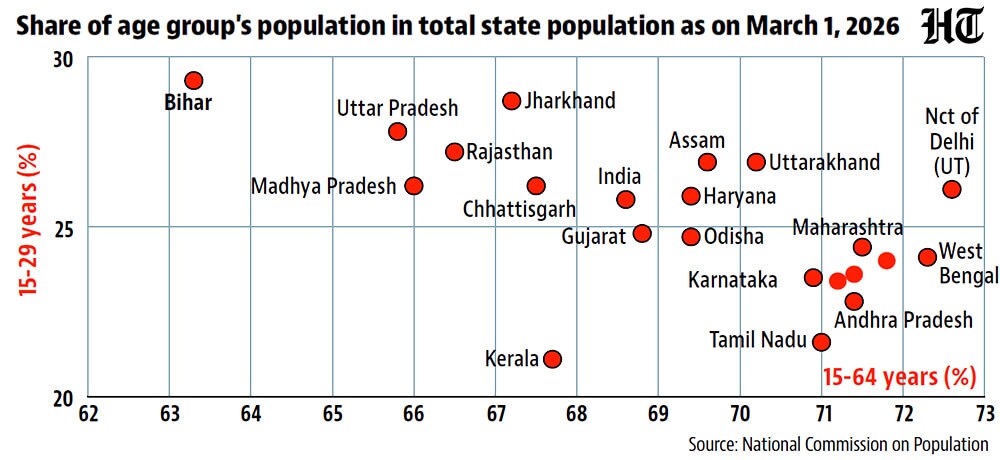
Bihar is the last and first in share of 15-64 and 15-29-year-olds in its total population
 Bihar is the last and first in share of 15-64 and 15-29-year-olds in its total populationThe 15-64-year-old cohort is normally considered the working-age population in India. If one were to take age-wise population projections by the National Commission on Population, Bihar has the lowest share of this age cohort in its total population among big states. This, in a way, explains some of the economic backwardness of the state, as others have a much higher share of the working-age population that can add to overall incomes. However, Bihar is ahead of every other major state in India in the share of 15-29-year-olds in its population. This perhaps makes the state more prone to unrest due to lack of good and enough employment opportunities.
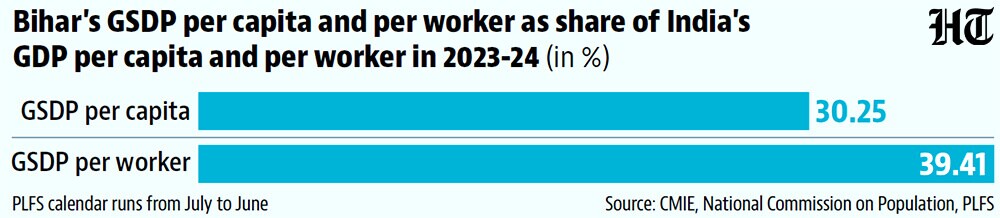
- A part of Bihar’s per capita income deficit is due to its working-age population disadvantageBihar’s per capita GSDP (gross state domestic product) was just 30% of the all-India average in 2023-24, the latest period for which this number is available for all major states. However, its per worker GSDP, based on extrapolating Periodic Labour Force Survey (PLFS) on National Commission for Population projections, is marginally higher at 39% of the all-India number. There is good reason to believe that the per worker GSDP numbers are an underestimate for Bihar because a large part of the state’s working age population perhaps works outside and therefore does not contribute to value creation in the state, although it must be contributing to consumption via remittances. However, because census numbers are more than a decade old now, it is difficult to estimate the extent of migration.
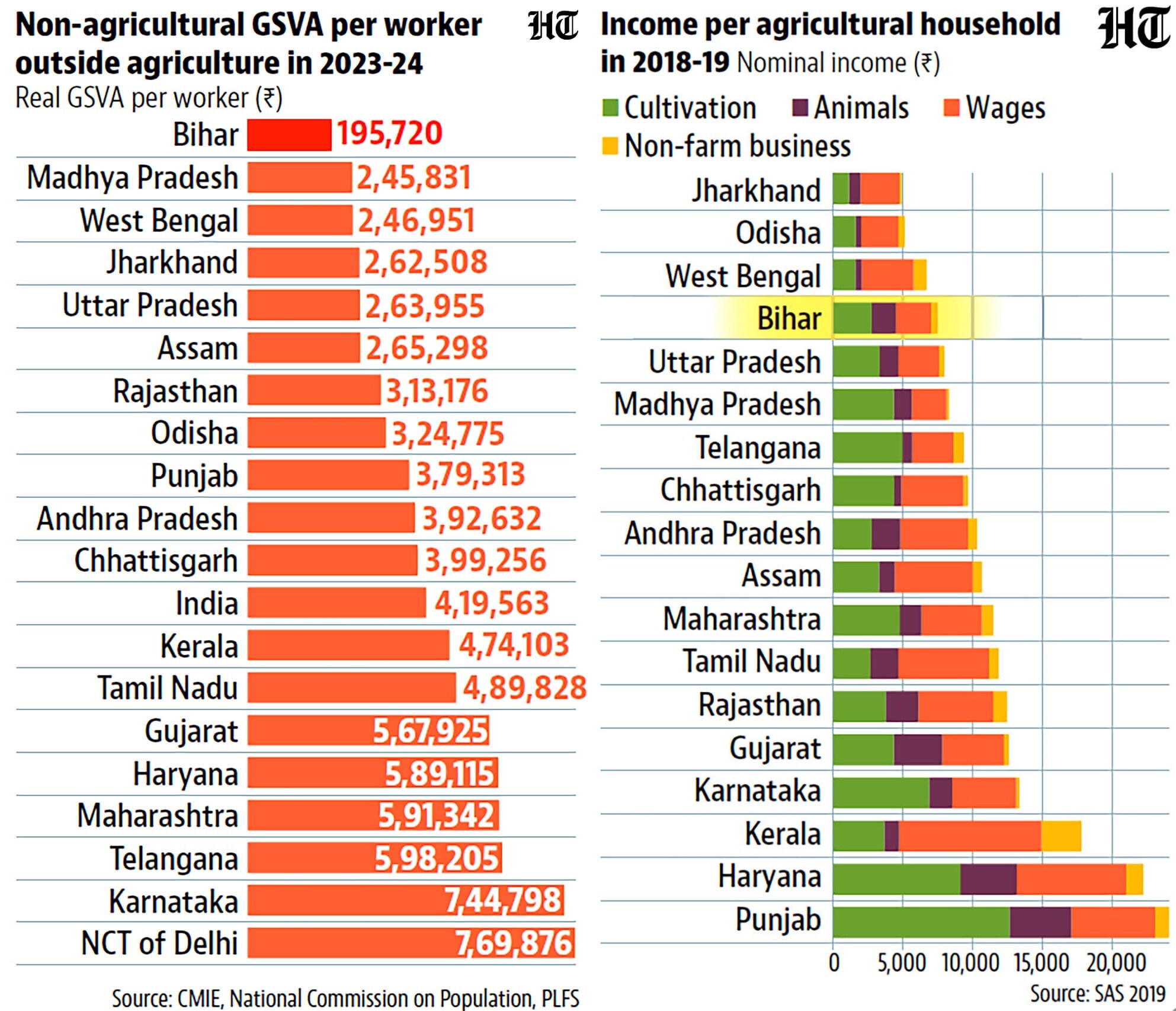
- It is tempting to attribute Bihar’s poverty to dominance of agricultural employmentAccording to 2023-24 PLFS data, agriculture employed 54.2% of Bihar’s workers, making it the fourth highest among major states in the country – Chhattisgarh, Madhya Pradesh and Uttar Pradesh are ranked first, second and third – and more than eight percentage points higher than the national average. Are Bihar’s low-income levels a result of a greater share of its workers being employed in agriculture? An HT analysis shows that this would be a half-truth at best. Bihar lags most states in not just per worker non-agricultural Gross Value Added (GVA), but also overall and cultivation incomes of agricultural households among major states. Agricultural households are the rural households in National Sample Survey Organisation’s Situation Assessment Survey which have a minimum economic stake in farming. The fact that both agricultural and non-agricultural activities are less productive on a per worker basis in Bihar than most other states shows that Bihar’s economic precarity is more deep-rooted than just its number of workers or their occupational classification.
- This is the first of a three-part series looking at the relationship between Bihar’s labour markets and its economic fortunes. The second part will look at the educational quality of Bihar’s labour force and the third part will look at caste-inequality in Bihar’s labour force.