
 E-Paper



El Nino and long-term monsoon rain patterns | Number Theory
Even those casually interested in the monsoon would have noticed that there is wide geographic variation in its performance, with some regions quite wet.
Updated on: Sep 14, 2026, 06:31:23 IST

 Prefer HTon Google
Share via


Copy link

Monsoon 2026 was widely expected to have a large rainfall deficit. This is because an El Nino – a cyclical warming of the central-eastern Pacific Ocean that crimps June-September rain in India even before its winter peak – had developed by April or May, depending on the index used. At any rate, it had enough time to suppress monsoon rainfall. However, even those casually interested in the monsoon would have noticed that there is wide geographic variation in its performance, with some regions quite wet. Why is this the case? The answer to this question can not only help us foresee the impact of El Nino on the monsoon, but also the wider implications of a dry monsoon. This two-part series will do just that.

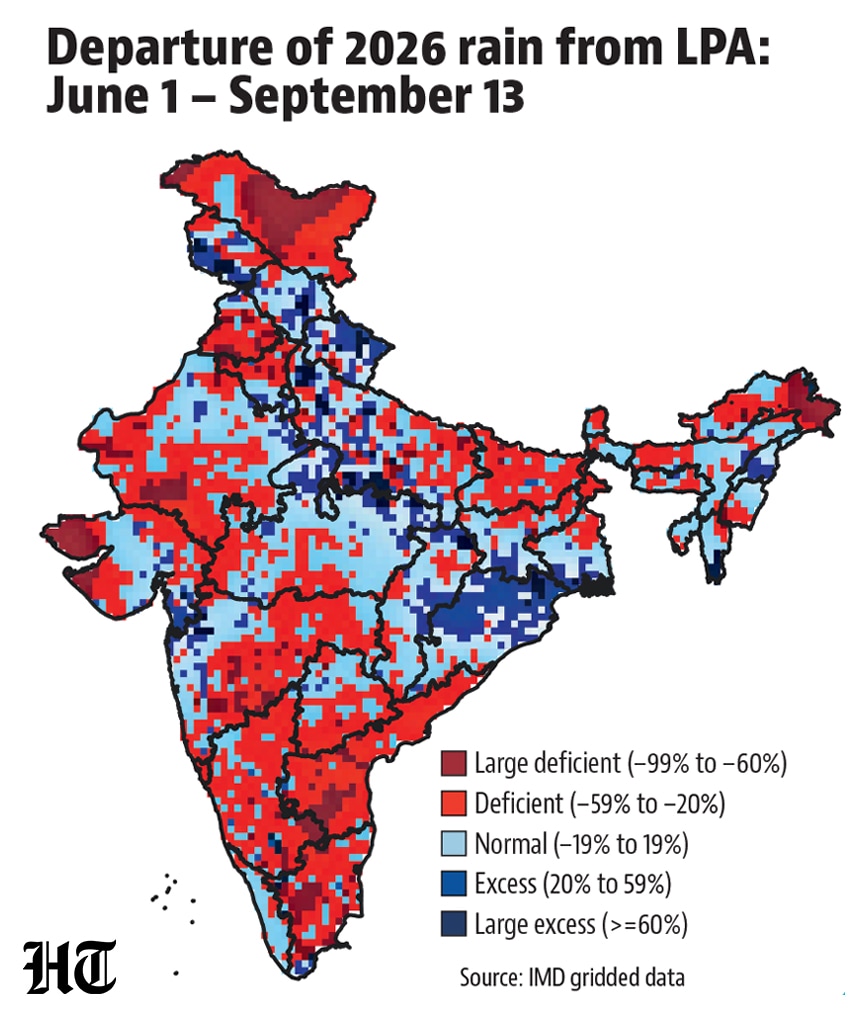
 El Nino has created drought like conditions for only half of the countryThe India Meteorological Department (IMD) tracks rainfall performance using departure from the Long Period Average (LPA), currently defined as the average rainfall during 1971-2020. It classifies rain as “deficient” if a place has a deficit of 20%-60% from the LPA, and as “large deficient” if the deficit is 60% or more. Surpluses of the same degree are classified as “excess” and “large excess”, with a departure of under 20% classified as “normal”. As of September 13, just about 50% of the country was in the deficient categories. The rest was either in the normal or excess categories. Clearly, El Nino’s relationship with the monsoon has not been of much consequence to almost half of the country. To be sure, a deficient monsoon in half the country is pretty bad in aggregate terms. This is reflected in the country-level statistics, where there was a 12.8% deficit, the highest since 2009 and 11th highest since 1901. The geographical distribution of the deficit, however, highlights that an El Nino year has not brought drought everywhere.
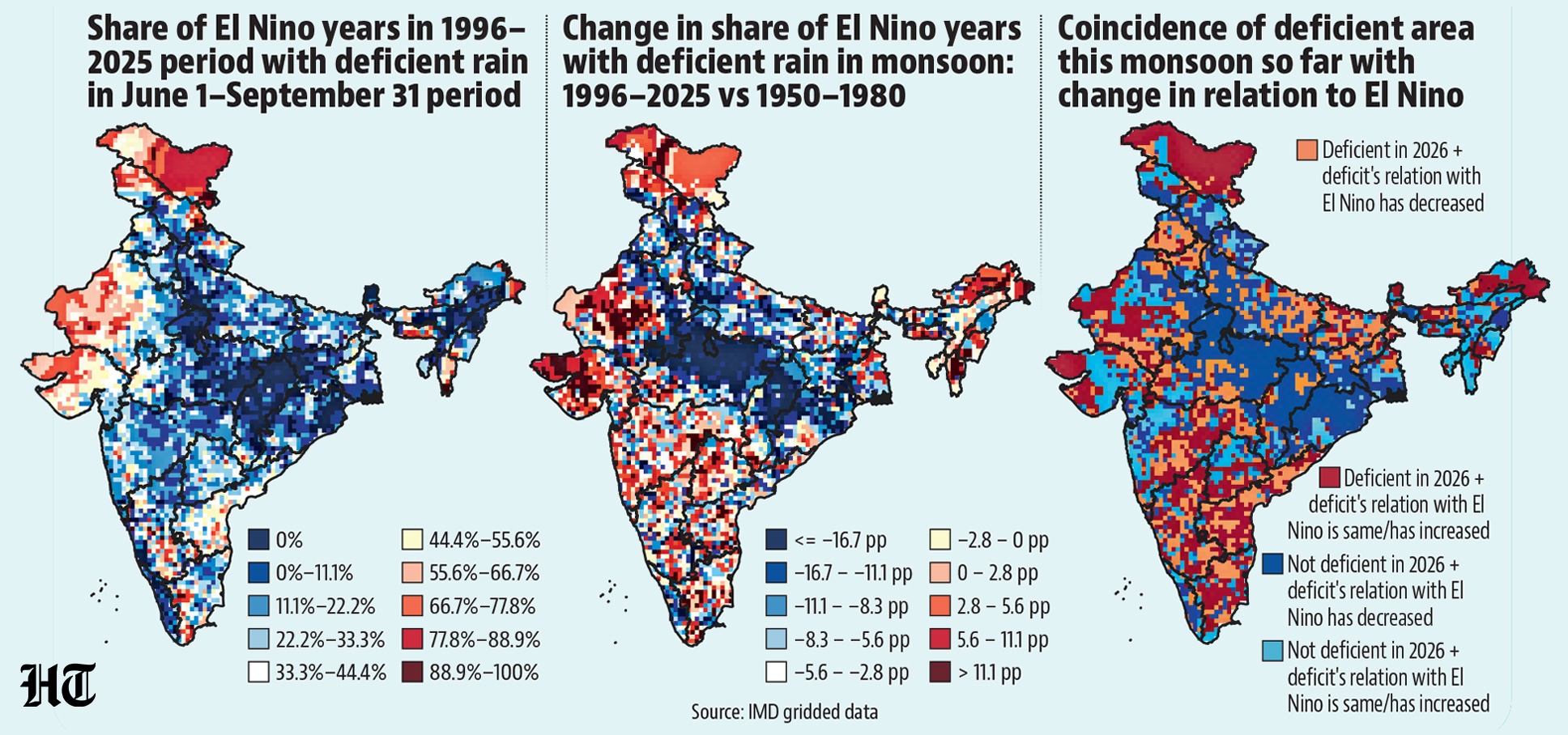
- Part of this has to do with geographic diversity in El Nino’s relation with monsoonPart of the trend described could be the result of the fact that El Nino does not suppress rainfall uniformly across India. This can be seen in the fraction of El Nino years in the 1996-2025 period (when there were nine El Nino affected monsoons) when different parts of India were deficient. Only 51% of the country was deficient in even three of those years. One reason for this is that El Nino’s relationship with deficient rain has weakened in some parts of India recently. Some of that changed relationship might have driven the 2026 monsoon. A majority of the area that is not deficient in 2026 is the area where relationship with El Nino has weakened and vice versa. To be sure, this is a crude way of describing a weakening of monsoon’s relationship with Pacific temperature trends, not just an El Nino, which describes only warmer than normal temperatures.
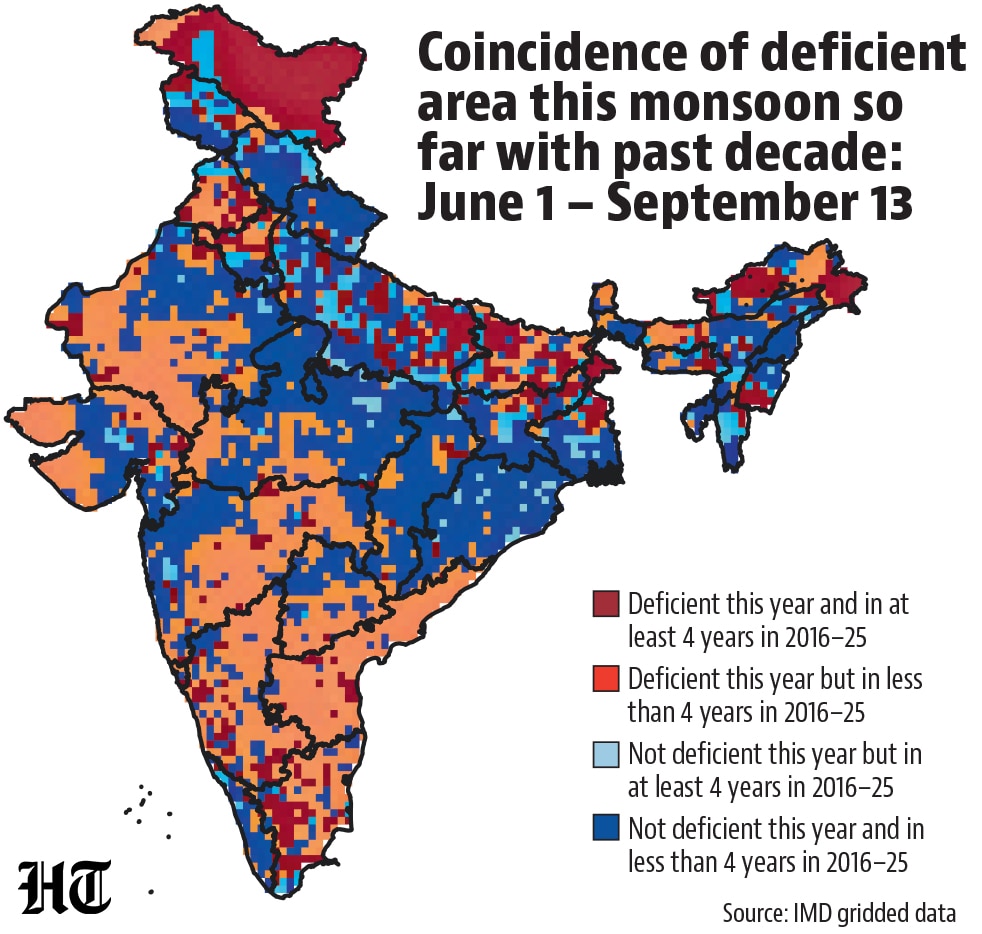
- And some of it is likely because of things unrelated to El NinoWhile assessing El Nino’s impact on the monsoon, it is important to consider that other factors also affect monsoon and that a weak relationship with El Nino does not mean good rain in every El Nino year. For example, half of Bihar and Uttar Pradesh, around 45% of Punjab and Haryana, and around a third of West Bengal and Jharkhand was deficient in four or more years in 2016-25, although the decade had just two El Nino monsoons. This implies that deficient area may be more widespread in an El Nino monsoon, but important cereal producing states have been dry recently irrespective of El Nino. What does this persistent dryness mean for food production and water availability? The next part will try to answer these questions with another set of maps.


Unlock a world of Benefits with HT! From insightful newsletters to real-time news alerts and a personalized news feed – it's all here, just a click away! -Login Now!


