
 E-Paper



How markets have fared in 18 days of war | Number Theory
How have the markets in Indian and global markets fared during this period? The charts below explores this in detail
Updated on: Mar 18, 2026, 08:47:19 IST

 Prefer HTon Google
Share via


Copy link

It has been more than two weeks since the US and Israel launched surprise airstrikes on multiple sites across Iran, killing Supreme Leader Ali Khamenei, and starting a new war in West Asia. Iran shutting down Strait of Hormuz, one of the most important shipping routes which is crucial in global oil trade, has sent crude prices soaring past the $100 per barrel mark. How have the Indian and global markets fared during this period? The charts below explore this in detail.
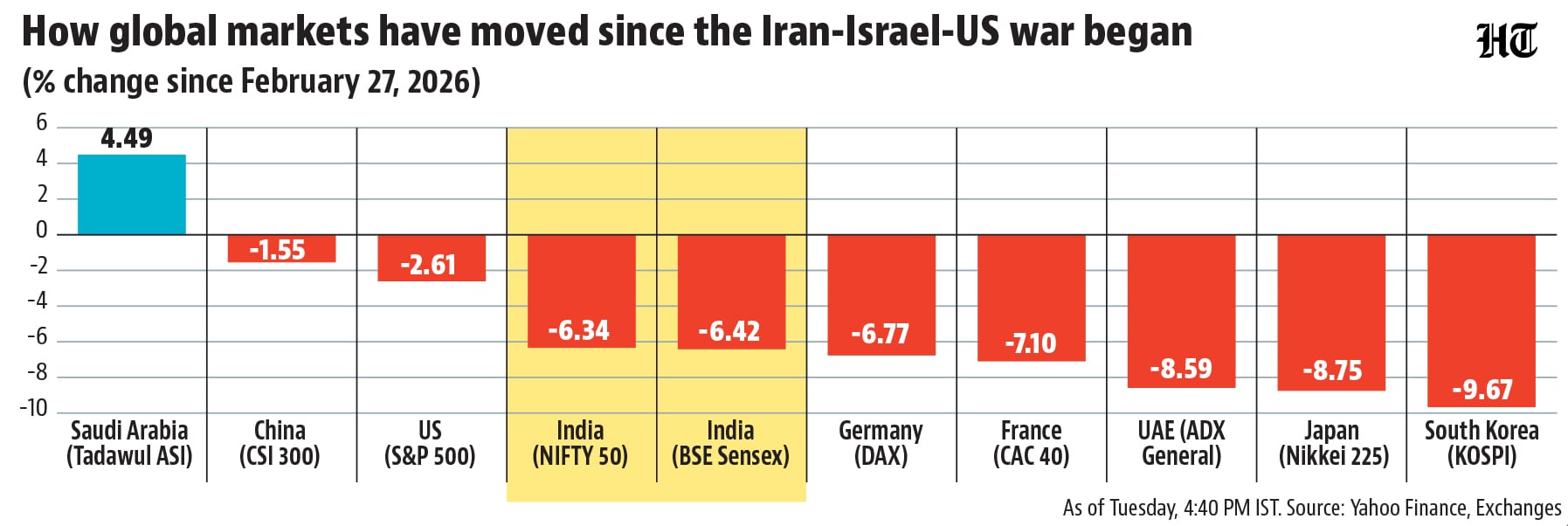
 Asian markets have taken the biggest hitGlobally, markets have not reacted uniformly to the war. Asian equities have borne the brunt, with South Korea’s KOSPI down 9.7% since February 27, Japan’s Nikkei 225 down 8.8%, and India’s benchmark indices down a little over 6%. European markets have also had a rough period, with the CAC 40 (France) down 7.1% and the DAX (Germany) down 6.8%. The relatively sharper fall in Asia reflects the region’s greater exposure to the oil shock, given its dependence on West Asia’s energy supplies. Response from the US markets have been much more muted, with the S&P 500 down just 2.6%. Part of that is structural. The US is far better insulated from an oil shock than Asian importers because of its large domestic energy production. But it also reflects what investors are still betting on. “There appears to be consensus among investors that the administration would eventually pull back on its war effort if there is enough political pressure ahead of the midterms or warning signals in the financial markets,” said a New York Times piece on the muted reaction on US markets to the war published last week. Saudi Arabia has been the outlier, with the Tadawul All Share Index up 4.5%, helped by domestic investors shifting capital back into local equities instead of sending it abroad. The country’s economy and stock market are also less reliant on foreign capital than regional peers such as the UAE, making them relatively more resilient.
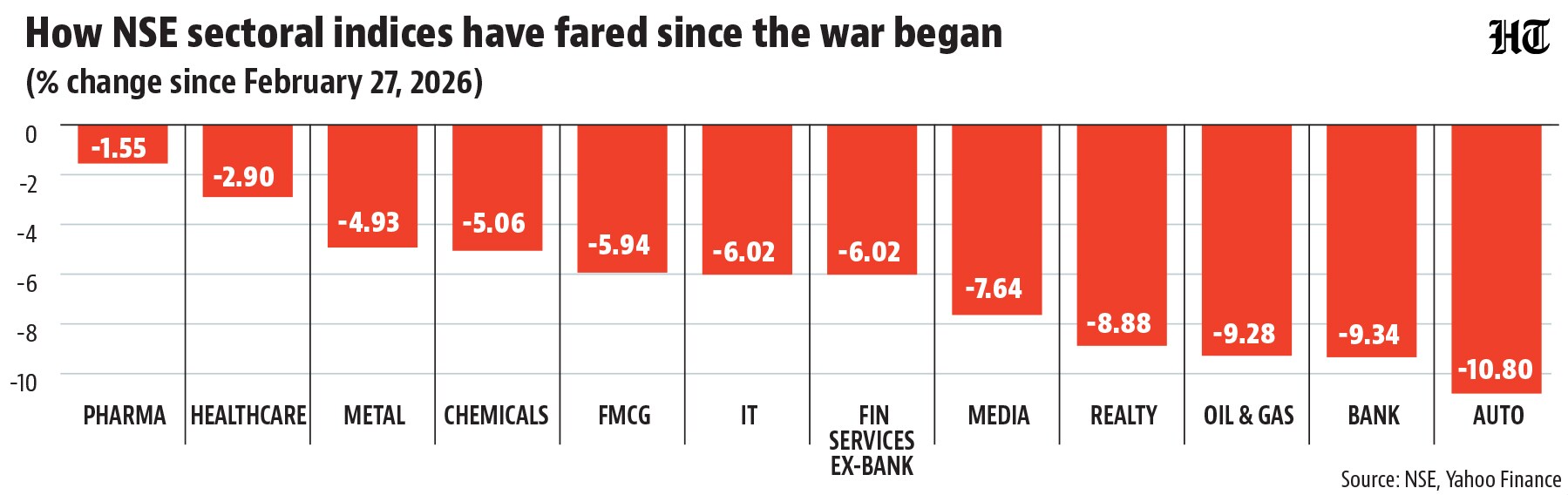
- In Indian markets, some sectors have fared worse than the othersThe selloff since the start of this war within India has been anything but even. Down 10.8%, autos have been hit the hardest—to be sure, auto stocks posted gains on Monday and Tuesday—followed by banks at 9.3%, realty at 8.9% and oil and gas at 9.3%, while pharma and healthcare have fallen far less. Part of this is the usual market logic of an oil shock. Higher crude threatens inflation, squeezes household demand and raises the risk that borrowing costs stay higher for longer, which is bad news for car sales, property and lenders. Defensive sectors, by contrast, have held up better. Pharma is down just 1.5% and healthcare 2.9%, suggesting investors have rotated towards relatively stable earnings amid uncertainty.
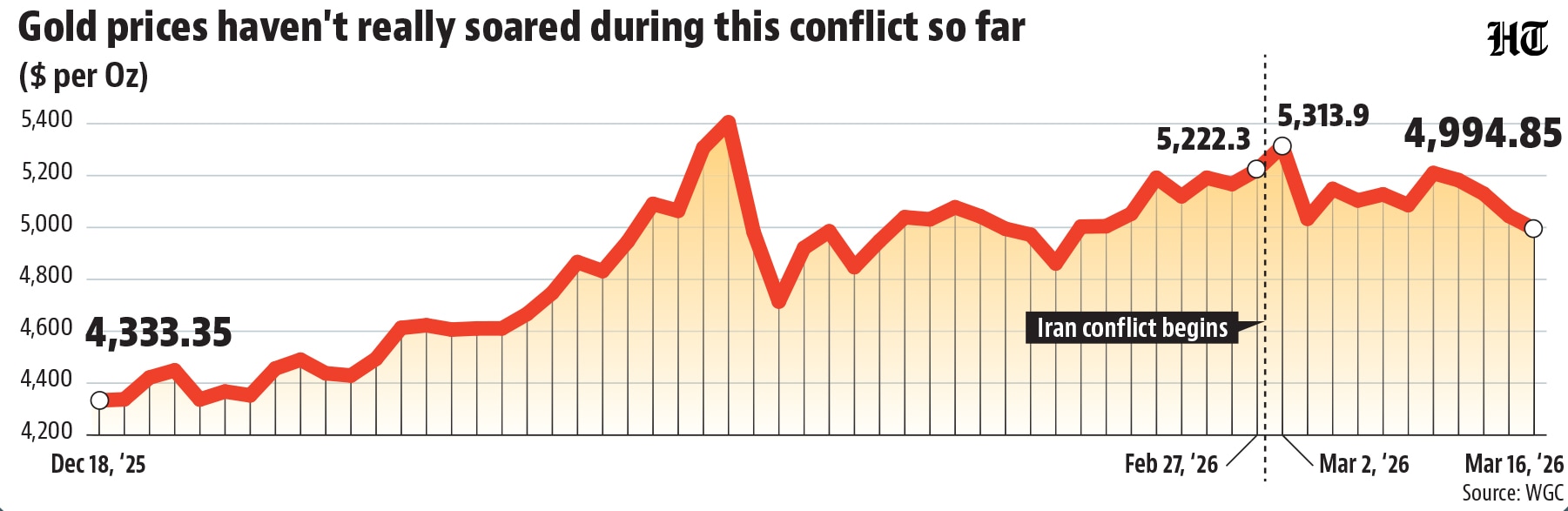
- Gold has not followed the usual script during this crisisGold, which is seen as a safe haven during volatile times, has not really surged during this conflict as it has in the past. In fact, its price on Monday was lower than what it was at the beginning of the conflict. That is partly because the gold market was already overheated before the war began. Ruchir Sharma, in a piece written for the Financial Times last month, described gold as having entered the “storybook stage” as its price surged over the last few quarters, going above levels suggested by fundamentals. Another reason is that this crisis is being read not just as a geopolitical shock, but also as an inflation shock. Rising oil prices have made it less likely that the US Federal Reserve will cut interest rates soon, which in turn makes gold less attractive relative to interest-bearing assets. The same concern is showing up elsewhere as well, with Australia’s central bank raising rates on Tuesday amid concerns regarding war-induced inflation. Moreover, the strengthening US dollar has also capped gains in bullion.
- For India and much of Asia, this is above all an energy-dependence story. With nearly 90% of the crude passing through the Strait of Hormuz headed to Asia, it is no surprise that markets here have corrected far more sharply than in the US. But a lot is based on how long this conflict lasts. “The current geopolitical situation is more concerning from an economic standpoint compared to the Russia-Ukraine conflict. Thus, there can be further downside risk to the markets in the short run as investors get worried about: (1) an aggravated and sustained supply disruption that materially impacts industrial production and (2) an even higher oil prices in our view,” said a report by Nomura on Monday.


Unlock a world of Benefits with HT! From insightful newsletters to real-time news alerts and a personalized news feed – it's all here, just a click away! -Login Now!


