E-Paper



Is Kerala a 2-way fight or a triangular contest? | Number Theory
.

 Prefer HTon Google


When the Communist Party of India (Marxist) or CPI (M)-led Left Democratic Front (LDF) retained power in the 2021 assembly elections, it broke a 40-year-long record in the state. The LDF came very close to achieving this feat in the 2011 elections as well, falling just 3 short of the half-way mark of 71 in the state assembly. In absolute terms, the vote difference between the LDF and the Congress-led United Democratic Front (UDF) was just 1.56 lakh votes. Kerala’s politics has always been seen as a tight race between the LDF and UDF. However, this was not the case in the past two assembly elections in the state, where the LDF had a comfortable lead over the UDF in terms of both seat share and vote share. The roots of this divergence between the nature of political competition in 2011 and in 2016 and 2021 are found in the expanding footprint of the Bharatiya Janata Party (BJP) in the state. Here are some data points that explain this argument.
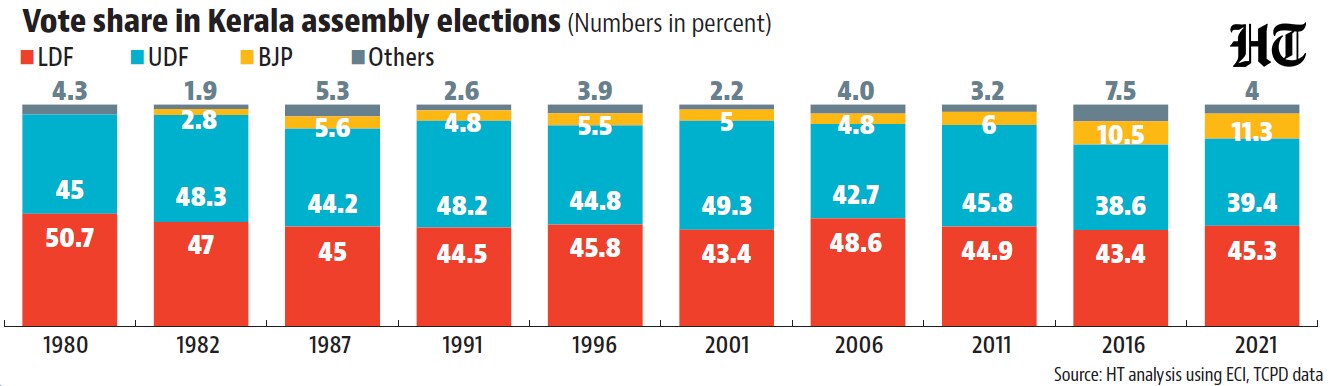
 Non-LDF-UDF vote share in Kerala has increased in the last two state electionsWhile CPI (M) and Congress lead the LDF and the UDF alliances in the state, these two fronts consist of many smaller parties and even independent candidates. HT has prepared a database of LDF and UDF candidates in Kerala going back to the 1980 assembly elections. It shows that the vote share of non-LDF-UDF candidates increased significantly in the 2016 and 2021 elections. Prima facie, this is a result of some of the UDF vote shifting to the BJP in the last two elections. This also means that for the UDF to come to power, it will have wrest part of its voter base which has made a pivot towards the BJP.
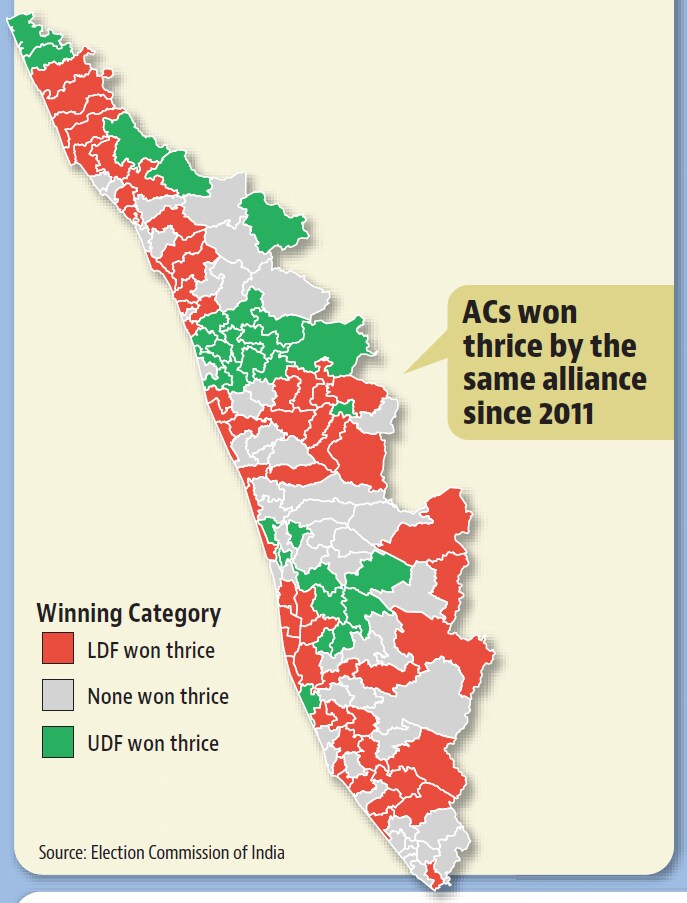
- Kerala has a very large number of stronghold assembliesThe state’s reputation for having “party-villages” is not just an exaggerated anecdote. It has a very large share of assembly constituencies (ACs), 89 out of the total 140 in the state, which have not changed political sides in all three elections since the 2011 assembly elections, the earliest period for which we have comparable ACs thanks to the 2008 delimitation. The LDF and UDF have retained 59 and 30 of these 89 ACs. A district-wise breakup of these ACs also shows how political strongholds are spread across the state’s geography. While the LDF dominates in districts such as Alappuzha, Kozhikode, Kannur and Kollam, UDF’s strongholds are concentrated in districts such as Malappuram and Ernakulam.
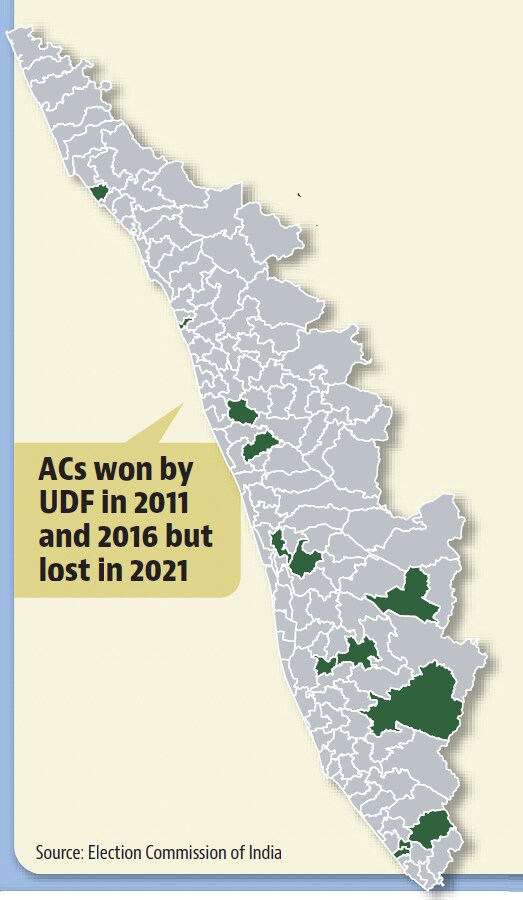
- In 2021, the UDF lost of 13 of its 43 strongholds which it had won in 2011 and 20162021 loss was a shocker for the UDF not only because it failed to capture power in keeping with Kerala’s four-decade long tradition of ousting the incumbent. It was also its worst performance in terms of both vote share and seat share since 1980. While the seat share of the UDF was comparable to the 2006 election when the LDF won a landslide victory, its 2021 vote share was 3.2 percentage point lower than the 2006 performance even though the LDF also saw a similar fall in its vote share. One way to look at the UDF’s loss is to see it via a loss in 13 ACs which it had won in 2011 and 2016 elections but could not retain in 2021. They were spread across the state’s geography. Three of these ACs are in Thiruvananthapuram, two each in Ernakulam and Kottayam and one each in the districts of Idukki, Kannur, Kozhikode, Palakkad, Thrissur, and Pathanamthitta. In 11 of these 13 ACs, the vote share of BJP was greater than the losing margin of UDF and in one such AC, BJP came second.
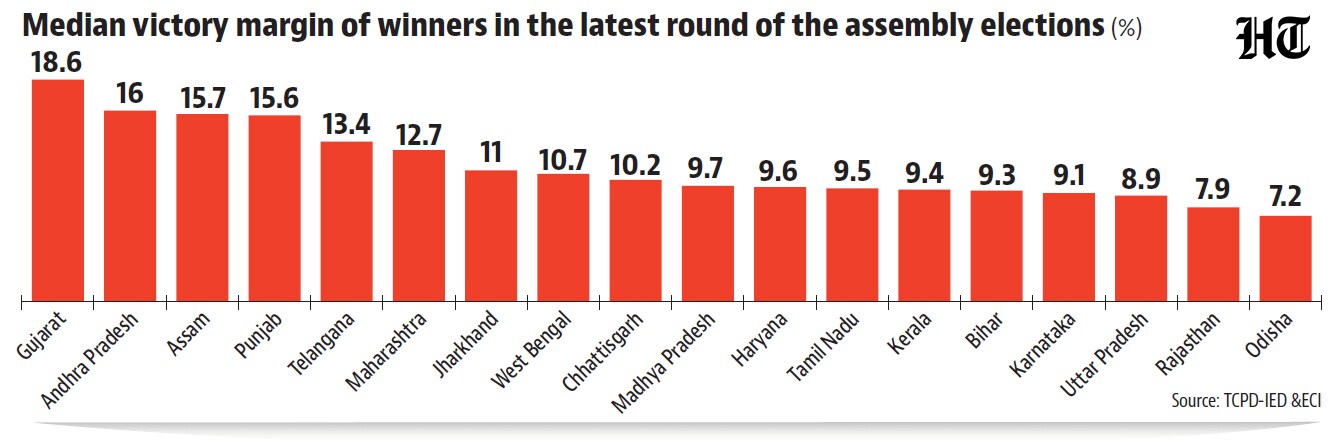
- The Kerala contest should be best seen as shifting loyalties than tight contestsIt is natural for pre-election commentary to focus on how tight contests in a state are. Kerala, as far as the distribution of AC-wise victory margins is concerned, is not really a tightly contested state when compared to its peers. Its median victory margin, in fact, is higher than the national average and many large states.
- Inference...The data shown above should make it clear that the UDF’s main problem in the last two assembly elections has been its inability to prevent a voter attrition to the BJP. Perhaps this why the entire top leadership of the Congress, Rahul Gandhi included, has been campaigning that the BJP and the CPI (M) have a tacit understanding in the state, something which goes against the Congress’s national strategy of working together with anti-BJP parties like the CPI(M). The Kerala electorate, however, seems to have settled on a pattern where they have been voting for the UDF in national elections but supporting LDF in state elections. Whether the Congress can break that pattern by expoliting the ten-year incumbency of the LDF remains to be seen.