
 E-Paper



New JMM chief Hemant Soren's achievements, challenges | Number Theory
.
Updated on: Apr 17, 2025, 09:04:44 IST

 Prefer HTon Google
Share via


Copy link

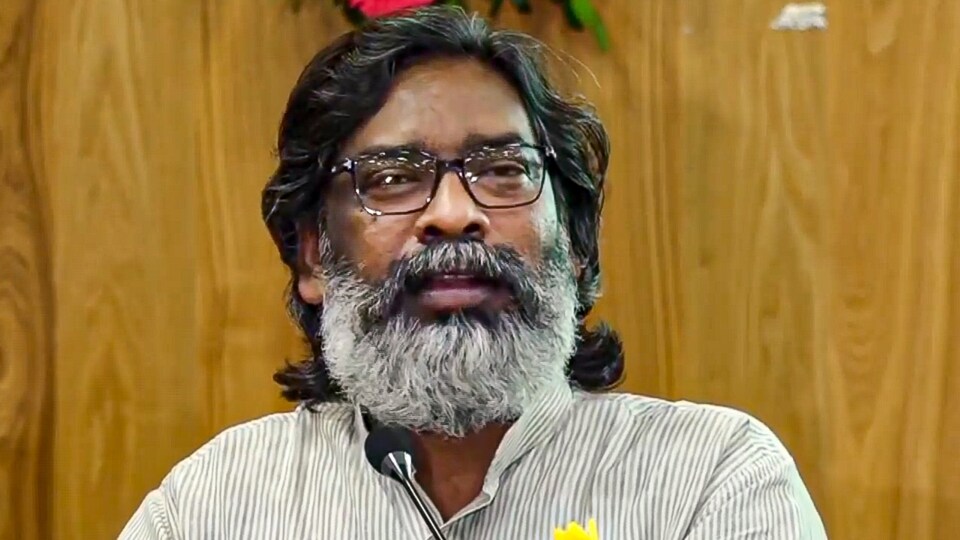
Hemant Soren has taken over the leadership of the Jharkhand Mukti Morcha (JMM) from Shibu Soren, Hemant’s father and the JMM’s founder. The change in leadership comes at a time when both Hemant and the JMM are at the peak of their political success. The political strength notwithstanding, Soren’s governance challenges are significant. Here are three charts which summarize this.
New JMM chief Hemant Soren's achievements, challenges
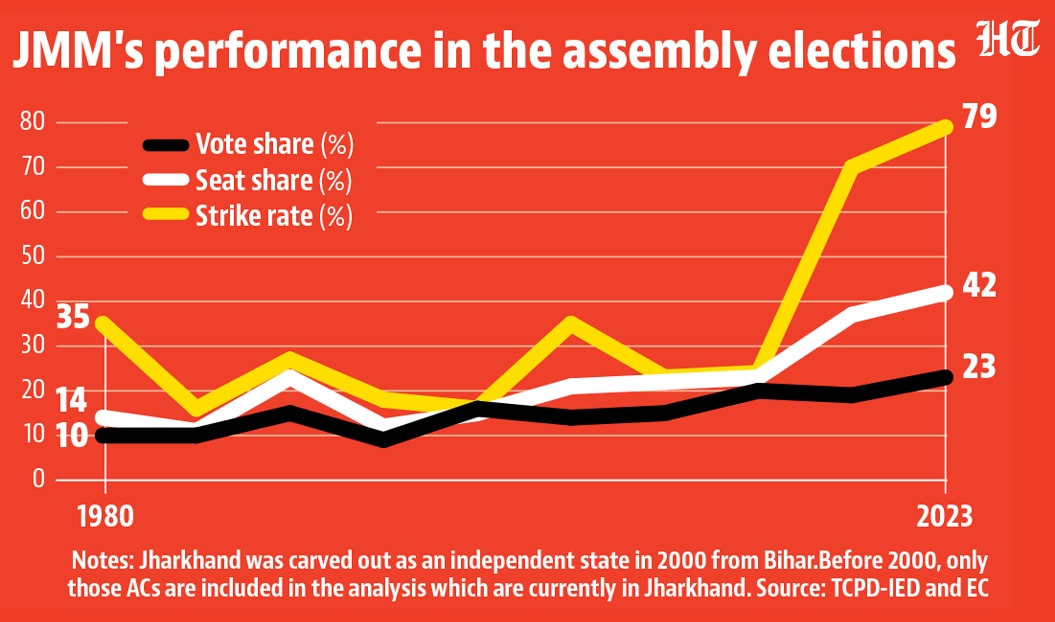
 The 2024 elections saw the best ever performance by the JMMJMM currently has 34 MLAs in an assembly of 81 in Jharkhand. With its allies, the JMM led alliance has 56 MLAs, giving it a two-third majority. JMM’s 2024 performance is the best ever for the party which contested its first election in 1980. What is even more important from the JMM’s perspective is the fact that it has increased its seat share in every assembly election in the state since 2000. Its seat share crossed the one-third and 40% threshold for the first time in 2019 and 2024, when Hemant Soren, not his father was leading the JMM on a de facto basis. The fact that JMM’s strike rate reached 80% in the 2024 elections shows that the JMM has done well in striking alliances to boost its own performance, once again a vindication of Hemant Soren’s political prowess.
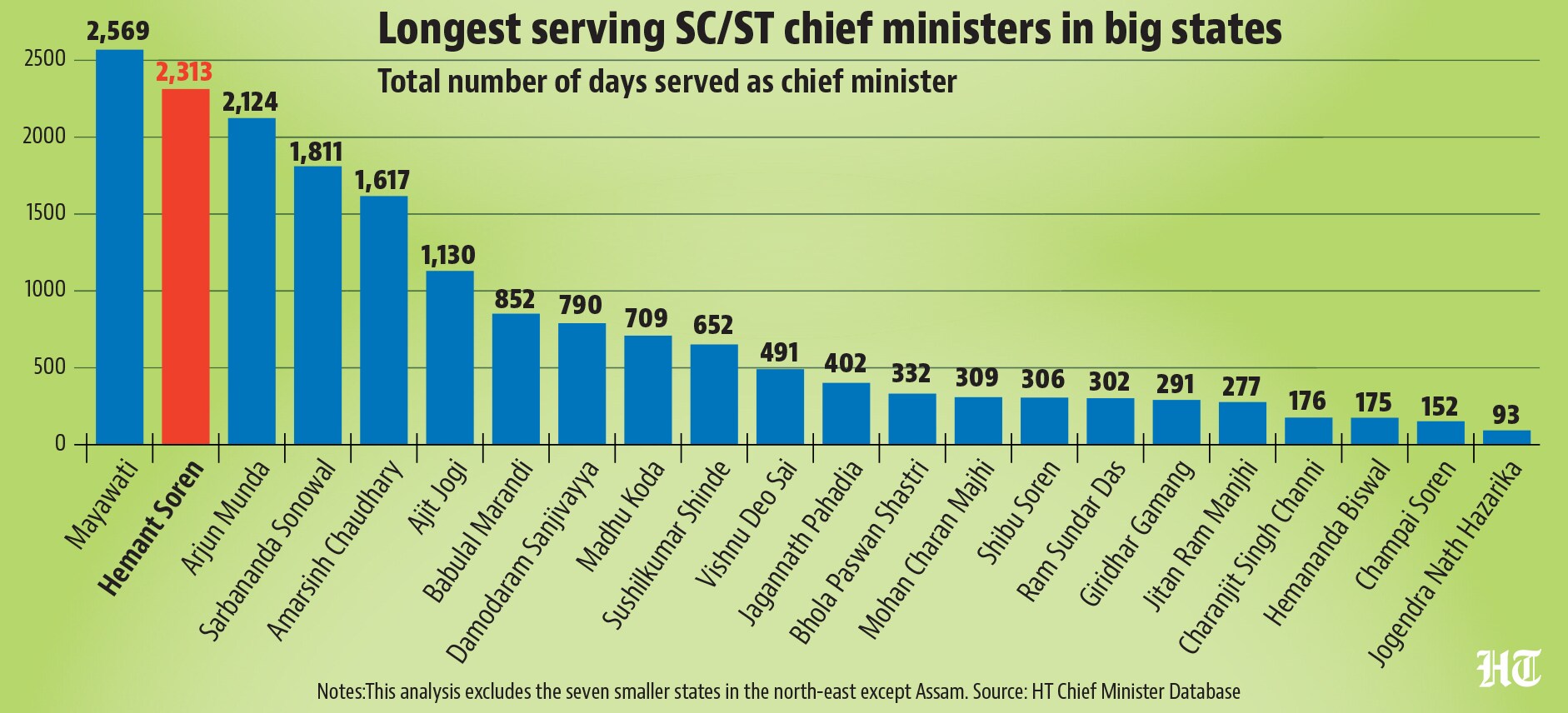
- Hemant Soren is now the second longest serving SC/ST chief minister outside north-eastern states in IndiaWhile Hemant Soren has not had a full five-year term as a chief minister – he resigned after being jailed in his last term and did not hold office for 152 days – he has spent 2,313 days as the chief minister in his four terms beginning July 2013. This makes him the second longest serving Scheduled Caste (SC) or Scheduled Tribe (ST) chief minister in the country among the 35 SC/ST chief ministers in HT’s chief minister database. This list of 35 excludes the chief ministers from the seven north-eastern states, where STs have an overwhelming share in population. The only person ahead of Soren among the 35 SC/ST chief ministers right now is Mayawati. If Soren were to complete his term till 2029, he would be the longest serving SC/ST chief minister in this list. This statistic underlines Soren’s stature among not just his contemporaries but also previous SC/ST politicians in India .
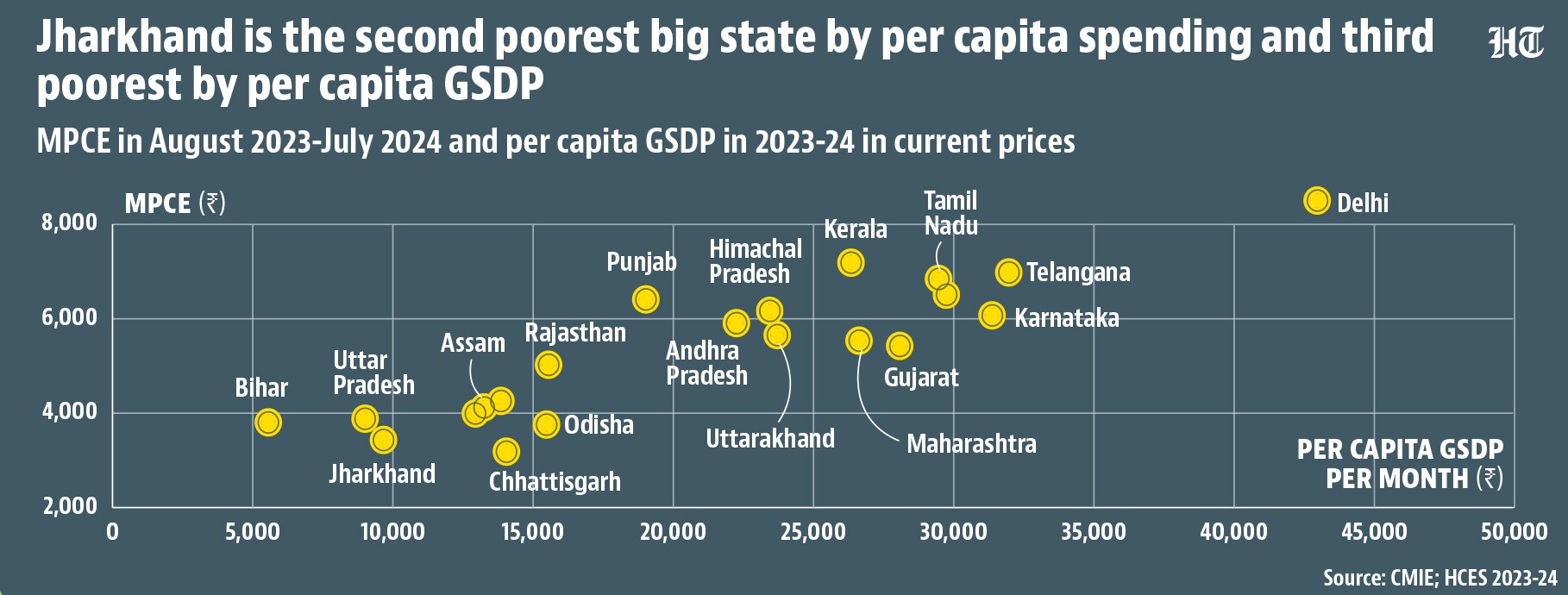
- Political strength alone, however, will not take care of Soren’s and JMM’s governance challengesJMM originally came into being as a party of STs which was leading a movement for creation of a separate state for STs in what was then southern Bihar. To be sure, the roots of the Jharkhand movement are much older and the original Jharkhand included areas from parts of what are today West Bengal and Odisha. While JMM was always a political force to reckon with in the politics of what is Jharkhand today, it aced its ST consolidation politics after the BJP appointed a non-ST chief minister in the state after getting a majority in the 2014 elections. JMM’s 2024 victory seems to be a result of the ST consolidation along with a consolidation of the non-ST poor driven by a cash transfer scheme for women which the JMM announced in its previous term. While such schemes and identity assertion have won the JMM political popularity, the fact remains that Jharkhand is one of the poorest states in the country today. Unless Jharkhand’s economy gets into a high-growth trajectory – and there are important fault lines to be negotiated here especially around ST land rights and environmental concerns – the well-being of a large part of the population in the state will continue to be extremely precarious. Hemant Soren might be at the peak of his political career, but his political legacy will be shaped by whether or not he can do justice to the state’s economic aspirations without being seen as reneging on property rights and environmental concerns of the state. This is a far more difficult challenge than winning elections.



Unlock a world of Benefits with HT! From insightful newsletters to real-time news alerts and a personalized news feed – it's all here, just a click away! -Login Now!


