
 E-Paper



Cat got your heart?: Sanjoy Narayan writes on a unique artist

 Prefer HTon Google


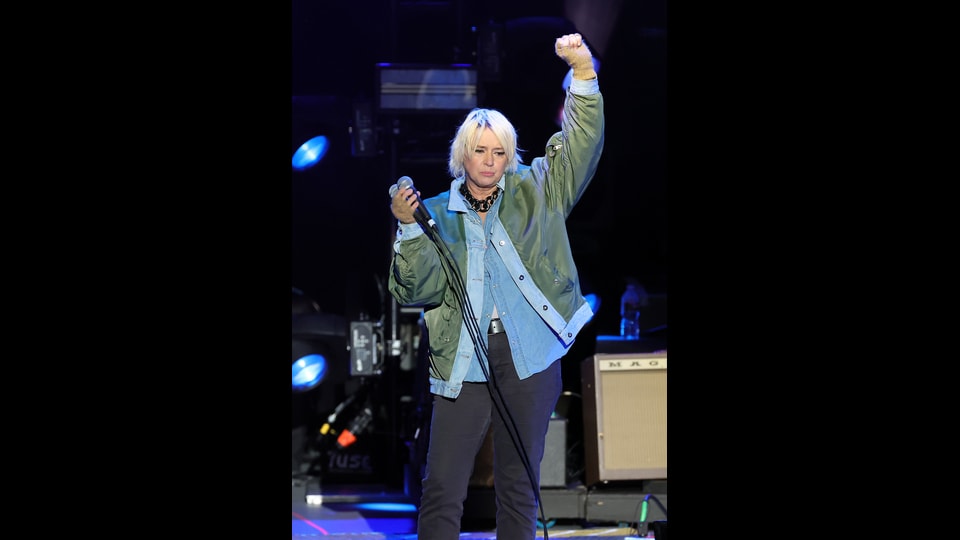
Cat Power is on tour celebrating 20 years of her album, The Greatest. She doesn’t exude charisma or do crowd work. Her voice, in live experiments, is the draw.
A waiter in Bengaluru shook his head from side to side when Cat Power asked if there was milk for her tea. She told us this from a stage in Helsinki; mused on whether “no” is expressed the same way elsewhere; and decided, probably not.
She was in Bengaluru? That was the bit that surprised me. After the gig, I looked it up, and learnt that she had visited in 2007, not to perform but to work with the non-profit Charity: Water.
But I’m getting ahead of myself. On a recent Wednesday, Charlyn “Chan” Marshall aka Cat Power, the indie rock icon known for her minimalist yet deeply emotional music and haunting husky vocals, sang all 12 songs from her 2006 album The Greatest, live and in sequence. Exactly as they are on that breakthrough record. No, wait. She switched it up, replacing Hate with Unhate, a cover of her Greatest song that appears on Covers (2022), a bluesy, majestic album that strips down songs by artists from Frank Ocean to Billie Holiday and rebuilds them with signature Cat Power intimacy. (How cool is it to do a cover of your own song?)
Marshall, 54, is currently on the Greatest 20th anniversary tour. In Helsinki, backed by a four-piece band, she had the crowd in thrall from the first track. Listening to the album always gives me chills. Hearing it live was electrifying.
Marshall’s live shows are unforgettable, not because she exudes charisma or works the crowd. She doesn’t. What gets you is how she performs her songs, using live vocal treatments as an artistic tool. In Helsinki, her voice kept shifting in texture, sometimes within a song, because she works with two set-ups. The dry mic is kept clean and catches her raw, natural tone. The wet mic is drenched in slapback delay, echo and deep reverb.
She pivoted between them, or sang into both at once, giving the songs a lush, psychedelic vibe and a dreamy haze. On the Moon, a haunting ballad that sets the distant silver satellite against the fragility of human life, she added a dash of auto-tune. A 2006 song suddenly sounded spacey and electronic.
That worked for me. It worked for the crowd too, a surprisingly diverse group of balding hippies, preppy types, oversized-hoodie wearers and primped young things in LBDs and boots. Someone shouted, “We love you, Chan!” “And I love you too,” she said, huskily. Her banter is minimal, but it was enough to disarm the room.
That melancholy minimalism has deep roots. Marshall was born in Atlanta in 1972, into an unsettled, nomadic childhood. Her parents’ lives were chaotic; her grandmother did much of the child-raising. She moved from one school to another across the American South.
Music was her refuge. As a child, she found her stepfather’s record collection, with Bob Dylan in it, and was hooked. She picked up the guitar as a teenager and played by instinct. She never had formal lessons.
But solitude can extract a price. Depression and crippling stage-fright dogged her through the 1990s and Aughts, and she turned to alcohol as she struggled to cope. Those early gigs became notorious: songs abandoned halfway, tears on stage, tempers with the crew.
In 2006, just as The Greatest was earning her a name, she had a breakdown and spent time in a Miami hospital. That was the turning point. She got sober and, over time, found her way back into the light. It’s hard to listen to The Greatest now without wondering how someone in such pain produced an album this warm and sunlit.
CUE APPLAUSE
Marshall’s career began in the early 1990s in Atlanta and then New York, where she fell in with the downtown indie scene. Sonic Youth’s Steve Shelley became an early champion.
Her stage name, she has said, came from a trucker’s Cat Diesel Power cap.
Her early albums were spare and haunted, none more so than Moon Pix (1998), recorded in Australia and inspired by a nightmare. Then came The Greatest. She went to Memphis and recorded with veteran session players, including guitarist Teenie Hodges, who had played with Al Green. Horns, organ and a lazy swing replaced the bare guitar and piano. It won the Shortlist Music Prize and propelled her into a new league.
Her sound has kept changing since. Sun (2012) was self-produced, and leaned into electronica. Wanderer (2018) returned to a spare, vocal-forward style and had Lana Del Rey sing on the track Woman. Through it all, Marshall has had a gift for covers, which for her are interpretations, not tributes. The Covers Record (2000) and Jukebox (2008) set the pattern, and Covers (2022) extended it.
The most astonishing of them all has been her recreation of Dylan’s entire 1966 “Royal Albert Hall” concert, performed in Manchester (though the wrong label stuck for decades). She took on both halves, the acoustic set and the electric one, and made them her own, in Cat Power Sings Dylan (2023). Her stepfather’s record collection had come full circle.
This year, she also released Redux, a three-song EP. It features a newly finished Try Me, a James Brown cover; her interpretation of Prince’s Nothing Compares 2 U; and a reworked version of Could We, which was on The Greatest.
Back in Helsinki, after the last song was done, the band came back for the encore: I Don’t Blame You, Good Woman and Manhattan (all by Marshall); It Wasn’t God Who Made Honky Tonk Angels (Kitty Wells); Nothing Compares 2 U (Prince); Try Me (James Brown); and I’ll Be Seeing You (Sammy Fain and Irving Kahal). Then the band left the darkened stage, and Cat, alone, entreated us several times to “be gentle and kind to yourselves”.
The ovation that followed went on long after the lights came up. Whatever the shake of a head may mean in Bengaluru, a standing ovation needs no translation.
(To reach out, email sanjoy.narayan@gmail.com. The views expressed are personal)


