E-Paper



Number Theory: Can BJP do a hat-trick of wins in all 7 Lok Sabha seats in Delhi?
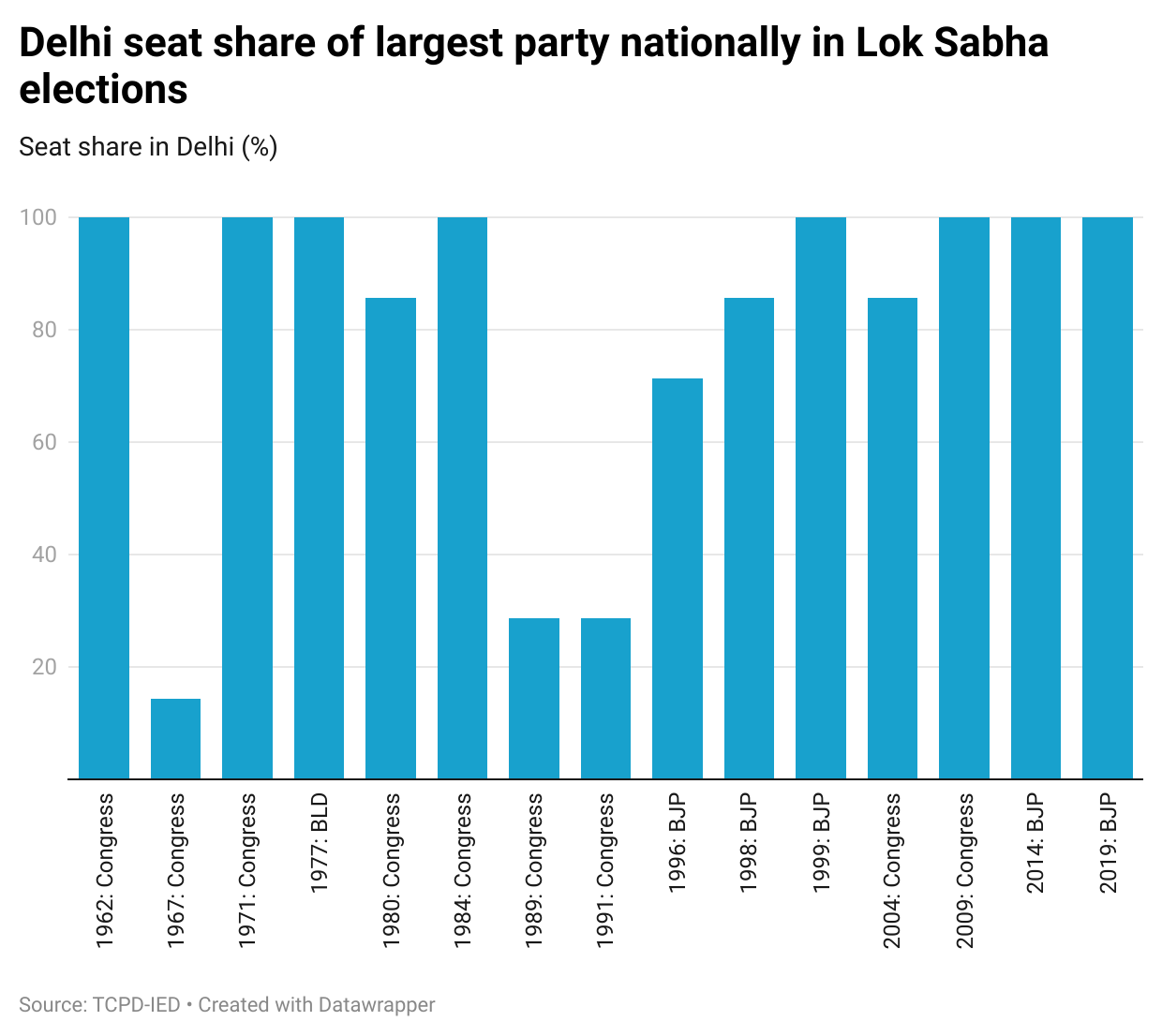
Except in 1967, 1989 and 1991, the party that won a majority of parliamentary constituencies in Delhi always finished first in the Lok Sabha nationally.
Updated on: May 30, 2024, 14:22:15 IST

 Prefer HTon Google
Share via


Copy link

Can the Bharatiya Janata Party (BJP) win all seven parliamentary constituencies (PCs) in Delhi for the third time in a row? Will an alliance of the Congress and the Aam Admi Party (AAP) be able to reclaim at least some of the seats in the Capital from the BJP?
The arithmetic of the 2024 contest was discussed in detail in these pages yesterday. However, Delhi’s electoral history shows that the city-state has often seen one-sided contests in the past and its verdict has almost always been in sync with the larger national mood in elections. Electoral patterns from Delhi’s distant and recent past suggest that the result in 2024 could also be a one-sided affair, whichever way it goes. Here are four charts that explain this in detail.
Can BJP do a hat-trick of wins in all 7 Lok Sabha seats in Delhi?
 Delhi has always been the bellwether of Indian electionsThe Trivedi Center for Political Data (TCPD) has historical results for Delhi from 1962 onwards. Except in 1967, 1989 and 1991, the party that won a majority of PCs in Delhi always finished first in the Lok Sabha nationally. Even the three elections where Delhi did not keep to the trend in the literal sense, it adhered to it in the larger sense. 1967 were the first national elections when the Congress suffered serious losses across states, and it is taken as the end of the phase of Congress’s unquestioned dominance in Indian politics. It gave way for what is referred to the Second Party System by political scientists when the Congress retained power at the Centre but became vulnerable in states. In 1989, the BJP emerged as the new national-level Opposition party, winning 85 PCs in all. It also won four out of the seven PCs in Delhi. In 1991, Delhi voted in the first phase of elections which were held on May 20. The subsequent elections were postponed because of Rajiv Gandhi’s assassination on May 21. The Congress finished as the single largest party riding a sympathy wave but did badly in the first phase of the elections. The BJP won five out of the seven PCs in Delhi in 1991. From 1996 onwards, Delhi has consistently and overwhelmingly voted for the party that finished first at the all-India level.
- Since 1998, Delhi has never given less than six PCs to the winning partyThis shows that elections have always been a one-sided affair in the Capital the last two-and-a-half decades. The BJP won six out of the seven PCs in Delhi in 1998 and all seven PCs in the 1999, 2014, and 2019 elections. The Congress won all seven PCs in 2009 and six out of the seven PCs in the 2004 elections. In fact, in all Lok Sabha elections since 1962, the seat share of the winning party in Delhi has always been higher than 70% except in the 1989 elections when the BJP, Congress and Janata Dal won four, two and one PC.
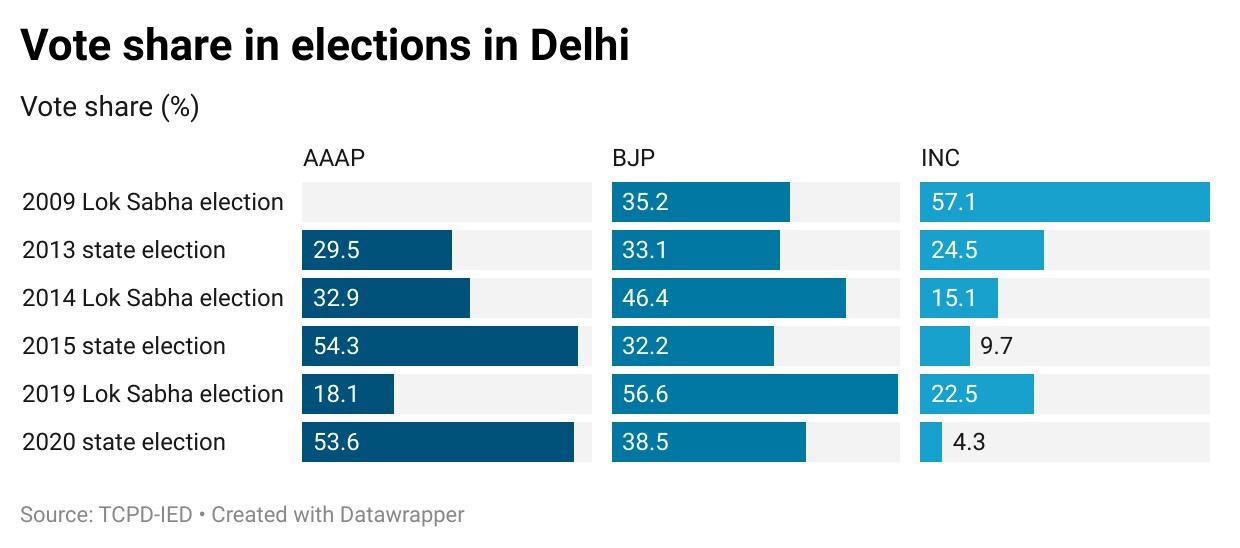
- Floating voters have played a big role in Delhi’s drastic outcomesBetween the 1991 and 2009 Lok Sabha elections, when the political contest in Delhi was largely bipolar between the Congress and the BJP, both the national parties saw a stable vote share with respective numbers never falling below the 35% mark. The fact that both the BJP and Congress managed to cross the 50% vote share mark in different elections during this period suggests that a chunk of floating voters would move between the two parties. Things changed when the AAP made its entry in the 2014 electoral contest. A comparison of Lok Sabha and assembly election results from 2014 onwards suggests that floating voters have been supporting the BJP in national elections and the AAP in the assembly elections.
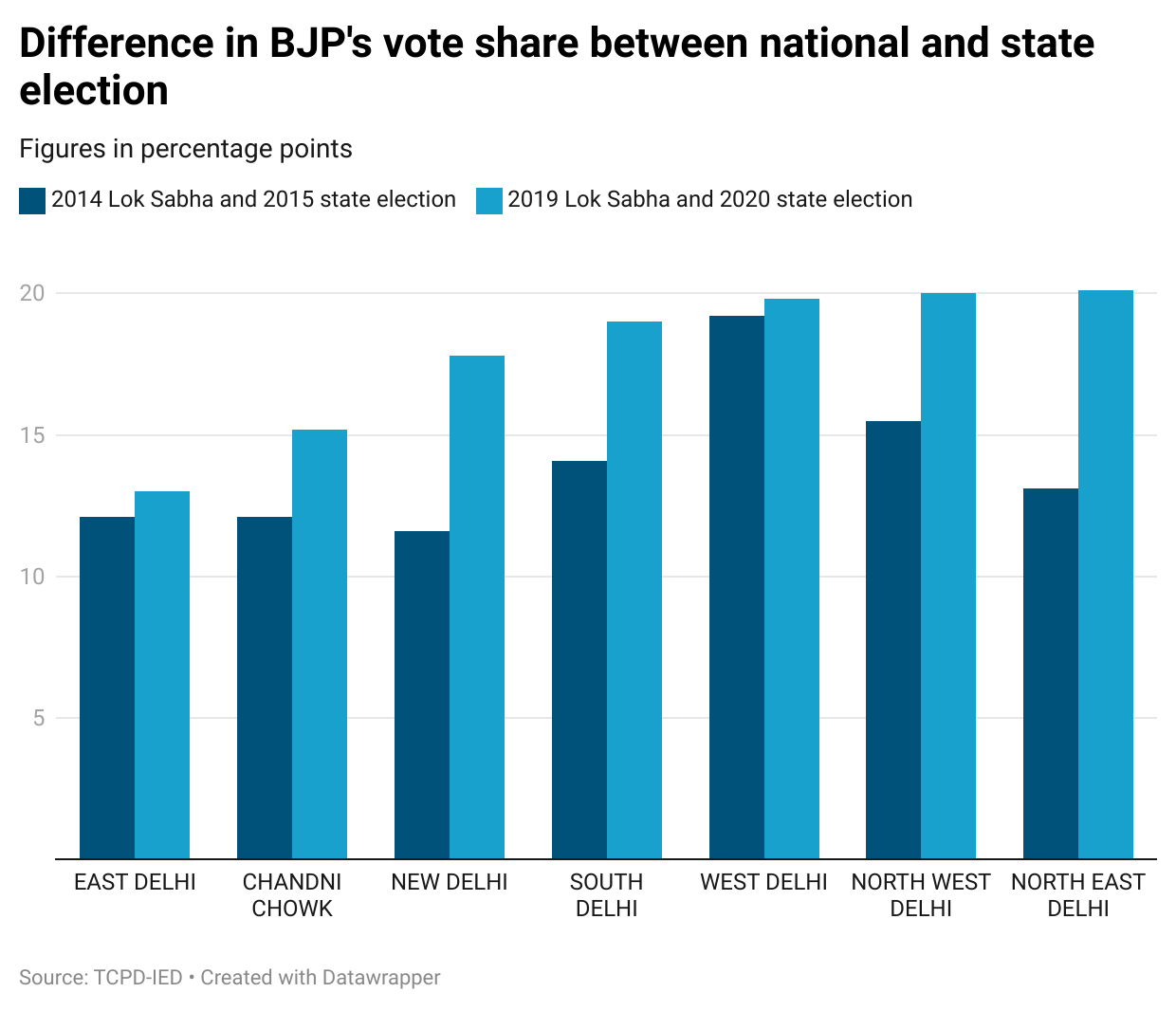
- BJP’s national premium after AAP’s entry is pretty consistent across constituenciesThe past two cycles of national and state elections in Delhi make it clear that the BJP has a definite national elections advantage in the city. Is this advantage muted in any PC? Not really. While there is a difference across PCs, BJP had at least a 13 percentage point advantage in 2019 in each PC compared to the 2020 state election that followed. Even in the 2014-2015 cycle, this national election advantage was at least 11.6 percentage points in each PC.