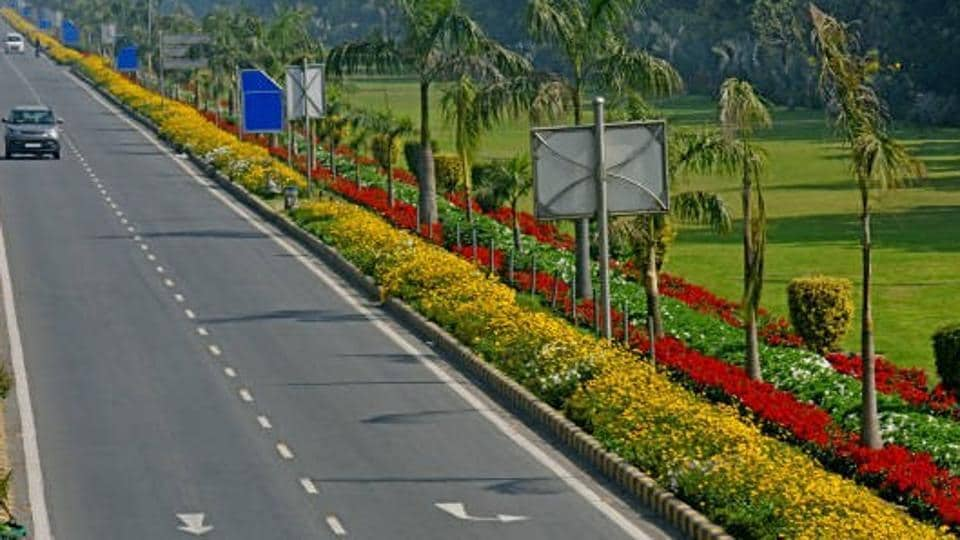
As many as 4.67 lakh tulips will bloom in the parks maintained by the New Delhi Municipal Council (NDMC) and the Delhi Development Authority (DDA) as the ones under the Municipal Corporation of Delhi (MCD) will remain without the seasonal flowers for the second consecutive year.
The bulbs are generally planted in December, with the flowers beginning to bloom towards the end of January. (File photo)
The NDMC has placed orders to import 467,000 tulip bulbs from the Netherlands for the upcoming winter season. Of these, 300,000 bulbs will be used in NDMC-maintained parks, prominent roads and other public spaces, while 167,000 bulbs have been ordered for DDA parks and other key locations across the city, senior NDMC officials said.
The bulbs are generally planted in December, with the flowers beginning to bloom towards the end of January. The flowering season typically continues until late February to early March, adding vibrant colours to the capital’s parks, roundabouts and prominent roads.
According to MCD officials, maintaining tulips in public parks has proved challenging, particularly owing to damage caused by miscreants.
In 2024, the civic body planted around 25,000 tulip bulbs in its parks. However, several flowers were reportedly damaged or plucked before visitors could see them.
Following this, the MCD decided against procuring tulip bulbs last year and has maintained the same approach this season.
NDMC prepares for the season
Meanwhile, the NDMC is preparing to plant tulips across its designated locations. The process of preparing flowerbeds in parks and other public spaces is expected to begin soon.
NDMC began importing tulip bulbs in 2017 at a cost ₹25 per unit. The civic body also attempts to reuse some of the bulbs from the previous season.
An official explained that once the tulips are harvested after blooming in February-March, their bulbs are harvested and stored in a climate controlled storage chamber at temperature varying from 15-20 degree Celsius for three months till July.
“They are later kept under a low temperature of 5-6 degree Celsius for 10 weeks till the first week of October. Around the first week of October these bulbs are put in the production chain by sowing them in a growth chamber at temperature 17-20 degree Celsius with the aim to increase the size of bulbs to at least 10cm,” official explained.
The NDMC began tulip plantation in 2017, when it began with a pilot project of 17,000 bulbs. It purchased 62,800 bulbs in 2021, 1.4 lakh in 2022, 2 lakh in 2023, and 3.25 lakh in 2024.
Paras Singh is a New Delhi-based journalist with Hindustan Times, where he serves as Deputy Metro Editor. He reports on urban governance, the Delhi government, the Delhi BJP, water management, the environment, communities and city life. He joined Hindustan Times in 2021 after beginning his journalism career at The Times of India in 2016, where he covered civic bodies, the water and power sectors, and urban infrastructure. Over the last decade, some of his reporting has led to significant public impact, with investigations into environmental violations, corruption and illegal industrial activity contributing to multiple judicial interventions by the National Green Tribunal and the Delhi High Court. A graduate of St. Stephen's College, University of Delhi, Paras studied journalism from the Indian Institute of Mass Communication (IIMC), New Delhi. Having extensively covered the capital's evolving civic and governance landscape, his recent work increasingly explores Delhi's history, built heritage, urban evolution and the relationship between people and place, alongside continuing to report on governance and public policy.Read More
Get Latest News, breaking headlines, and top India News, and today real-time updates from across the nation. Stay informed on politics, government policies, crime, Today Weather, and major developments on Hindustan Times
Home/India News/4.67 Lakh Tulips To Bloom In NDMC, DDA Parks; MCD Gardens To Miss Out Again

 E-Paper