
 E-Paper



3 govt laboratories position Bathinda as food-testing hub
Bathinda is emerging as a food-testing hub with three laboratories at government-run institutions catering to the testing requirements of food businesses, agricultural firms and self-help groups (SHGs), ranging from food adulteration checks to contamination testing.

 Prefer HTon Google


Bathinda is emerging as a food-testing hub with three laboratories at government-run institutions catering to the testing requirements of food businesses, agricultural firms and self-help groups (SHGs), ranging from food adulteration checks to contamination testing.
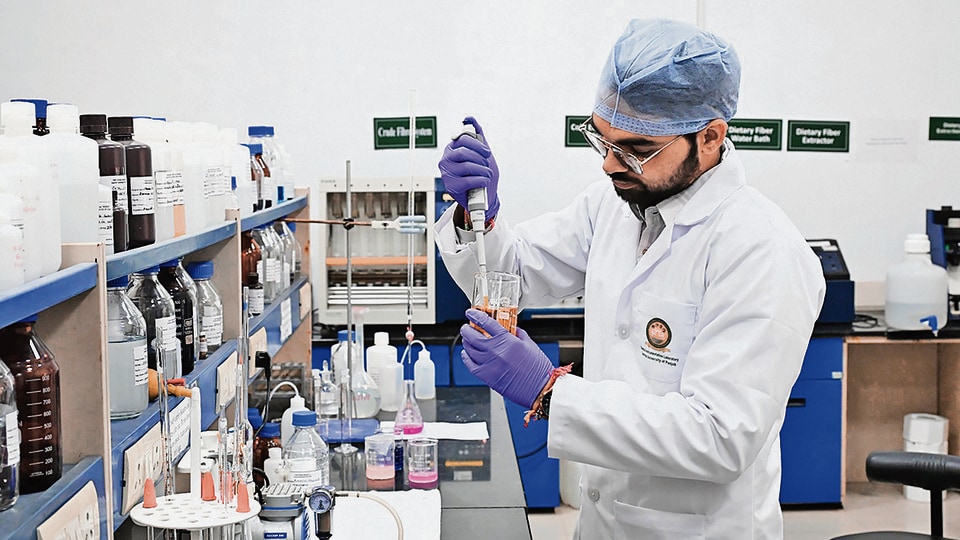
The laboratories, located at the Central University of Punjab (CUP), Maharaja Ranjit Singh Punjab Technical University (MRSPTU) and Punjab Agricultural University’s (PAU) regional research station, have different capabilities and levels of accreditation.
The CUP laboratory received accreditation from the National Accreditation Board for Testing and Calibration Laboratories (NABL) in May this year. Since then, it has analysed more than 400 samples from industries and in-house university researchers, acting vice chancellor Ramakrishna Wusirika said.
He said the facility was equipped to analyse food, agricultural products, residues, and contaminants in food and agricultural products.
The university has also invested ₹5 crore in an isotope-based facility to assess the authenticity and purity of raw honey using methods prescribed by the Food Safety and Standards Authority of India (FSSAI), Wusirika said.
“Additionally, the varsity plans to expand the laboratory’s testing capabilities to include pesticide residues, microbiological analysis and water quality assessment. Also, the laboratory is exploring the expansion of trace-metal analysis in honey, cereals, and other food and agricultural products, he added.
At MRSPTU, a laboratory inaugurated in March last year examines around 70 samples a month, including water, flour, starch, honey and milk products. “Nature of testing includes proximate analysis, structural properties, bioactive composition, food adulteration and quantification of various elements, including heavy metals, that can pose serious health concerns,” a university spokesperson said.
Samples come from academic institutions, including MRSPTU, PAU, Guru Nanak Dev University and Sant Longowal Institute of Engineering and Technology, cooperative societies, individuals and food businesses.
PAU’s regional research station established its food-testing laboratory in 2019 as part of an initiative to boost food processing facilities. “Its services were disrupted due to certain administrative issues but have since resumed,” said Karamjit Singh, head of the station.
Laboratory in-charge Himanshu Sharma said women running SHGs that manufactured bakery products and pickles were using the facility to assess product quality.
He said although the laboratory did not have NABL accreditation, it offered testing services at competitive prices to help small-scale entrepreneurs and SHGs improve their marketing prospects. The university was also promoting its food and dairy testing facilities through farmer workshops, Sharma said.


