
 E-Paper



How to make graduates job- ready urgently
Lack of job-readiness remains a major concern for a large number of graduates and organizations underscore that they have to invest considerable time and money in equipping the fresh hires with the requisite training to be able to join the workforce effectively. Most engineering students in India have mainframe knowledge but lack job specific skills.


According to different estimates, India produces around 15 lakh engineers every year and 3 lakh management graduates. However, a more important question here is whether all of them are employable? Do degree holders also bring with them the skills needed on the job? The answer unfortunately is in the negative!
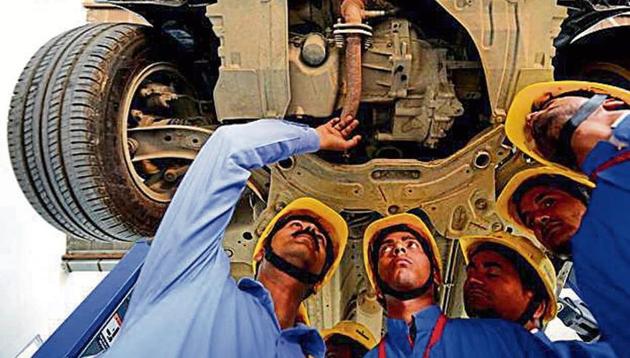
India’s industry leaders and corporate houses have long been complaining of the gap between market demand and student academic knowledge. Lack of job-readiness remains a major concern for a large number of graduates and organizations underscore that they have to invest considerable time and money in equipping the fresh hires with the requisite training to be able to join the workforce effectively. Most engineering students in India have mainframe knowledge but lack job specific skills. This statement was confirmed when a machine learning based assessment of software development skills was conducted for over 36,000 engineering students. The recently concluded aspiring minds study found out that there is a massive skill gap when it comes to job specific requirements with employability for electronic engineers 7.07 %, designer engineer’s 5.55 percent, civil engineers’ 6.48 percent and for chemical design engineer’s 1.64 percent.
Theoretical knowledge of the domain, through absolutely critical, is not sufficient to make engineering graduates job ready. This is why apart from domain-based education, educational institutions must also modify their curriculum patterns to serve the objectives of giving practical knowledge, skill training and personality development
Personality Development and Communication Skills
No matter how good an engineer you are, you also need to be a congenial personality to be able to work in a team. Interpersonal skills and the art of communicating effectively are very important skills particularly for people whose work requires people handling. Personality development and communication skills programs will assist people in realizing their true potential as well as instill in them some significant interpersonal skills. Colleges must focus on inculcating traits like positive attitude, right body language, power dressing, importance of commitment and choosing the correct words while communicating – both written and verbal.
Industry Programs
Prior industrial experience and exposure to practical training are the most critical elements that make an individual job-ready. This is why it is very important to ensure that students undergo several internship programs during the course of their education. Internship programs give them the much-needed opportunity to apply their knowledge practically, and ensure the students hit the ground running when they actually enter the workforce. This hands-on experience of working in a real time environment has no theoretical substitute. E-commerce firm Amazon India said that it converts 60% of their summer interns into full time employees through pre-placement offers as when the candidate works for them for a while, they know exactly what to expect from him/her.
Closer Industry-Academia Ties
For educational institutions to be able to train students in what is exactly needed on the job, they must have a close understanding of the same. This is why it is extremely important for educational institutions to develop closer ties with the industry. This must be done through regular visits and mentorship programs with industry leaders. At the same time, industry members must also be taken on board while deciding the curriculum of courses and modifications needed in it.
Flexible Curriculum
Future engineers need to be more than just technically competent as they must be able to refresh their skills continually to remain relevant in an ever-changing world. Introduction of provisions for additional courses, electives and micro specialization will help students gain the upper hand in job interviews as well pursue other topics of interest study of which can come in handy if the need to utilize the specific knowledge arises. Micro-Specialization courses currently allow study of embedded wireless systems, engineering systems reliability, biomedical devices and instrumentation, rubber engineering, bio-energy, rubber engineering, entrepreneurship and education, drug discovery, photonics, industrial safety engineering, optimization theory and applications as well as intellectual property rights.
(The author is Registrar, IIIT Naya Raipur)


