E-Paper



MP: Uncertainty looms over future of students tangled in Vyapam
Uncertainty looms large for students even as the culprits of the MP Vyapam scam rejoin society after serving their jail terms.


Uncertainty looms large for students even as the culprits of the MP Vyapam scam rejoin society after serving their jail terms.
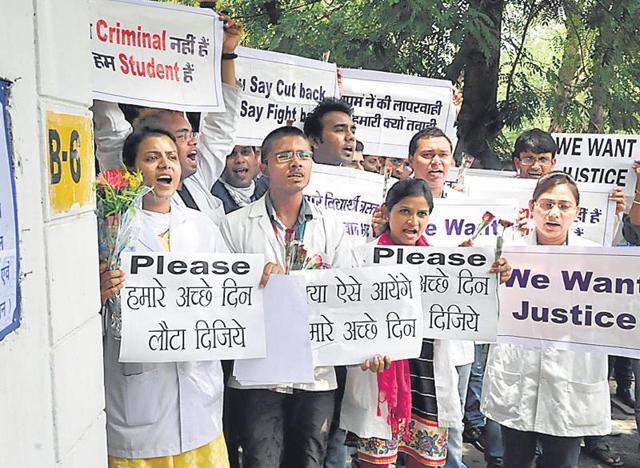
Before the Central Bureau of Investigation (CBI) had even concluded its investigation, several students were evicted on suspicion of being beneficiaries of the multi-layered scam.
“An accused in the Vyapam scam and jailed till three-and-a-half-months back, Laxmikant Sharma may resume his political career and another accused may be at the helm of his mining business,” said an MBBS student of Gajra Raja Medical College (GRMC), Gwalior. “But our future is bleak. We have been punished even before the court pronounces its judgement.”
Being thrown out of college has hit students with education loans particularly hard.
“I can’t pay fees of `35,000 annually but the investigative agency says I had paid lakhs of rupees to an impersonator to get through PMT,” said 2009 batch medical student. “I have been expelled. Now, the bank is seeking repayment of the loan.
‘I AM SHATTERED’
Affected students claim to be innocent victims of the slow-progressing probe. The scam broke in July 2013, but the investigation continues almost three years later.
The ramifications of the scam go beyond the education of those accused.
A girl suspected to have benefited from the scam was set to be married when the scam broke. Her to-be husband called off the marriage until she is cleared by the investigating agency.
“The future of my daughter is at stake but even after two-and-a half years, we are waiting for the completion of investigation, not to say of the court’s verdict, which may take several years,” said the girl’s mother.
‘PUNISH US OR ALLOW US TO STUDY’
After being suspended from college, several students moved the Jabalpur high court and were allowed to resume studies. However, the colleges sought and the students signed affidavits that they would not act against the college administration’s decision, whatever that may be.
“We didn’t know the college administration was playing a trick,” said a student of GMRC who was expelled on March 4. “After about a month or so, we were expelled from the college saying that the special investigation team, Gwalior, looking into the scam found some concrete evidence against us.”
The signed affidavit is now a security blanket for the college, preventing the students from filing a contempt petition in court.
“We believe in justice but when will it be delivered?” said another student. “If we are found guilty, punish us. But if we are not a guilty, who will be responsible for this irreparable loss caused to our career.”
The students are demanding that they be allowed to complete their education, but their degrees be held until a final verdict.
More than 100 medical students and junior doctors have even sought permission from the government to kill themselves because they were denied justice due to the slow pace of the probe.
TRAUMA STILL FRESH
The trauma of persecution still haunts the lucky few who were suspended but later cleared by the special investigation team.
“In the probe of the college-level committee, my photo was found mismatched with that on the admit card and registration form,” said a third-year medical student at GMRC.
“When the SIT called me for interrogation, I had collected all my photographs from the past 10 years. I got a clean chit from SIT, but I still keep photographs with me as I can’t trust the college administration.”
Students said being cleared of the charge has not stopped the harassment.
“I am going to sit on hunger strike from Monday as harassment by the college is not coming to end,” said Raghvendra Singh, an MBBS student. “Now, the college has withheld my result. When I got clearance once, why are they questioning the validity of my admission?”
A large number of students were expelled if their names appeared in a list released by the Madhya Pradesh Professional Examination Board, or Vyapam. Many others were removed on the findings of a high-level committee set up by the medical colleges.
The college-level committees were formed in 2009, four years before the Vyapam scam broke. They found some students guilty on the basis of their photographs not matching with those on their admit cards or registration forms. But after the Vyapam scam, the Directorate of Medical Education decided to carry out a separate probe of the admission process during the 2008-12 academic years.
CASE STUDIES
26-year-old former MBBS student of Gwalior: He can’t forget the day he was asked to leave college in his pre-final year. When he returned to his village in Bhind, villagers who used to respect him now avoided him. Facing criminal charges, he spends most of his time with lawyers and police. “I’m facing social stigma and suffering from mental trauma. In fact, my career is ruined. , I want to work as a labourer as I have to repay my loan. The bank is after my life,” he said.
A third-year medical student: He was cleared of all charges and started studying again at Gajra Raja Medical College in Gwalior. Yet, he cannot get rid of the pain he suffered. He was one of 10 students suspended by a committee set up by the college. “At least our future is secured. We may not regain the trust of fellow students and teachers in the college, but we can start a new life after we get the degree,” he said.
THE SCAM
The Vyapam scam is an admission and recruitment scam involving politicians, senior officials and businessmen in Madhya Pradesh
The scam involved 13 different exams conducted by Vyapam for selection of medical students and state government employees. The exams were taken by around 3.2 million students.