
 E-Paper



New rules promise safe ride for UP school kids
E-rickshaws, autos, tempos won’t be allowed to ferry school children; female attendant mandatory on school bus


New rules for transporting school children will come into force in Uttar Pradesh on September 1, over two decades after the apex court framed guidelines to ensure the safety of children in school vehicles. While the rules promise a safe ride for school children, it remains to be seen how well they will be enforced by the authorities concerned.
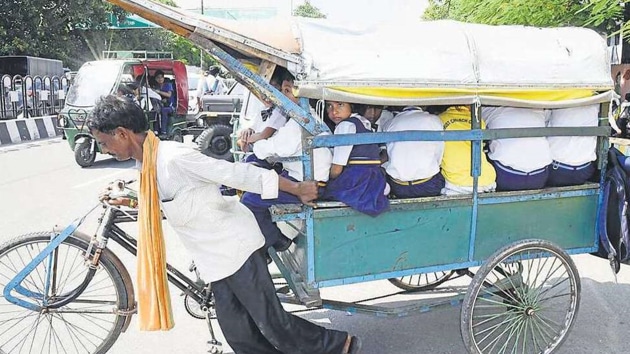
Open vehicles, including e-rickshaws, auto rickshaws and tempos, will not be allowed to ferry school children, as per the new rules that the state government notified on May 31. The government had given three months to the schools and transporters to fall in line. The three-month deadline ends now.
While transporters have expressed resentment over the step and said they feared a loss of business, the government has formed a committee and asked all the protesting parties to submit their suggestions.
In a major step to ensure girl child safety, a female attendant is mandatory in school van or bus in case a girl student is travelling, according to the new rules.
A state government official said, “These rules are made to ensure the safety of school children. There is nothing more important than that. Still, doable suggestions may be considered.”
As per the new guidelines notified recently, school, as well as district-level committees, will be formed to ensure the safety and security of children and adherence to the guidelines notified by the state.
Additional transport commissioner Arvind Kumar Pandey said the new rules will transform the system. “Vehicle tracking system is yet to be installed in school vehicles as a data centre could not be set up. As for the rest, the government is working to ensure the compliance of these rules. Those, unwilling to mend their ways are being penalised,” he said. Recently, the government revealed there were 3,424 unfit vehicles ferrying children across Uttar Pradesh and it has cancelled the registration of 847.
The rules have been made more stringent after several accidents, especially the one in Kushinagar where at least 13 school children were killed when a van collided with a passenger train at an unmanned crossing in April last year.
From September onwards, no unauthorised vehicle will be allowed to ferry children and those plying in violation of the rules will be impounded, according to the new notified guidelines. So far, there was no legal mechanism to monitor the activities of school vans.
There are three categories of school vehicles under the recently notified rules. These are: buses owned and operated by schools, buses owned by private operators and ferrying children as an agreement between parents and bus operators and vehicles, including vans, autos, and tempos.
A transporter Amit Kumar said, “Our business will be affected. We have been ferrying children for years and no untoward incident took place. We realise our responsibility, but the government should also think about us.”
An auto-rickshaw driver, Imran, said, “If the government is thinking about children’s safety, we are with them. We can be guided to make necessary changes, instead of having our livelihood snatched from us.”
What’s new
There will be a blanket ban on ferrying children in vehicles with an open body, such as tempos. It also prescribes a dress code for drivers—khaki for drivers of buses and gray for drivers of other vehicles. New rules will fix the number of children that a vehicle can carry.
One-and half times of the seating capacity of a vehicle is permitted in case of small children. For example, a vehicle with a seating capacity of eight passengers will be allowed to transport a maximum of 12 small children. The vehicle will have a female attendant in case of girl child traveling in it. Besides all the vehicles engaged in ferrying children should have CCTV and GPS.


