
 E-Paper



Stamp of success? High class 12 marks no guarantee for college berth
High CBSE class 12 scores are a matter of concern if students are unable to get a college berth


Two days after the Central Board of Secondary Education (CBSE) announced the results for the 2016 class 12 school-leaving examinations on May 21, Ankur’s (name changed on request) father was feeling a “bit disappointed”. His mother disagreed. “We were disappointed yesterday. Today we are mostly okay,” she said. Ankur himself was dejected – more because of his parents’ reaction, than his results. “Is 92 per cent that bad?” he wonders aloud.
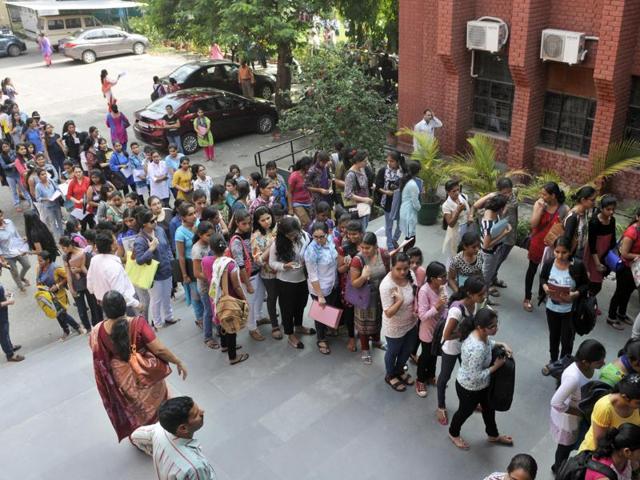
The stratospheric CBSE scores in the last few years, with many students getting marks in the range of 95 to 99 per cent, have set the bar abnormally high. This year’s top score of 99.4 per cent, a mere 0.2 per cent lower than CBSE’s all-time high of 99.6 per cent scored by Delh’s Sarthak Agarwal in 2014, went to Sukriti Gupta, also from the national capital. An approximate 90,000 students scored 90 per cent or above. The number of those who scored 95 per cent or more, was 14,000. In this scenario, scores in the range of 85 to 95 per cent fail to impress anymore. Or, more importantly, fail to get students into a good college with the subject of their choice. It is this fear that has nagged Avantika Sinha (name changed on request) ever since the results were announced. A Commerce student, she has her heart set on studying Economics (Honours) in one of Delhi University’s (DU) better colleges. A dream she is not sure she can realise with her 91 per cent score. “We have applied for re-valuation, but that won’t make a drastic change,” says her worried mother.
What’s wrong with a high score?
“And why shouldn’t students want high scores?” asks educationist Vineet Joshi, who was associated with the CBSE for many years. While there can be no argument against this, one can’t help but wonder: how exactly are so many students doing so well? CBSE did not respond to a mail sent by Hindustan Times, but Joshi explains, “The awareness levels of students, parents and teachers have gone up. With technological advancements, they have better access to information. The Board has been publishing previous years’ question papers and the marking scheme on the website. This too has helped students understand how to score well.” The examination pattern plays a role too. “There has been a drastic shift from descriptive-type questions to objective ones. Examination scores are directly proportional to the number of objective-type questions in the question paper,” says Dr Yagnamurthy Sreekanth, professor (Education) and head, educational survey division, Nation Council of Educational Research and Training (NCERT). “Interestingly even descriptive questions are turned into objective questions by specifying ‘give three reasons’, explain with ‘four examples,’ thus making it easier to score.”
On the flip side
Not everyone is convinced that this is the best evaluation of a student’s learning.
According to teachers at Delhi University, at times, high scorers actually do worse than the others. “In English, for example, they give full marks if a student has used certain key words,” says Sanam Khanna, professor of English at Kamala Nehru College. “Till a few years back we used to have an entrance examination for admission to English (Honours). I would often find that students who scored between 75 to 85 per cent in English in the Boards, performed better in the test than those who scored above 85 per cent,” she says. Khanna’s views are echoed by Sangeet Ragi, a professor of Political Science in Delhi University. Ragi cites the example of a student who had scored 100 in her class 12 political science paper, but fumbled badly in her college admission tests. “She was asked why India is called a republic and she had no answer. Neither did she know why the country is called a parliamentary democracy.”
While such cases can’t be used to argue that every CBSE high-scorer is ignorant, it does reveal the restricted scope of evaluation. “There is a need to understand the difference between knowing a subject and performing well in an exam,” says LV Sehgal, principal, Bal Bharati Public School. Joshi feels it depends on the question paper really. “If a question paper has not been designed well, a high score does not indicate a good knowledge of the subject, but a good knowledge of the answers to the questions being asked.”


