E-Paper



UP polls: Karma dancers’ tale of poverty goes unheard in election din
Karma is a folk-dance form popular in east UP’s Sonbhadra and the dancers say politicians remember them only during the election season, forgetting them afterwards

 Prefer HTon Google


The spellbinding performance of the Karma dancers of eastern UP’s Sonbhadra district wins over many a heart but the tale of the artistes’ poverty and neglect remained largely unheard as the region votes in the last of the seven-phase UP polls on Monday (March 7).
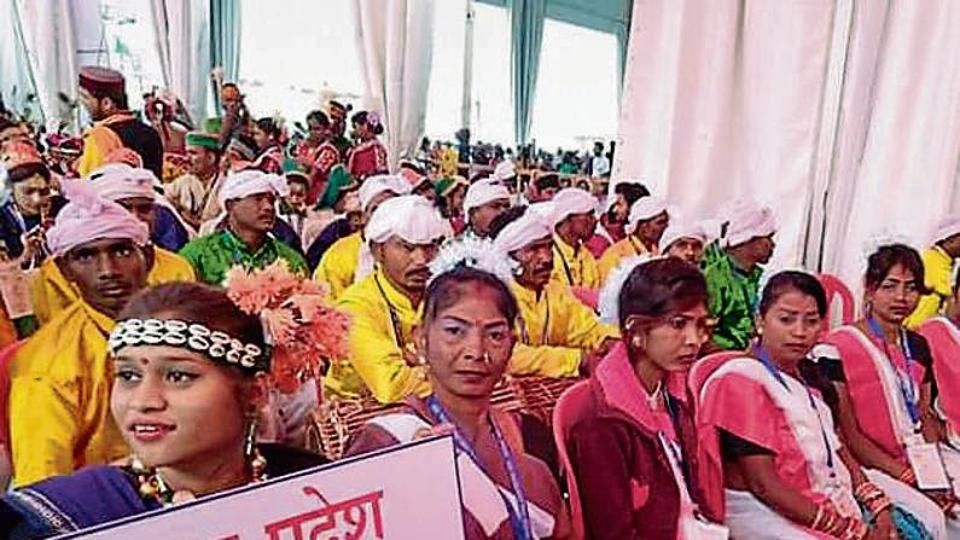
Karma is a folk-dance form and the dancers say politicians remember them only during the election season, forgetting them afterwards.
About 500 Karma dancers live in the pockets of Vabhani, Jorukhand, and other villages near Robertsganj, the district headquarters of Sonbhadra, which shares its boundary with Chhattisgarh, Madhya Pradesh, Jharkhand and Bihar.
The artistes’ earnings are relatively meagre. The artistes say anyone may hire a Karma dance troupe comprising a minimum of 10 artistes for ₹8000 to ₹10,000 a day. Half the amount is spent in travelling. The remaining amount is divided equally among the artistes and each one gets only ₹500.
Devchand Ghasia and Guddi Ghasia, two such Karma artistes, say they learned this dance from their parents, but they will not ask their children to learn it as the life of a Karma dance artist is a struggle.
“We get work occasionally. The meagre remuneration, we get is not sufficient to meet our expenses,” say Devchand and Guddi.
Anarkali Ghasia, a resident of Lauband in Sonbahdra, is another Karma artiste. She learnt the nuances of the dance form from her father Bhuali Ghasia over three decades ago.
Ever since, she has visited Delhi, Lucknow, Kolkata and Raipur for her performances, getting ₹500 for two to four hours. Her husband Dinesh Ghasia is a daily wager.
“Election season came yet again. Politicians wanted our votes, but they don’t want to do anything for us,” alleges Anarkali Ghasia said in the context of the UP polls.
“We live in this remote area and depend on whatever little my husband earns as a daily wager,” she says.
She recalls that the then Prime Minister Indira Gandhi called her father Bhuali Ghasia, a Karma artiste, to Delhi for lunch over four decades ago and honoured him.
Later, Indira Gandhi’s son former PM Rajiv Gandhi also invited Bhuali to Delhi and had lunch with him. After that, no prominent political leader invited Bhuali and he passed away 18 years ago.
She says, “Indiraji and her son Rajiv Gandhi had great respect for Karma dance artistes. After them, the Karma dance artistes are neglected.”
Ingur Ful, Karma dance artiste and troupe leader, alleges, “The Karma dance artistes have been ignored over the years. Politicians remember us only during the election for votes, and forget us after the election.”
“We have preserved this great folk dance. We should get a monthly pension of ₹3,000 to ₹4,000. A Karma dance centre should also be set up in the Faripan area (in Sonbhadra) where youngsters interested in learning the Karma dance may be imparted training,” adds Ful.
“Local political leaders don’t take the pain to visit our locality, let alone helping us. No matter, which party forms the government in the state after the election, it should make a scheme for helping the Karma dance artistes preserving and promoting the folk dance form,” she says.
A troupe of Karma dancers may comprise 10 to 20 artistes, including both men and women. Clad traditionally in white dhoti and undershirt with a scarf around the head, the male artistes play the mandar (a drum-like musical instrument) and women attired in saree and top (blouse) dance to its tunes.
Atali Ghasia, who plays the mandar, “I work as a daily wager to eke out a living. It would be great, if the government provides some help.”
“We don’t have work yearlong. Therefore, we (even) go to marriage parties and play the mandar to earn some money,” says Atali Ghasia.
Social activist Jagat Vishwakarma says, “There are around 100 Karma dance artistes in the Lauband area. Likewise, 100 or more lives in remote pockets like Jorukhand in the Duddhi area. A concrete policy is needed to help these artistes in order that this folk art could be preserved.”
Vishwakarma says children of these artistes don’t want to learn the Karma dance in the absence of concrete support for preserving this folk heritage. A policy is needed to save this folk dance, he says. Such troupes perform dance wherever they are invited. In 2021, the Chhattisgarh government invited them for a performance on the Chhattisgarh foundation day. They visited Saifai and performed in a function at the house of SP chief Akhilesh Yadav over five years ago.