
 E-Paper



Monsoon showers clean up Gurugram’s air
As per data obtained from the Central Pollution Control Board’s (CPCB) website, levels of suspended particulate matter (SPM) in Gurugram started declining on June 27.


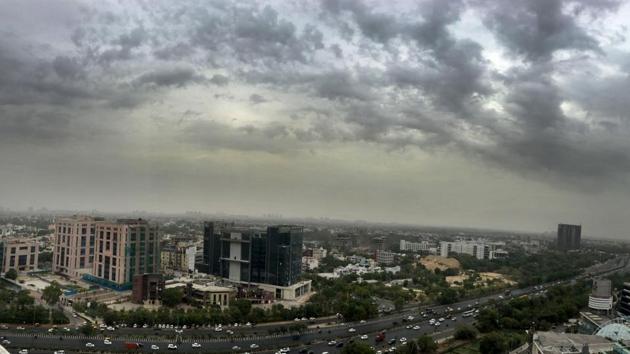
Monsoon showers might have wreaked havoc on Gurugram’s roads, causing waterlogging, disrupting traffic and leaving pedestrians stranded, but the seasonal change has helped improve the city’s air quality.
On Sunday, July 15, Gurugram recorded a particulate matter 2.5 (PM2.5) concentration of 32.17ug/ m3 (micrograms per cubic metre of air), the lowest in at least two months and well below the permissible limit of 60 ug/m3.
According to Dipankar Saha, former head of the Central Pollution Control Board’s air quality lab, the rain is ‘washing’ pollutants out of the atmosphere and precipitating them to the ground. “Rainwater also keeps the ground wet, preventing particles from getting kicked up into the air. The monsoon season helps clean up the atmosphere,” said Saha.
In addition to rainfall, prevalent humidity levels are also providing a respite from pollution. “when humidity rises, it causes atmospheric particulate matter to stick together and become heavier, due to which they are unable to remain suspended,” said Sachin Pawar, an independent air quality expert and consultant.
As per data obtained from the Central Pollution Control Board’s (CPCB) website, levels of suspended particulate matter (SPM) in Gurugram started declining on June 27, right before the city recorded its first spell of rain this monsoon, with PM2.5 level falling to 46.2ug/m3 on the day.
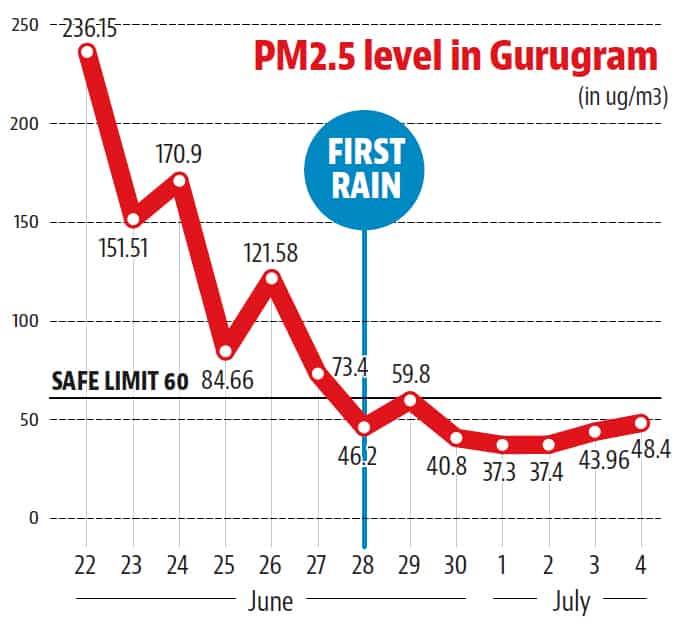
Gurugram has since recorded three days of ‘safe’ PM2.5 concentrations. On June 13, Gurugram recorded its highest daily average level of PM2.5 this year, at 572.93ug/ mg3.
Gurugram has also been faring well on the Air Quality Index (AQI) end, issued daily by the CPCB. Since June 28, Gurugram’s air quality has alternated between ‘satisfactory’ and ‘moderate’ levels. On Sunday, June 15, Gurugram scored AQI was 53, the highest this year.
The city’s AQI was ‘satisfactory’ for six days in July, ‘moderate’ for nine days and ‘poor’ for just one day. In comparison, the air quality of Gurugram was ‘severe’ for six days of June due to anti-cyclonic, dust-raising winds blowing towards the capital region from Rajasthan.
According to Jai Bhagwan, the Haryana State Pollution Control Board’s regional officer for Gurugram, this is because rains arrived earlier this year. “On the whole, this is a positive development and the air quality has improved,” Bhagwan said.
However, Pawar and Saha both warned that this period of respite is temporary before another seasonal change kicks in. Once the south-west monsoon winds pass the region, there will be no wind or water to transfer the pollutants.
“Monitoring air pollution during this transition period, beginning around September, will be crucial to understanding how bad the situation will be in winter,” Saha said.
Meanwhile, the improved air quality has provided relief to patients with respiratory ailments. Pulmonologist Piyush Goel, who practices at Columbia Asia Hospital, said, “We have seen a reduced inflow of patients. With the current climate, we are able to reduce the dosage of medications,” he said.

Stay updated with all the Breaking News and Latest News from Mumbai. Click here for comprehensive coverage of top Cities including Bengaluru, Delhi, Hyderabad, and more across India along with Stay informed on the latest happenings in World News.


