
 E-Paper



Water pipeline sustaining wildlife in Aravallis damaged
A pipeline laid to provide water to the local wildlife in the Aravallis has been damaged. The objective behind laying the pipeline was to keep animals from straying into residential areas in search of water.


Residents of Gairatpur Baas, Raisina and Mohammadpur Gujar villages — located on the foothills of the Aravallis — on Saturday said that a pipeline they had laid to provide water to the local wildlife has been damaged.
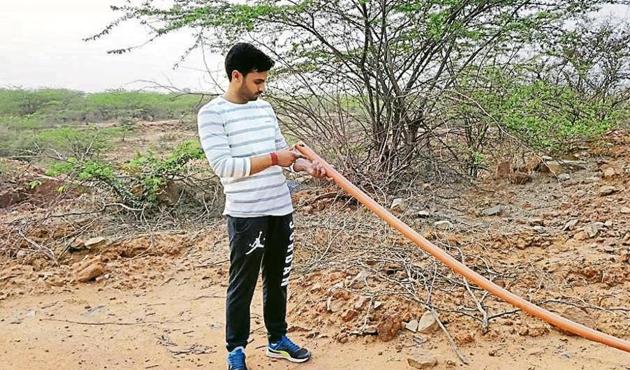
A group of residents from these villages had, in May this year, raised ₹3 lakh to lay the water pipeline, spanning 2.5 km. The pipeline straddles villages adjacent to the Aravalli hills.
Water is critical to sustaining the wildlife, especially in peak summer, and villagers said the objective behind laying the pipeline was to keep animals from straying into residential areas in search of water.
“We are finding it difficult to supply enough water to fill the pits inside the Aravalli forest as the animals have damaged the pipeline in six places. A proposal to supply water to the forest from an old borewell in Mohammadpur was mooted after several animals were spotted sneaking into residential areas in search of water,” Rafiq Khan, a Mohammadpur resident, said.
Villagers alleged that the government is not doing much for the welfare of the wildlife and this explains why there are recurrent incidents of leopards and other animals straying into villages in search of water. They said they would repair the pipeline on their own and won’t seek help from the forest department.
However, forest officials they have been filling pits, both the natural ones and the ones built by the department. They said their teams have been visiting the villages, adjacent to the Aravallis, on alternate days to assess if the pits need filling.
“Digging a borewell marks a violation of rules. Water could either be supplied through tankers or by connecting the pits to the prevailing water pipeline. The pipeline that was laid was a privately funded project. There’s not much we can do here,” Vinod Kumar, additional principal chief conservator of forests, Gurugram, said.
“I will raise the issue regarding the pipeline damage with the forest minister and see what we can do to help the villagers protect such pipelines,” Kumar said.
The villagers, meanwhile, said they will pool in funds once again to have the damaged parts of the pipeline repaired. They said that the estimated cost for the repair work — as given by the contractor — is ₹70,000. On May 15, a one-and-half-year-old female leopard was found dead in Gairatpur Baas village, located on the foothills of the Aravallis and around 15 km from Gurugram city.
The incident spawned concern over the rising incidents of man-animal conflict in the Aravallis — blamed mostly on the shrinking habitat of the local wildlife and frequent straying of animals in residential areas in search of food and water.
Rajesh Vats, founder of Keshav Dham, a shrine in Raisina village, said he has plans to lay pipelines in other areas as the population of the wildlife is a lot more than is estimated officially. Vats, who has been living in the temple for 20 years, said, “There is acute water scarcity inside the forest.” “We laid the pipeline from Shiv temple to Lohari pond, covering a distance of two-and-a-half kilometres. It took us a lot of effort to lay the pipeline as there is a risk of it being damaged by wild boars. Wild animals often sneak into residential areas in search of water. The only borewell in the village is 10 years old and we often face hurdles when it comes to filling pits for the local wildlife,” Vats said.


Stay updated with all the Breaking News and Latest News from Mumbai. Click here for comprehensive coverage of top Cities including Bengaluru, Delhi, Hyderabad, and more across India along with Stay informed on the latest happenings in World News.


