
 E-Paper



At 104, orange zone Gurugram has the highest number of cases in Haryana
Khandsa Mandi, the wholesale fruit and vegetables market of Gurugram, will remain shut till May 8. Total cases from here on Wednesday touched 19—highest from any area of the city.


With 17 more confirmed positive for the Coronavirus disease (Covid-19)—the highest single day spike yet—Gurugram district’s tally touched 104 on Wednesday. Of these 10 are vegetable sellers of Khandsa Mandi, with links to Delhi’s Azadpur Mandi hot spot, four from Dundahera, a declared containment zone, and three health care workers from a city-based hospital, who were in contact with other Covid patients.
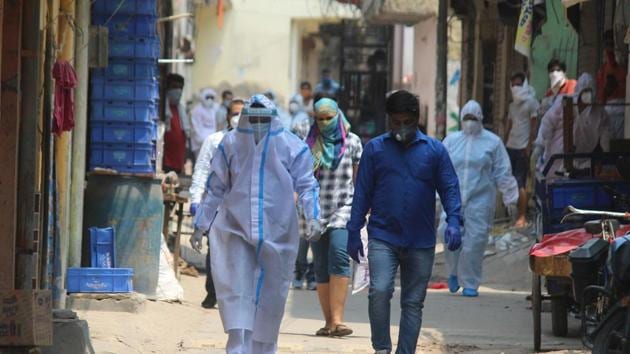
Khandsa Mandi, the wholesale fruit and vegetables market of Gurugram, will remain shut till May 8. Total cases from here on Wednesday touched 19—highest from any area of the city.
Dr Jaswant Singh Punia, chief medical officer, said, “We have reported the highest spike in Covid-19 cases today (Wednesday). While 10 are vegetable sellers, who had links with Azadpur Mandi, four cases from Dundahera are from the same building where six Covid-19 cases were reported last week. Also, three health care workers of a private hospital on Railway Road contracted the virus after coming in contact with a driver working with the referral ambulance service in Delhi; he had tested positive on Sunday.”
Gurugram, despite being an orange zone, now has the highest number of cases in the entire state, much more than the other affected district—Sonepat (81), Faridabad (78) and Jhajjar (70).
INTENSIFYING TARGETED SAMPLING
Health department officials said spike in Covid-19 cases is due to intensified targeted sampling which is being conducted to control the spillover of infection coming from Delhi, which has third highest number of Covid cases in the country.
“We were cautious after positive cases surfaced in Delhi’s Azadpur Mandi as many traders visit it regularly. We must also remember that there are a lot of frontline workers, such as police personnel and health staff, who work in Delhi but live here. Contact tracing becomes crucial in areas where density of population is high, especially in districts like Gurugram, Faridabad, Sonepat, Panipat and parts of Panchkula,” additional chief secretary (health) Rajeev Arora said, adding that these cases are mostly asymptomatic and pose a greater threat than symptomatic cases.
In case of Khandsa, the health department did surveillance of more than 1,600 people and collected samples of over 128 vegetable sellers. The health team’s plan is to track hawkers who were in contact with the Covid-19 patients and to reach out in areas where they have sold vegetables. “Ward-wise, these hawkers will be traced. To detect if the infection has spread random sampling will be done. If positive cases are found, then containment strategy will be prepared,” said Dr Punia.
Arora, on the other hand, said the state government has decided to increase the base for targeted sampling. “We will now cover ration depot holders, people who are involved in the task of procuring food grains as this activity has been going on continuously across the state,” he said.
EXPECTING POTENTIAL CASES
Health experts called targeted sampling and testing an efficient approach in identifying emerging hot spots. “Targeted sampling is an appropriate use of resources to target areas for testing where high risk cases are likely to be concentrated,” said Dr Preeti Kumar, a public health systems expert and vice-president of Public Health Foundation of India (PHFI).
“Targeted sampling and testing is done in areas where you expect a high yield of potential cases or to identify clustering of cases in or out of the containment zone or to study a silent area. It helps in understanding the distribution of disease in a community,” said Kumar.
In Gurugram, Khandsa remained a silent area till targeted sampling was done after cases emerged in vegetable sellers in Delhi, Sonepat and Jhajjar.
It is the fourth wave of targeted sampling in the state, said Dr Dhruv Chaudhary, nodal officer Covid-19 in Haryana. “First, it was for people with travel history to China, second for people coming from other western countries, third was people who attended the congregation in Delhi and fourth are people with essential services jobs in Delhi, a place which is experiencing community spread.”
According to him, the purpose behind targeted sampling is to prevent or delay the community spread of Covid-19 by tracing asymptomatic or pre-symptomatic cases in affected district.
Chaudhary said, “There are two strategies– targeted and random collection of samples – to detect infection spread in a community. Random sampling cannot be 100% correct so targeted sampling is an effective measure.”
According to health officials, targeted sampling was the only way to break the chain of spread. According to Arora, intensive targeted testing was a key factor in breaking the chain of transmission in Nuh and Palwal when patients were traced in large numbers. “It helped us in containing the infection in the affected districts,” said Arora.
In Nuh 59 cases have been reported till now, out of which only 6 are undergoing treatment, rest have recovered. Likewise, in Palwal 36 cases were reported, of which only four are hospitalised.
INCREASING CASES CAUSE FOR ALARM?
Arora said that the number of Covid patients might increase as they are proactively searching for potential cases in a community.
Affirming Arora’s view, Kumar said, “Number of cases might increase in this strategy, but it should not lead to panic reaction. Sudden spurt will help in identifying high risk groups and building up the containment strategy.”
But Kumar also cautioned that targeted sampling didn’t imply the district administration would be able to start doing mass testing in a population where population has remained asymptomatic for long. “Testing them gives no additional advantage. It may give a false assurance and may lead to people avoiding social distancing and hand washing–which are really the most key strategies for breaking the transmission,” said Kumar.

Stay updated with all the Breaking News and Latest News from Mumbai. Click here for comprehensive coverage of top Cities including Bengaluru, Delhi, Hyderabad, and more across India along with Stay informed on the latest happenings in World News.


