
 E-Paper



Gurugram ‘undertesting’ for Covid-19, say experts
By May 31, Gurugram had 774 positive cases and 3 deaths. In June, like the rest of the country, these numbers surged and the city had 4427 positive cases and 64 deaths on June 21.


Even with a recent upgrade in testing capacity, Gurugram is not testing enough to reign in the spread of Covid-19, leading to a recent uptick in mortality in the district, according to experts who reviewed an analysis of the health department data. They added that this data point was an indicator of the district’s test positivity rate (TPR, or the number of positive results per test expressed in percentage), which of late has surged in Gurugram.
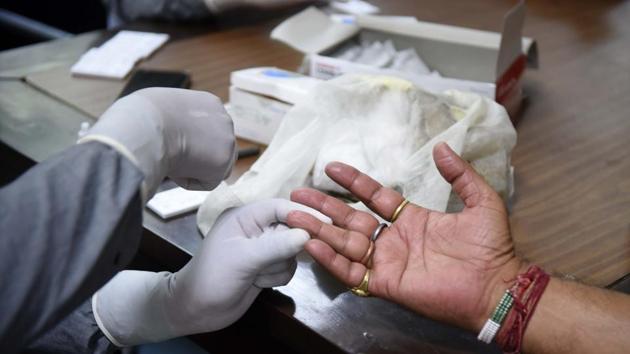
In April, Gurugram was testing an average of 192 samples per day (total tests 4789) and clocked an average TPR of 1 percent. While the samples increased to 257 per day in May (total tests 7958), TPR grew to 9 percent. The number of samples tested, however, need not necessarily equate to the actual number of individuals being tested, as some patients may have given multiple samples to be tested.
By May 31, Gurugram had 774 positive cases and 3 deaths. In June, like the rest of the country, these numbers surged and the city had 4427 positive cases and 64 deaths on June 21.
While an average of 414 samples per day were tested in June thus far, the TPR has surged to 42.7 percent. Gurugram’s doubling-rate (about 13 days) is among the quickest of India’s 20 worst affected districts.
“With rising positivity, one can say that transmission of the virus has not been curbed,” said Dr Lalit Kant, an independent public health consultant and former head of the ICMR’s epidemiology division. Kant added that there is no set benchmark for how many tests need to be conducted in a given region, “You want a lower percentage of the tests to come back positive. If you are seeing positivity at 60, 70, even 80 percent, (either) you simply aren’t testing enough.” Kant, and other experts, also said that rising test positivity may indicate a high, if not increasing, prevalence of the disease within a community.
Dheeraj Singh, a Gurugram-based data scientist who has been tracking Covid-19 data in Haryana, drew attention to the World Health Organization (WHO) recommended benchmark -- a sustained TPR of 5 percent over two weeks, at which point lockdown restrictions may be eased in a given region. “Assuming that there is already a high incidence of unreported cases within Gurugram, an increase in testing is the most viable way of lowering the TPR, and widening surveillance to find unreported cases,” Singh explained.
Thus, going by the current numbers and assuming that the number of new positive cases detected each day remains the same, the district should have conducted at least tested 3100 samples per day to achieve a TPR of 5 percent. “Similarly, by the same extrapolation, a TPR of 10 percent would require 1353 tests per day, while 15 percent would require 764 tests per day,” Singh added.
Evidence of Singh’s projections can found in more granular, daily data. “On June 19, when we tested 790 samples, the TPR was 18 percent. The previous day, with 686 samples tested, the positivity rate was 19 percent,” pointed out Dr Virender Yadav, chief medical officer, Gurugram. However, on June 20, when only 590 tests were conducted, the positivity rate rose again, touching 33 percent.
Dr Rajib Dasgupta, associate professor at the Centre of Social Medicine and Community Health, Jawaharlal Nehru University, who reviewed the district health bulletin data, agreed that there is a shortfall in the number of tests being conducted daily. However, he added a caveat to Singh’s projections. “Calculating the shortfall in testing is tricky, because you are making the assumption that the number of new daily positives will remain the same. It would be more correct to assume that the number of new positives being detected every day will increase, so these calculations are conservative estimates, at best,” Dasgupta cautioned.
A senior surveillance officer in Haryana’s Integrated Disease Surveillance Program (IDSP), who requested anonymity, said this is indeed the case in Gurugram. “To say that we have been effective in controlling the spread, we would need to lower the TPR down to about 10 percent. This was the case in May, when we were seeing less deaths,” said the officer, cautioning that the district will likely see an increase in patients requiring intensive care, or succumbing to the disease, in coming weeks.
To increase testing would mean casting a wider net, bringing unreported cases onto the health department’s radar, and enabling the contact tracing effort to catch up with some of those it hasn’t reached yet.
Officials in the health department said that Gurugram’s testing capabilities are being upgraded to meet these projected capacities. “We have started RT-PCR tests in Civil Hospital. We are conducting about 50 tests per day there, but we are soon going to adopt automatic RNA extraction protocols which will increase the capacity to at least 200 to 300 new tests per day.” The surge in testing numbers on June 19 and 20, Yadav added, were a result of private labs accepting more samples, and not entirely due to an increase in government testing.
With Gurugram’s first public testing facility expected to process at least 200 new samples, the district’s daily average should touch between 600 to 700 tests per day. This is about half the required number (to bring TPR down to 10 percent). Haryana’s additional chief secretary (health), Rajeev Arora, however, added that Gurugram would, by the end of the month, “Conduct close to 1000 tests per day.” Yadav, too, said, “Our target is 1000 tests a day in the foreseeable future.”

Stay updated with all the Breaking News and Latest News from Mumbai. Click here for comprehensive coverage of top Cities including Bengaluru, Delhi, Hyderabad, and more across India along with Stay informed on the latest happenings in World News.


