
 E-Paper



Insurance may not be enough to cover Covid treatment: Data
Industry insiders and employees of private hospitals attributed this discrepancy to the cost of ‘overhead consumables’, such as PPE kits, which aren’t liable to be covered under existing health policies.


A medical insurance policy may not be enough to cover the costs of Covid-19 treatment at a private facility in the district, suggests industry data compiled by the General Council of Insurance (GIC). The data shows that patients in Gurugram have been spending an average amount close to half their treatment costs out-of-pocket, per claim.
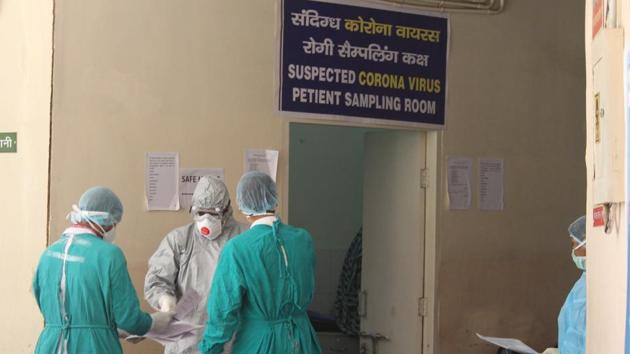
Industry insiders and employees of private hospitals attributed this discrepancy to the cost of ‘overhead consumables’, such as PPE kits, which aren’t liable to be covered under existing health policies. They also spoke of increased operating costs being borne by private hospitals which are, in turn, driving up the cost of treatment—resulting in a tussle between insurers and hospitals, but ultimately impacting patients.
Manish, who wished to be identified only by his first name, and whose parents were both admitted to a corporate hospital in Sector 29, received two bills for their treatment. “For my mother, I was charged about ₹1.5 lakh for a week of stay. She did not require any intensive care, just isolation, and insurance covered almost 90% of the bill. But my father has been on the ventilator and received plasma therapy. His bill is more than three times the amount. My insurer is not willing to cover more than 60% of the bill.”
A private insurer said that they are not receiving substantially high claims for the treatment of mild or asymptomatic cases. “But when it comes patients who have been in the ICU, for example, the bills can be as much as ₹7 lakh-₹8 lakh. The number of patients requiring intensive care in Gurugram has not been as high as in Delhi, going by the claim amounts we are receiving.”
Even so, data shows that there is a large discrepancy between what insurers are willing to pay, and what patients are having to spend out-of-pocket. A total of 459 insurance claims were made in the district up to June 17, to the tune of ₹8.8 crore. While 266 of these claims have been settled, the amounts disbursed by insurance companies is less than half—about ₹3.1 crore.
The average claim size—or the amount claimed for treatment by a single patient—comes to ₹1.93 lakh in Gurugram (based on data for 459 claims filed with private insurers up to June 17). The average settlement size is ₹1.15 lakh, indicating that patients in Gurugram are paying an average cost of ₹78,000 out-of-pocket per claim.
“Our liabilities include the cost of the beds, medicines, and so on, but don’t include items not used in the direct treatment of the patient. PPE kits, for example, are used by a healthcare worker. The cost should be borne by hospitals, and most insurers will be opposed to footing it,” said an underwriting officer at a leading national insurance company, which has processed over 100 insurance claims in Gurugram.
The employee of another private sector insurer, on condition of anonymity, said, “Consumables form a major portion of surgical cases amounting to almost 10% of the total bill. But for Covid-19 cases, even mild ones, they constitute a much a larger share, sometimes as much as 50%, depending on the hospital.” The employee added that insurers typically have a cap on bed rents and ICUs, the cost for which has been driven up due to increased demand. “A typical Arogya Sanjeevani health product caps the room rent payable by the insurer at ₹5,000 per day, but in Gurugram and Delhi, room rents at some hospitals are exceeding ₹20,000 a day,” the employee added.
Data shows that across Haryana, too, patients are paying close to half of their treatment costs out-of-pocket. Of 384 claims for Covid-19 treatment (till June 9), Haryana’s total claim size was ₹5.99 crore. The average amount settled (up to June 9), however, comes to ₹2.23 crore (about 37% of the amount claimed). Haryana’s average claim size amounts to ₹1.56 lakh, while the average amount settled comes to ₹84,000, indicating an out-of-pocket expenditure (borne by the patient) of ₹72,000 per claim.
A senior physician dealing directly with Covid-19 patients at a prominent corporate hospital in Palam Vihar explained that private hospitals across India have had to invest heavily in logistical changes to keep patients and employees safe from Covid-19. “We are putting up health care workers in alternate accommodations, reserving separate dialysis machines for patients, setting up negative pressure isolation rooms, spending on PPEs, increasing the health cover provided to doctors and nurses, and so on. Operating costs are up by at least 20%, so naturally, treatment costs are up, too,” the doctor said.
Experts, on the other hand, criticised this response and stressed on the need to not just cap prices, but also more transparent billing. “Figures compiled by GIC show that Covid-19 treatment is prohibitive even for persons who are covered by insurance, because of huge out-of-pocket expenditures. In general, hospitals are levying higher charges on patients due to increased operating costs, but this is disingenuous because costs for PPE and biomedical waste disposal were anyway being offloaded on to patients,” Malini Aisola, co-convenor at the All India Drug Action Network (AIDAN), said.
Aisola added that this practice of straddling patients with additional expenses amid a pandemic requires official intervention as is being done in several states—through fixing Covid-19 treatment charges based on cost analysis. Moreover, while the IRDAI has instructed general and standalone insurers to redraft their policies (to include consumables) by September 30, Aisola said this date may be too far down the line to help patients in need of immediate relief.
VS Kundu, the nodal officer for Covid-19 monitoring in Gurugram, said, “We have instated a committee to specifically address the high cost of treatment at private hospitals. Their report should be out in a day or two. That should provide some clarity to all stakeholders, whether hospitals, patients, or insurers.”

Stay updated with all the Breaking News and Latest News from Mumbai. Click here for comprehensive coverage of top Cities including Bengaluru, Delhi, Hyderabad, and more across India along with Stay informed on the latest happenings in World News.


