
 E-Paper



Only 6% street vendors in allotted spaces, MCG to revise its policy
According to MCG officials, only 1,100 of 18,000 street vendors are covered in their 157 street vending zones, which has resulted in a large number of vendors encroaching upon public spaces


The Municipal Corporation of Gurugram is planning to overhaul its street vending policy, after it was found that only 6% of the city’s street vendors are covered under its vending zones.
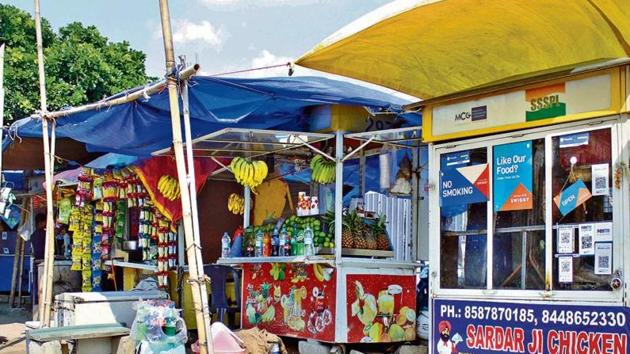
According to MCG officials, only 1,100 of 18,000 street vendors are covered in their 157 street vending zones, which has resulted in a large number of vendors encroaching upon public spaces and main roads, leading to congestion, snarls and chaos.
The street vending policy was introduced in 2016, to provide social security and reserve the livelihood of street vendors.
The number of street vendors operating in the city was provided to the MCG earlier this month by the Haryana government, following a citywide survey.
“We received data from the state government after its recently concluded survey, which revealed that there are 18,000 vendors operating within the MCG jurisdiction area. We are in the process of verifying the number of vendors and getting biometric attendance of vendors, to add them to our database. Once the number is confirmed, we will work on revising the existing street vending policy for integrating the maximum numbers of vendors,” said Mahender Singh, city project officer, MCG.
MCG officials said that the revision in policy is aimed at integrating a larger number of vendors, bringing the production cost of carts down by one-fourth and identifying vacant areas across the city.
MCG vending zones are essentially designated areas, either in a market or plot, next to popular spots for vendors to sell their products.
Residents can purchase hot and cold beverages such as tea, coffee, aerated drinks, snacks, such as samosas and pakoras, and Indian street food, such as rajma chawal and chole bhature, for ₹5-₹300.
In addition, provisions for drinking water, mobile toilets, benches and dustbins are also being provided in each of the zones.
On Monday, during an internal meeting, MCG councillors had asked officials for an explanation on addressing issues, such as overcrowding of vendors in vending zones, zones being built upon pavements and green belts.
Singh said that placement of vending zones was done improperly in some areas, while some recent infrastructure projects had also led to the MCG to place vendors in different vending zones, leading to overcrowding and encroachment of pavements and green belts.
“In Sector 14, we realised that the number of vendors exceeds the available space, leading to a few encroaching upon main roads and causing snarls. We have shifted the vending zone to another part of the market. In addition, due to the Sohna elevated project, three vending zones had to be shifted and incorporated in nearby residential sectors, which has led to some vendors encroaching upon pavements and green belts,” said Singh.
He said that under the new policy for vending zones, MCG will also identify markets and vacant plots where vending zones can be established, with respect to the total available space, to ensure vendors are evenly spread out and do not cause traffic issues.
The MCG’s first street vending zone opened in November 2016, on a vacant plot opposite Medanta Hospital in Sector 32. Prior to its opening, the MCG had prepared its own street vending policy in 2015, loosely based on the Street Vendors Act, 2014.The MCG had carried out a survey in 2015 and found 14,175 street vendors to be operating in the city.
MCG had studied the street vending policy in countries such as Philippines, Thailand, Singapore, Vietnam, Colombia, Turkey, Canada, Netherlands, and other Indian cities, such as Bhubaneswar and Navi Mumbai, and established a pilot model around the same.
As part of the vending zone, MCG provides carts to vendors at a cost of ₹1.06 lakh, for carrying out their operations.
Singh said that the MCG is also looking for companies that can manufacture smaller carts, to incorporate vegetable and tea vendors, at much lower prices.
“We are scouting for companies that can produce smaller carts at a cost of ₹20-25,000 to make it more affordable to street vendors, such as the existing vegetable cart sellers and tea stall owners, who do not require as much space as food vendors. Once the policy is prepared, we will shortlist 10-12 companies and finalise the concessionaire,” said Singh.
Arbind Singh, the national coordinator of National Association of Street Vendors of India (NASVI), a body that safeguards the interests of vendors, said that the MCG’s decision is a positive development for vendors but added that its outcome will depend largely on how well the civic body prepares its policy.
“While the move is in the positive direction, the success or failure of the policy will depend on MCG’s planning. 18,000 is a large number and finding so many spaces, where demand for their products exits, is a big challenge. The MCG could look into regulating vendors and positioning them on a rotational basis, to ensure that the maximum number of vendors can be incorporated into vending zones,” said Arbind.


Stay updated with all the Breaking News and Latest News from Mumbai. Click here for comprehensive coverage of top Cities including Bengaluru, Delhi, Hyderabad, and more across India along with Stay informed on the latest happenings in World News.


