
 E-Paper



The urban design trap - Gurugram floods, bakes and chokes for the same reason
This article is authored by Sarika Panda Bhatt, co-founder and trustee, Raahgiri Foundation.

 Prefer HTon Google


On August 24, school buses in Gurugram were sent out early, at 1.30 pm, after a red alert. At 4.15 pm, many were still stuck at Subhash Chowk, children waiting inside as parents tracked delays on their phones. Across the city, schoolchildren were stranded for anywhere between three and six hours.
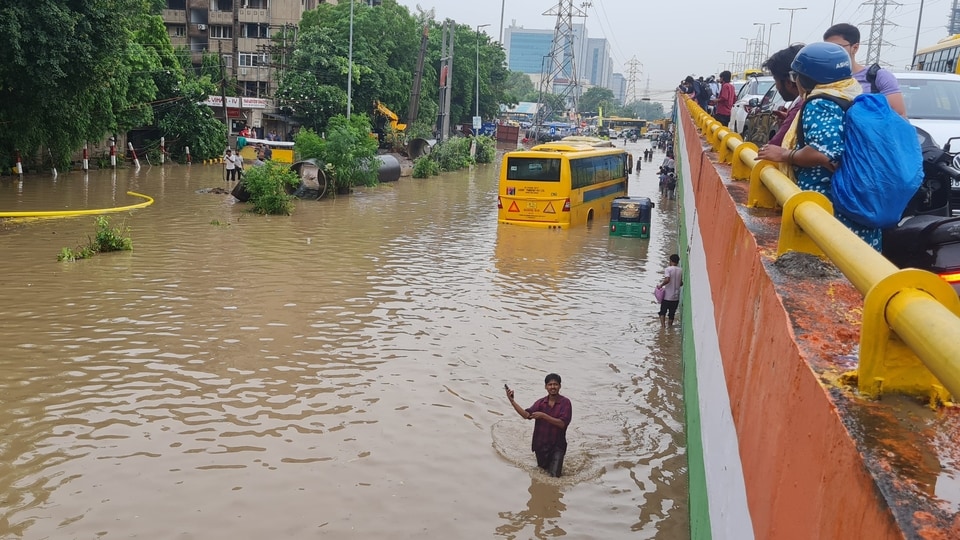
The rain itself was ordinary by this monsoon's standards. Gurugram tehsil recorded 75 mm between 8 am and 5 pm, with Badshahpur at 65 mm over the same nine hours. It was still enough to leave residents wading through close to three and a half feet of water in places, and to force the district administration to advise every office and school to work from home the next day.
A city that halts under rainfall it ought to absorb will halt again in November when the air turns, and again in May when the heat arrives. Each event is filed as a different emergency, yet all stem from the same choices about urban design: limiting natural drainage, reducing green cover, and prioritising vehicles.
Our seasonal responses- pumps for floods, sprinklers for air pollution, water kiosks for heat- are managed by separate departments, yet all result from the same design flaws. Gurugram floods because 75% of its natural drains were built over, leaving the city dependent on a handful of master drains, and water collects at low points such as Subhash Chowk. It overheats because construction replaced trees and permeable ground with heat-trapping surfaces; India lost 373 million dollars in labour capacity to heat stress in 2024, mostly among outdoor workers. Its air is unbreathable for months, mainly because only 12 to 15% of residents have a usable public transport option and the rest must drive.
If these symptoms share a cause, they share a remedy too, which ought to interest anyone holding a budget more than it currently does. A well-designed street with bioswales, trees and safe paths holds stormwater, cools the area, and reduces vehicle trips and emissions.
Sanath Road, a 2.4-km stretch in Udyog Vihar once known locally as Anath, or orphaned, road because it flooded and could not be walked, was rebuilt as Haryana's first complete street, with bioswales designed to absorb close to 80% of the stormwater falling on them and 700 mature trees retained rather than felled. On August 24 it stayed dry while Narsinghpur, Hero Honda Chowk and Sohna Road went under.
Other cities reached this conclusion earlier. Singapore turned a concrete canal at Bishan into a naturalised river that absorbs floodwater, cleans it and doubles as one of its best-used parks. Medellin built thirty green corridors from 2016 for about 16 million dollars, and average temperatures along them fell by roughly two degrees.
The connection is already recorded in our own paperwork. Gurugram's clean air action plan, finalised in December 2025, lists road redevelopment as an air pollution measure. MCG has identified 155 waterlogging-prone points and signed an agreement with IIT Gandhinagar for a master drainage model. GMDA plans to redevelop 100 km of roads on the complete streets template. None of these is evaluated together, so the department that rebuilds a road for cleaner air gets no credit for the flooding it prevents.
Gurugram has spent about 503 crore rupees on drainage over the past nine years, and on August 24 its roads still went under. Its road repair target for 2026 is 396 km, of which 177 km were completed by late July. Money has been spent, targets have been set, and the flooding has not changed.
In April 2026, the ministry of housing and urban affairs released operational guidelines for the Urban Challenge Fund, committing one lakh crore rupees of central assistance towards four lakh crore rupees of urban investment, with selection in challenge mode, so cities must compete by making a case for what they build.
That last feature is where the opportunity lies. When cities compete, the evaluation criteria quietly become national urban design policy, whether anyone intends them to or not. A fund that scores a drainage proposal only on drainage will receive drains, and one that scores a road on vehicles moved per hour will receive road widening.
Three changes would prevent that. Score co-benefits explicitly, so that a project reducing runoff, lowering surface temperature and cutting vehicle trips ranks above one that performs a single function well; our appraisal formats contain no field for the difference.
Put a design and policy team inside the department that owns the road. Municipal engineering departments are staffed almost entirely by civil engineers, with few urban planners and almost no landscape architects, ecologists or transport planners in the room. Gurugram's difficulty is more basic still: of 427 sanctioned civic posts, 209 are filled and 218 lie vacant. A department in that condition cannot appraise a bioswale, let alone commission one.
And stop awarding this work to the lowest bidder. The (L1) system rewards the least experienced firm quoting the thinnest margin, even though the Union government has amended its rules to permit Quality-cum-Cost-Based Selection. A bioswale built by the cheapest available contractor silts up within a season and drains worse than the pipe it replaced.
When schools reopen, those children will travel the same route through Subhash Chowk. That junction will flood again in the next heavy spell, sit inside a heat island through May, and register as a pollution hotspot in November. What our cities look like in 2040 turns on a narrow and unglamorous question: whether the forms our engineers fill in have anywhere to record that one street did all three jobs.
This article is authored by Sarika Panda Bhatt, co-founder and trustee, Raahgiri Foundation.


