
 E-Paper



India and Japan are strengthening ties on two fronts
This article is authored by Sanchari Ghosh, doctoral scholar, department of international relations, Jadavpur University.

 Prefer HTon Google


India and Japan have spent the past decade building a strategic partnership around the Indo-Pacific. Now the interesting part is the scope of what that partnership is turning into. In rapid succession, the two countries have made headway on maritime security, defence-industrial cooperation, trade, investment and technologies. The relationship is maturing on two fronts simultaneously – security and economy.
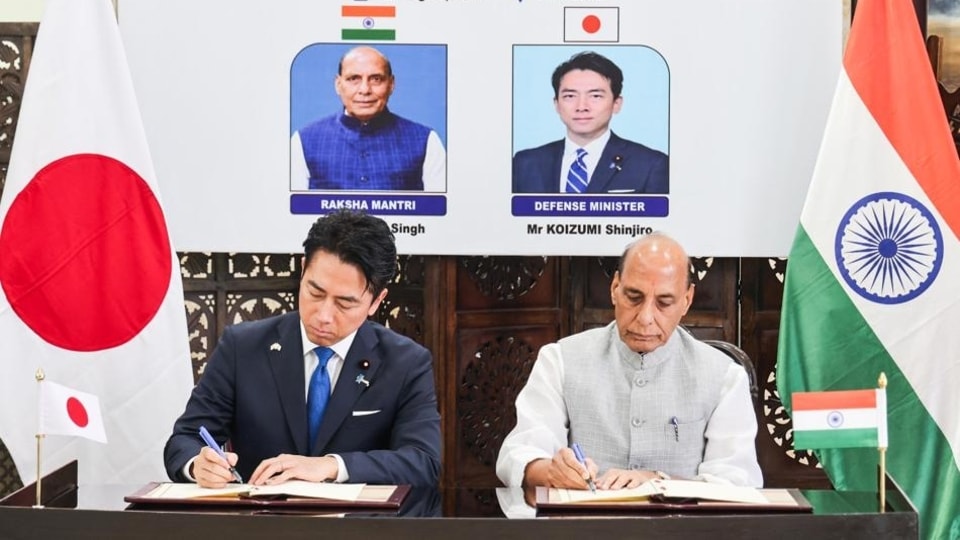
The sequence of recent developments makes the point. On August 20, India and Japan signed a new agreement on maritime security cooperation, covering maritime-domain awareness, information-sharing, naval cooperation, sea-line protection, logistics, port access, maintenance and repair. The two sides will also explore cooperation in naval ship-building and design, combining Japanese technological expertise with India's production capabilities. Days later, commerce and industry minister Piyush Goyal travelled to Japan with India's largest-ever business delegation to the country, comprising more than 200 representatives from sectors including manufacturing, semiconductors, automobiles, finance, health care and start-ups. The visit focused on expanding trade and investment, while discussions also covered Japanese participation in India's emerging technology and manufacturing ecosystem.
These developments are worth considering together. The two sides are beginning to connect security, technology, manufacturing and commerce in ways that give the partnership a broader base. India and Japan have conducted military exercises for years, including the Army exercise Dharma Guardian and the maritime exercise JAIMEX. This year, Japanese fighter aircraft are also scheduled to participate in Veer Guardian in India for the first time. The latest maritime agreement takes the relationship further into information sharing, logistics, repair facilities and defence ship-building.
The industrial provisions are also significant here. They will also examine Japanese use of Indian production capabilities under Make in India and work towards reciprocal ship-repair arrangements. This takes the relationship beyond cooperation between naval forces and into the industrial base that supports them. Japanese technology and Indian production capabilities can reinforce each other in ship-building and maintenance, while reciprocal access to repair facilities could make naval cooperation easier to sustain.
Concurrently, the economic side is moving in a related direction. Goyal's visit was not simply about increasing the volume of bilateral trade. The sectors that have been emphasised were semiconductors, advanced manufacturing, clean energy, technology and supply chains, which are now closely tied to economic and strategic security. India is seeking more Japanese investment and technology and presenting itself as a production base and potential global sourcing partner for Japanese companies. This gives the economic relationship a different character from a conventional trade partnership.
There is a broader reason why the two tracks have been able to develop together. India and Japan did not always see their regional roles in complementary terms, as their focus of attention was on two different seas, the Indian Ocean and the Pacific Ocean, respectively. But they gradually developed more compatible expectations about the roles they could play in the regional order. India has come to present itself as a country with responsibilities extending beyond its immediate neighbourhood, particularly across the Indian Ocean and the wider Indo-Pacific. Japan, for its part, has sought a more active role in maintaining regional stability, secure sea lanes and a free and open Indo-Pacific. Their partnership has gained strength as these expectations have converged.
That does not mean every economic project will have a strategic purpose or that every defence initiative will produce commercial gains. The relationship still has practical obstacles. India wants greater Japanese investment, but Japanese companies will continue to weigh regulatory conditions, market access and the ease of doing business. Indian companies, meanwhile, continue to seek better access to the Japanese market.
Defence cooperation faces a similar test. Agreements on shipbuilding, repair and technology transfer are significant on paper, but their value will depend on whether they lead to actual projects and sustained industrial cooperation. That is precisely why the recent sequence is worth watching. The relationship is developing simultaneously at the level of strategic purpose and practical capability.
The next phase should, therefore, focus on bringing these strands together - Japanese investment and technology with Indian manufacturing, maritime cooperation with industrial capacity, and defence needs with economic security. If that convergence can translate into concrete projects, the India-Japan partnership will acquire a depth that goes well beyond its familiar strategic language.
(The views expressed are personal)
This article is authored by Sanchari Ghosh, doctoral scholar, department of international relations, Jadavpur University.


