
 E-Paper



Venezuela’s oil revival: Lessons for unlocking India’s mature fields
This article is authored by Amir Ullah Khan, economist and adjunct professor, TISS.

 Prefer HTon Google


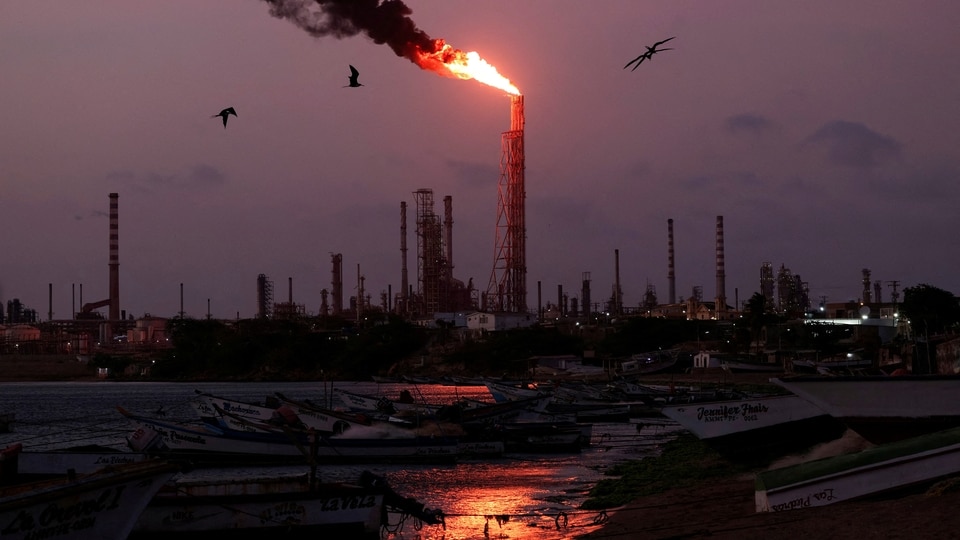
Venezuela has put a hefty price tag on its oil industry revival. The country’s acting President, Delcy Rodríguez, on October 17 said that Venezuela expects nearly $76 billion in oil investment over the next five years under the recently signed agreements to boost the country’s oil production. At the heart of this initiative is a US-Venezuela agreement covering 17 oilfields and plans to deploy 250 drilling rigs. The investment drive comes as oil production shows signs of recovery in Zulia state, around Lake Maracaibo, where oil output has climbed to 370,000 barrels per day (bpd), up from a low of 70,000 bpd, with officials targeting 400,000 bpd by the end of 2026.
US secretary of State Marco Rubio said this week that Washington is in talks with Reliance Industries to increase its capacity to process Venezuelan heavy crude. For India, which is also grappling with declining output from mature oilfields, Venezuela’s revival plan offers valuable lessons about attracting investment to the oilfields that can produce for years to come.
As the world’s most populous country, with growing energy needs and a rapidly expanding economy, India’s energy dilemma lies in balancing its growing demand for oil with its high dependence on imports. India imports nearly 90% of its crude oil and around 50% of its natural gas requirements. The share is only going to increase in the future if the country does not take active measures to increase its domestic production.
Venezuela has the world’s largest proven crude oil reserves, with about 304 billion barrels, accounting for roughly 17% of global crude oil reserves. Even then, the country’s output fell from 3.4 million bpd in 1998 to about 350,000 bpd in 2020. And the reasons were not geological but rooted in policies.
Expropriation, the requirement for Venezuela’s State-owned oil company, PDVSA, to hold a majority stake in every oil project, and underinvestment discouraged investors. Sanctions further limited access to the technology needed to extract heavy crude.
Hence, when it came to revival of the oil fields, the first major step was regulatory, not operational. A partial reform of the Organic Hydrocarbons Law in January 2026 allowed private companies to operate upstream through production participation contracts and ended PDVSA's mandatory majority. The law sets a baseline royalty of 30%, which can be lowered to keep projects commercially viable. It caps the integrated hydrocarbons tax at 15% of gross revenue, allows operators to sell their share of production directly and restores access to international arbitration. These changes raised oil production from about 924,000 bpd in January to more than 1.1 million bpd by May 2026. PDVSA has set a target of three million bpd in oil production within five years, which is three times its current production.
In India, demand continues to grow, while domestic output struggles to meet the needs. The country’s dependence on imported crude oil reached 88.6% in the first ten months of FY26, with imports accounting for over 90% of the crude processed by Indian refineries. Meanwhile, domestic crude production has declined from a peak of 35.9 million tonnes in FY12 to around 28.7 million tonnes in FY25, as ageing oilfields yield less. ONGC’s crude output fell by a further 1.1% in FY26. India’s dependence on imported gas also crossed 50% in FY25.
The IEA expects India to be the largest contributor to global oil demand growth, with consumption projected to increase from 5.5 million bpd in 2024 to 8 million bpd by 2035. As India’s oil demand grows faster than domestic production, its dependence on imports leaves the rupee, trade balance and inflation exposed to global disruptions and geopolitical shocks in the Gulf, Moscow and now Caracas.
Zulia’s revival is being driven largely by brownfield rehabilitation and renewed investment in long-producing oilfields. Just as Venezuela’s Maracaibo, India has mature oilfields in Mumbai High, along the East and West Coasts, and in the onshore fields of Rajasthan and Assam. These fields, which have been in production for decades, still hold recoverable reserves that could be tapped through enhanced oil recovery, infill drilling and modern reservoir management.
Next, India’s Barmer basin produces waxy crude, while the Cambay basin holds heavy oil, much like Venezuela’s Orinoco Belt, which is known for its extra-heavy crude. Both reward operators with specialised technical expertise and require fiscal terms that reflect the cost of extracting remaining reserves.
Additionally, as PDVSA dominates Venezuela’s oil sector, India’s oil and gas industry has historically been led by state-owned companies such as ONGC and Oil India. These companies control most of the acreage and production. State-controlled companies remain central to production, but unlocking the potential of mature and technically challenging fields requires private capital, advanced technology and specialised operating expertise.
Furthermore, Venezuela’s expropriations represent an extreme case of policy risk. Although milder, India has faced its own challenges. This includes retrospective taxation, changes in levies and prolonged disputes over production-sharing contract (PSC) extensions and profit petroleum. Such uncertainties can make investors hesitant.
The key difference is that Venezuela has proven reserves. It has large reserves in both mature and unexplored fields. The challenges there were mostly above ground. India faces both reserve and exploration challenges.
Only about 10% of India’s 3.36 million square kilometres of sedimentary basins are under exploration, while 1.32 million square kilometres lie in largely untested deepwater areas. S&P Global Commodity Insights has identified four largely unexplored Indian sedimentary basins—Mahanadi, Andaman Sea, Bengal and Kerala-Konkan—that could hold up to 22 billion barrels of oil equivalent in undiscovered resources. Exploring this potential will require investment and technology. Frontier exploration is a long-term commitment, often taking nearly a decade from licence to first oil and exposing investors to prolonged geological and policy risks. In such cases, a predictable policy environment gives companies the confidence to commit capital over the long term. It matters more here than in Venezuela.
India needs policy stability. The new PNG Rules 2025 do give investors the legal framework they seek to invest billions of dollars in exploration in India. However, ambiguity over executive discretion slows progress and makes investors hesitant. To boost investment, India must prioritise ease of doing business through faster approvals, consistent rules and protection of existing contracts from new levies.
Venezuela’s flexible royalty system, which can adjust to project economics, offers another critical lesson for India. In India, oil companies face royalties, a crude oil cess of about 20% of the realised price on nominated blocks, and profit-sharing payments. Together, these can consume more than half of project revenue, leaving little revenue for further investment. The recent royalty cut is a step in the right direction, but the cess and profit-sharing requirements remain obstacles. A better framework on field maturity and extraction costs could encourage investment in fields that might otherwise remain undeveloped.
In terms of monetising mature fields, Zulia field revival shows how quickly output can increase when private operators are allowed to work on old fields. India should do the same. India should open more mature and marginal NOC fields to private partnerships and production-enhancement contracts, with transparent revenue-sharing arrangements and time-bound approvals to attract investment and raise output.
Lastly, India should also consider making its exploration targets measurable by setting clear goals. Similar to Venezuela’s target of 250 drilling rigs, India’s goal of bringing 1 million sq km under exploration by 2030 needs clear, achievable targets. Time-bound approvals would make these targets more achievable, as rig contractors favour markets with predictable permits and attractive terms.
Venezuela’s oil and gas industry scenario highlights that long-term investment in the upstream sector requires predictable rules. India has a strong case for upstream investment, with an estimated $100 billion opportunity in E&P by 2030, vast under-explored basins, a fast-growing domestic market and one of the world’s largest refining industries. Jamnagar can refine Venezuela’s heavy barrels, helping India secure supplies. But equally crucial is increasing our domestic production. And achieving this will require policy stability that gives investors’ confidence over 25 years, not just the next budget cycle.
(The views expressed are personal)
This article is authored by Amir Ullah Khan, economist and adjunct professor, TISS.


