
 E-Paper



What to expect from the India-Russia Summit
This article is authored by Pravesh Kumar Gupta, associate fellow (Eurasia), Vivekananda International Foundation, New Delhi.

 Prefer HTon Google


India-Russia relations in late 2025 have reached a level of maturity and interdependence that is no longer adequately described by the standard categories of defence cooperation, energy trade, or strategic balancing. The December 4–5 Summit in New Delhi is taking place against three structural shifts that give the relationship a distinct character and a wider global significance.
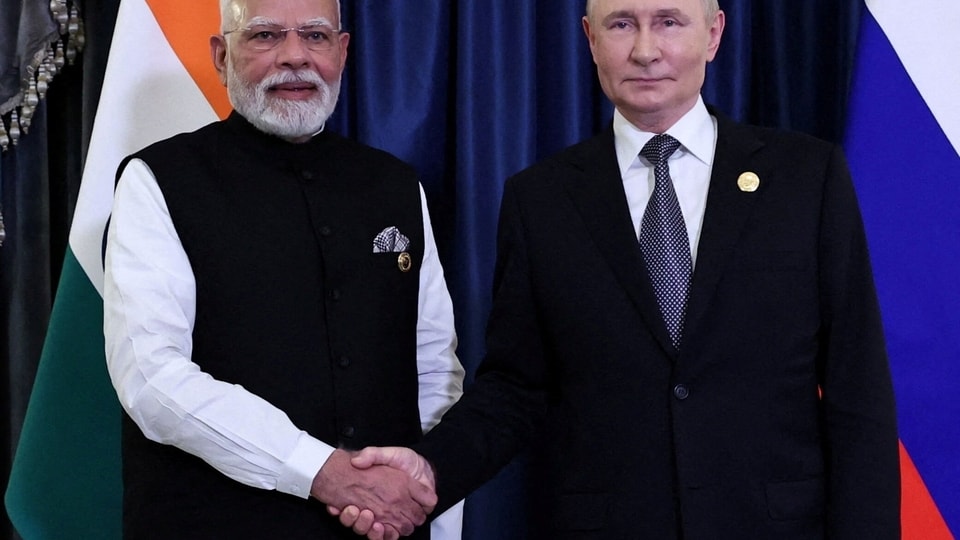
First, the partnership has become one of the few functioning bilateral mechanisms that remain largely immune to geopolitical shocks. While the US has imposed secondary sanctions on more than 180 entities linked to Russian energy exports and has threatened 500% duties on refined products containing any Russian molecules, India-Russia trade has continued to operate through a combination of insurance re-routing, fleet substitution, rupee-based letters of credit, and limited use of non-SWIFT messaging. By November 2025, India accounts for approximately 38 percent of Russia’s seaborne crude exports and has emerged as the largest buyer of Russian ESPO blend via the Kozmino terminal. This is not merely opportunistic purchasing; it is the deliberate construction of an alternative commercial circuit that other middle powers (Turkey, Brazil, the UAE) are now studying as a template.
Second, the military-technological dimension has moved beyond traditional buyer-seller dynamics into sustained co-development with enforceable transfer-of-technology clauses. Russia remains the only country that has agreed to joint design authority and source-code access for critical platforms supplied to India. The February 2025 reciprocal military logistics agreement, which Moscow ratified in October, effectively creates a framework for co-production of spare parts and sub-systems inside India for the entire inventory of Russian-origin equipment in the Indian armed forces. The next logical step, expected to be formalised during the summit, is the establishment of two new joint ventures: one for licensed production of the 9M730 Burevestnik-derived cruise missile engine and another for the AL-41F1S turbofan with 80% local content by 2032. These are not prestige projects; they are calculated responses to the reality that western supply chains for high-end defence articles are increasingly conditional on geopolitical alignment.
Third, and most importantly from a global perspective, India and Russia are converging on a shared theory of multipolar transition. Both countries now operate on the assessment that the US, under its current administration, is moving toward a selective withdrawal from extended deterrence commitments while simultaneously weaponising economic access. In this environment, neither Delhi nor Moscow believes that formal alliances offer greater security than flexible, high-trust bilateral arrangements backed by independent capabilities. The India-Russia partnership therefore functions as a load-bearing node in a wider network that includes the RIC format (may be revised soon), SCO defence consultations, and selective BRICS-plus initiatives, without requiring any member to subordinate its decision-making.
The practical agenda of the summit reflects these underlying realities rather than ceremonial declarations. Five clusters of outcomes are anticipated:
* Energy and payments: Conclusion of a 2026–2035 framework agreement for 45–50 million tonnes of crude and LNG annually, with pricing indexed to a basket that reduces exposure to Brent fluctuations; expansion of the Vostro account mechanism to 22 Indian banks; and a pilot for digital-ruble/INR settlement covering 8–10% of bilateral trade by value.
* Defence industrial integration: Signing of the implementing protocol for the February logistics agreement, launch of the S-500 co-development feasibility study, and approval of a 70% indigenous content roadmap for Project 11356 frigates still under construction at Goa Shipyard.
* Technology and critical minerals: Establishment of a joint working group on small modular reactors using Russian VVER-300 designs adapted for Indian thorium fuel cycles; memorandum on cooperation in nickel, cobalt, and rare-earth processing from Russian Arctic deposits with Indian equity participation; and a framework for collaborative research in applied quantum communication.
* Cooperation in high technology: In order to diversify the trade and economic relations, cooperation in AI, quantum technologies, engineering and high-speed engineering trains, may be included in the bilateral agenda.
* Eurasian connectivity: Decision to accelerate the eastern alignment of the International North-South Transport Corridor via Kazakhstan and Turkmenistan, with a target of reducing transit time from Mumbai to St. Petersburg to under 18 days by 2029; agreement on mutual recognition of electronic seals and digital customs documentation.
None of these items is revolutionary in isolation, yet taken together they constitute a systematic effort to reduce vulnerability to unilateral economic coercion. The relationship is not expanding in ideological scope; it is deepening in operational resilience.
From a global standpoint, the India-Russia framework now serves as one of the few empirical demonstrations that large economies can maintain strategic autonomy without sliding into either isolation or subordination. It offers no universal model; its replicability is limited by the specific historical trust between the two States and by Russia’s willingness to transfer sensitive technologies that China, for example, has consistently refused. What it does demonstrate is that multipolarity need not await the emergence of a new hegemon or a formal anti-Western bloc. It can be constructed incrementally through bilateral and minilateral arrangements that prioritise redundancy, optionality, and mutual capability enhancement.
In this sense, Putin’s visit is less a diplomatic spectacle than a working session between two leaderships that have concluded that the post-2022 international system will be defined less by grand bargains among great powers than by the quiet accumulation of resilient bilateral circuits. The summit will not produce dramatic headlines, but it will add several more load-bearing elements to a structure that is already keeping two major civilisations upright in an increasingly unstable world.
This article is authored by Pravesh Kumar Gupta, associate fellow (Eurasia), Vivekananda International Foundation, New Delhi.


