E-Paper



1,615 militants from Bodo factions lay down weapons
The cadres, belonging to the factions led B Sawraigra, Gobinda Basumatary and Ranjan Daimary, submitted 178 arms and a large cache of ammunition to Assam chief minister Sarbananda Sonowal, making their return to the mainstream.


Three days after signing a peace accord with the Union government, 1,615 members of three factions of the Bodo militant outfit National Democratic Front of Bodoland (NDFB) officially laid down arms in a ceremony on Thursday.
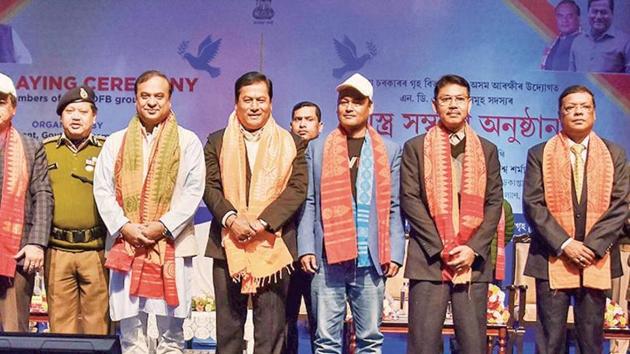
The cadres, belonging to the factions led B Sawraigra, Gobinda Basumatary and Ranjan Daimary, submitted 178 arms and a large cache of ammunition to Assam chief minister Sarbananda Sonowal, making their return to the mainstream.
“I appeal to all cadres of NDFB who have joined the mainstream today to dedicate themselves to building Assam so that our state becomes an exemplary one not just in India but is known across the world,” Sonowal said at the ceremony.
The people who laid down arms include 836 members from NDFB (Progressive), 579 from NDFB (Ranjan Daimary), and 200 from NDFB (Songbijit).
Senior Assam minister Himanta Biswa Sarma said on the occasion that a bill to create a Bodo-Kachari Welfare Council (according to the accord signed this week) will be tabled in the next assembly session, and assured surrendered NDFB militants that they would get a “comprehensive” rehabilitation package.
Last week, 644 rebels from eight militant outfits — the United Liberation Front of Assam-Independent, NDFB (S), Kamtapur Liberation Organisation, National Liberation Front of Bengalis, Rabha National Liberation Front, Communist Party of India-Maoist, National Santhal Liberation Army and Adivasi Dragon Fighters — laid down arms in Guwahati in the presence of Sonowal.
“It is a memorable day as the decades-old of tag of ‘Bodo insurgency’, which was used to paint an entire community, will go away forever,” said Pramod Bodo, president of All Bodo Students Union (ABSU), one of the signatories to the new accord.
On Monday, the four leaders of NDFB, ABSU and United Bodo Peoples’ Organisation (UBPO), who had been seeking a separate Bodoland state for decades, gave up that demand and signed the peace accord in New Delhi in presence of Union home minister Amit Shah.
Prime Minister Narendra Modi and Shah are expected to be part of the official Bodo Accord signing celebrations to be held in Kokrajhar on February 7.
As per the accord, all the four NDFB factions will abjure violence, surrender weapons, and disband their armed organisations within a month.
The Centre and the Assam government will, in return, take steps to rehabilitate the cadres of all four factions through measures such as lump sum payment of ex-gratia, funding of economic activities through existing schemes, provide vocational training, and recruiting them in government jobs according to eligibility.
The deal also states that criminal cases against NDFB cadres for non-heinous crimes will be withdrawn, but cases involving heinous crimes will be reviewed on a case-by-case basis as per existing policy on the issue.
In the past three decades, nearly 4,000 people have died due to the Bodo insurgency.
“NDFB laying down arms will bring an end to militancy in Bodo-dominated areas, but it is doubtful if it will end violence given the ethnic issues there,” said senior journalist and author of ‘Rendezvous with Rebels’ Rajeev Bhattacharya.