
3 more Delhi areas under Covid-19 hard lockdown over Tablighi Jamaat cases
List of 26 localities in Delhi that have been placed under the Covid-19 containment zone strategy.
The government on Friday expanded the containment zones in national capital Delhi, bringing three more localities of central and north Delhi under the hard lockdown. A top Delhi home department official told Hindustan Times that the three fresh localities in central Delhi were brought under the strict lockdown procedure in view of cases linked to the Tablighi Jamaat in these areas,
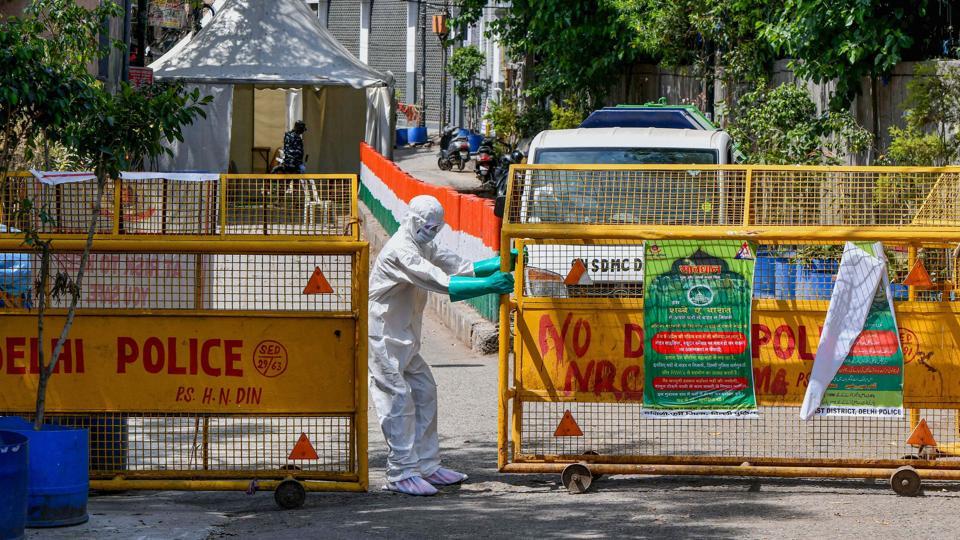
The three localities that have been added to the list are B Block Jahangirpuri, Nabi Karim and Chandni Mahal.
Containment zones are localised (up to a kilometer in radium) and are aimed to prevent the spread of Covid-19 from a locality or a village to nearby areas. Health ministry officials have described it as a barrier erected around the focus of infection.
Complete list of 26 Delhi containment zones
Entire street affected near Gandhi Park, Malviya Nagar
Entire street affected of Gali No 6, L 1 Sangam Vihar, New Delhi.
Shahajahanabad society, plot no 1, Sector 11, Dwarka.
Dinpur Village
Markaz Masjid and Nizamuddin Basti
Nizamuddin West (G and D block) areas.
B Block Jhangirpuri.
H. No 141 to H. No 180, Gali no. 14, Kalyanpuri Delhi
Mansara Apartments, Vasundhara Enclave, Delhi
3 Galis of Khichirpur including Gali containing H. No. 5/387 Khichirpur Delhi
Gali No 9, Pandav Nagar, Delhi 110092.
Vardhaman Apartments, Mayur Vihar, Phase I, Extension, Delhi
Mayurdhwaj Appartments, I P Extension, Patparganj, Delhi
Gali no. 4, from H. No. J- 3/115 (Nagar Dairy) to H. No. J- 3/108(towards Anarwali Masjid Chowk), Krishan Kunj Extension, Delhi
Gali No. 4, from H. No J- 3/101 to H. No. J - 3/107 Krishan Kunj Extension Delhi.
Gali No. 5, A Block (From H No. A- 176 to A-189), West Vinod Nagar Delhi 110092.
J&K, L and H pockets, Dilshad Garden
G, H, J Blocks, Old Seemapuri
F -70 to 90 block, Dilshad Colony
Pratap Khand, Jhilmil Colony
Shastri Market including JJ cluster of South Moti Bagh
Bengali Market/BabaR Road adjoining area of Todarmal, Babar Lane and School Lane
Sadar Bazar Central District
Containment zone in District North: B Block Jahangirpuri
Nabi Karim
Chandni Mahal
Officials said the decision to expand the number of containment zones in central Delhi areas was a fallout of concerns about the possible spread of Covid-19 cases due to contacts of Tablighi Jamaat workers.
Also read: India reports 37 Covid-19 deaths, 896 cases in 24 hours; biggest jump in a day
In containment zones, residents are not allowed to step out to buy vegetables, grocery items, medicines and other essentials. There could be multiple screening by health officials, police and civic bodies. People living in containment zones are put under surveillance to track if any person has developed the symptoms of Covid-19 (fever, sore throat, etc).
A majority of Covid-19 cases reported in Delhi are linked to the congregation at the Tablighi Jamaat headquarters last month, turning the Markaz into the epicentre of the disease in Delhi and across the country.
In the national capital, Tablighi Jamaat-linked cases have also been a cause of key concern. For one, officials concede, because they cannot say with any amount of confidence that the authorities including the police have been able to trace all the people who joined the congregation at the Nizamuddin headquarters or identify all the Covid-19 clusters linked to the Jamaat.
But Delhi Police has been trying, scanning phone signals that were in and around the Tablighi headquarters, the Markaz. A senior city government official said Nabi Karim and Chandni Mahal were added to the containment zone list after the police carried out field verification about some of these people, before the health services moved in.
ABOUT THE AUTHORShishir GuptaShishir Gupta is Executive Editor at Hindustan Times and one of India's top journalists covering national security, strategic affairs, foreign policy and geopolitics. Over the past three decades, he has extensively reported on India's military, diplomatic and security landscape, covering every major conflict and national security challenge, from the 1999 Kargil War and the 2020 East Ladakh standoff to Operation Sindoor in 2025. He has also covered major terror attacks, including the IC-814 hijacking, the 26/11 Mumbai attacks and the 2025 Pahalgam terror strike, along with numerous Pakistan-backed terrorist incidents in the Kashmir Valley and across India. He has reported on national and state elections for more than three decades. A recognised authority on strategic affairs, Gupta has covered India's nuclear programme since the Pokhran-II (Shakti series) tests in May 1998 and has written extensively on global nuclear issues, Indian diplomacy and the country's expanding global outreach. He has also reported widely on international conflicts and terrorism, with a special focus on the Indian subcontinent. Gupta has interviewed Prime Minister Narendra Modi more than four times, including Modi's first interview with the print media after becoming Prime Minister in May 2014. His other interviews include three with the Dalai Lama, as well as conversations with Benjamin Netanyahu, Amit Shah, Yogi Adityanath, S. Jaishankar, Nirmala Sitharaman and Piyush Goyal. He is the author of Indian Mujahideen: The Enemy Within (Hachette, 2011) and Himalayan Face-off: Chinese Assertion and Indian Riposte (Hachette, 2014). He was awarded the Chevening-Wolfson Joint Scholarship at Wolfson College, University of Cambridge, UK, in 1998 and participated in the International Visitor Leadership Program (IVLP) of the US State Department in 2006. He received the Ben Gurion Prize from Israel in 2011 and the K. Subrahmanyam Prize for Strategic Studies in 2015 from the Manohar Parrikar Institute for Defence Studies and Analyses (MP-IDSA). Since 2024, he has hosted Point Blank, Hindustan Times' weekly YouTube show on global geopolitics.Read More

E-Paper


