
 E-Paper



55% of total stubble burning cases in Punjab this year reported in last 5 days
The number of farm fires thus far this year, at 23465, is still almost half of 44086 cases reported for the corresponding period (till November 4) last year, but most officials expect it to increase over the coming week. .

 Prefer HTon Google


With the paddy harvest almost 70% complete, the spike in the farm fires is visible in the hinterland of the agrarian state of Punjab, with 3,032 farm fires were reported on the Diwali Day; 55% of total cases of stubble burning this year have been reported in the last five days.
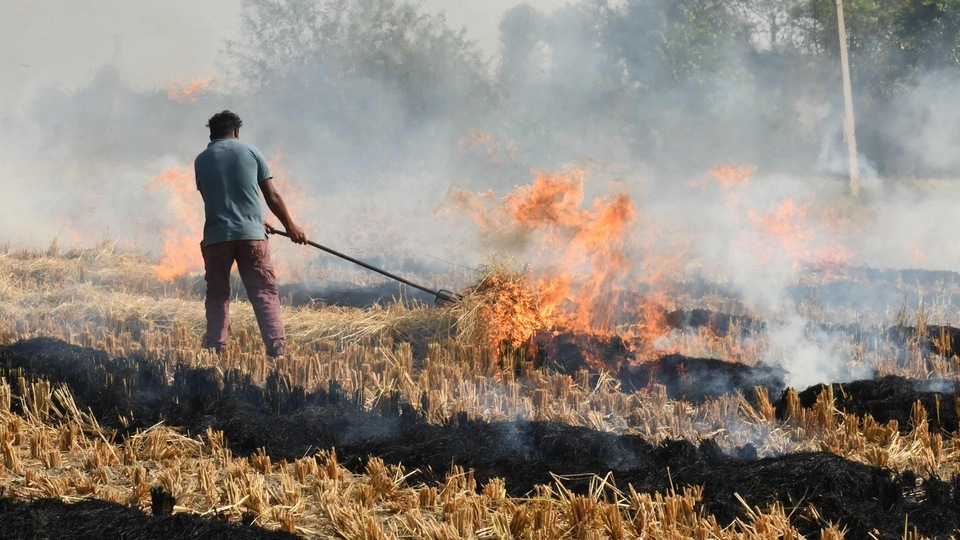
The number of farm fires thus far this year, at 23465, is still almost half of 44086 cases reported for the corresponding period (till November 4) last year, but most officials expect it to increase over the coming week. .
On November 4, 3,032 farm fire events were captured by satellite in Punjab. In 2019, there were 5,953 active fires on the same date and in 2020, 4,908 -- an indication of how high the number could go.
Many farmers with smaller holdings are burning straw instead of exploring ex-situ (away) and in-situ (onsite) handling and there is a need to offer incentives for farmers who don’t burn straw said a Punjab agriculture department official.
“If the government wants to end this practice, it should implements the Supreme Court judgment and give Rs. 100 per quintal as incentive for handing of straw. This will help, as farmers can’t spend extra due to the high cost of clearing fields using machinery”, said Jugraj Singh, farmer leader from Samana.
The highest number of farm fires on Diwali were reported from Ludhiana, which saw 292 cases. Sangrur recorded 283, while neghbouring Barnala recorded 237. Ferozpur recorded 278 cases.
The Punjab Pollution Control Board is sending teams to penalise erring farmers.
Meanwhile, the number of farm fires has also gone up in Haryana with the state reporting 228 such incidents on November 4, taking the number of fires so far to 3,666. State government officials claimed there has been a 45% decline in farm fires this year, as against 6,581 incidents of stubble burning reported from September 15 to November 4 last year. A delayed season is at least partially responsible for this too.
System of Air Quality and Weather Forecasting and Research (Safar), the Union ministry of earth sciences’ air quality monitoring centre, said that on Friday, the share of stubble fire smoke in Delhi’s PM 2.5 (particulate matter with diameter less than 2.5 micrometres) levels peaked to 36% - the highest in this season so far. On Friday, Delhi’s air quality index (AQI) peaked to 462, in the severe category. Experts said that large scale cracker bursting in Delhi-NCR along with peak stubble burning in Punjab and Haryana were responsible for this deterioration.
Indian Institute of Tropical Meteorology (IITM) Pune’s Decision Support System has also forecasted that from November 5 to November 9, stubble burning share in Delhi’s pollution is likely to be around 45-47%.
“Today (Friday) over 3,500 stubble fires were reported in Punjab and Haryana. In the next three days, air quality is expected to be poor in north and central India,” said Pawan Gupta, a research scientist at the Goddard Earth Sciences Technology and Research (GESTAR), Universities Space Research Association.


