
 E-Paper



68 tonnes of aid across 4 flights: PM Modi's love for Nepal reflected in swift relief efforts
Since August 26, India has sent four military flights carrying emergency relief material, temporary shelters, blankets, hygiene kits, solar lamps and more.

 Prefer HTon Google


India, the first major nation to deliver aid to Nepal after devastating flash floods left over 700 dead and thousands missing, is stepping up its relief efforts.

New Delhi has now rushed more than 68 tonnes of emergency relief supplies to the neighbouring country, delivered across four military flights. The swift aid delivery is a testament to Prime Minister Narendra Modi's focus on the “Neighbourhood First” policy.
HT reported on Friday that India was the first country to physically deliver aid to Nepal after the disaster, reinforcing India's "first responder" tag and reflecting its growing record of delivering aid and assistance to disaster-hit countries such as Türkiye and Syria to Myanmar, Sri Lanka and Venezuela.
Deep Dive

Since August 26, India has sent a total of four flights carrying emergency relief material such as temporary shelters, blankets, hygiene kits, solar lamps, and medicines.
Other countries and international organisations have also pledged or begun providing assistance to Nepal.
HT has accessed details of how governments and global organisations are rallying around the disaster-hit country.
Nepal: By 29 August, more than NRs 5 billion has been collected in the Prime Minister’s Disaster Relief Fund operated by the government for flood victims.
India: India has sent a total of about 68.5 tons of emergency relief supplies across four military flights. On 26 August 2026, an IAF C-130J Hercules airlifted 10 tonnes of emergency relief material such as temporary shelters, blankets, hygiene kits, solar lamps, and medicines. On 27 August 2026, an IAF C-17 Globemaster airlifted 37.5 tonnes of relief items, including 28.5 tonnes of tents, blankets, hygiene kits, solar lamps, dewatering pumps, kitchen sets, gensets, 8 tonnes of medicines, and 1 tonne of food items. On 28 August 2026, a C-130J Hercules airlifted a 5-member Indian Army tunnel rescue recce team and a 6-member medical team, and another 10 tonnes of material, including portable gensets, dignity kits, food, water purification tablets, and medicines. The 4th flight carrying 11 tonnes of relief assistance landed in Nepal this morning. It consists of a tunnel technical contingent along with equipment for search & rescue operations; a team of forensics experts for DNA analysis and relief supplies, including blankets, sleeping bags, tarpaulin, plastic sheets & hygiene kits. India's contribution has been announced in physical tonnage rather than a cash figure. Additionally, 16 trucks carrying equipment for a 230-foot Single Lane Modular Steel Bridge have reached Nepal.
China: China has committed to providing both emergency supplies and cash assistance to Nepal. Chinese Ambassador Zhang Maoming has asked Nepal's Finance Ministry to begin the process for receiving these funds, but no confirmed amount has been made public yet. China's offer of a search-and-rescue team was declined by Nepal, which said its own security agencies could manage rescue operations. China’s Ministry of Emergency Management dispatched five tunnel experts to Nepal on 29 August. Two Y-20 transport aircraft of the Chinese People’s Liberation Army Air Force carrying 50 tonnes of emergency relief supplies arrived at Tribhuvan International Airport this morning. The supplies include tents, blankets, sleeping bags, hard tack and first-aid kits. It is reported that Nepal has also asked China to supply Bailey bridges.
UAE: The UAE has allocated $10 million in assistance through the UAE Aid Agency, which is coordinating with local authorities and international organisations to ensure relief reaches all affected communities.
UK: The UK has pledged £5 million (approximately $6.8 million) along with emergency responders, to be disbursed through development partners in a coordinated manner. Like China's offer, the UK's search-and-rescue team offer was declined by Nepal.
Australia: Australia has pledged a $5 million assistance package, broken into three parts: $2 million to the World Food Programme (which has already dispatched food rations and logistics support), $2 million to Australian NGOs through the Australian Humanitarian Partnership (for shelter, hygiene kits, blankets, medical and psychosocial support), and $1 million to the Emergency Action Alliance for locally-led recovery efforts. Three Australian humanitarian workers are set to deploy within 48 hours, along with additional consular staff.
South Korea: South Korea has pledged $1 million in humanitarian aid to be channelled through international organisations. Its offer to send a search-and-rescue team was declined by Nepal.
Sri Lanka: Sri Lanka has pledged $1 million in direct financial assistance to support Nepal's relief efforts.
United States of America: The US State Department has committed $500,000 in immediate assistance for flood-affected communities, covering emergency shelter, relief supplies, clean water and hygiene needs - reportedly channelled through a global grant to Catholic Relief Services. The U.S. is also deploying a disaster-response adviser to support the relief effort. Catholic Relief Services, working through implementing partner Caritas Nepal, plans to deliver more than 2.5 metric tons of food supplies, 500 blankets, 500 mosquito nets, and 500 insulating foam sheets for temporary shelter flooring to two school locations in Rasuwa. The first shipment was delivered on 28 August. On 29 August, the U.S. announced that it is providing more than USD 3.6 million worth of humanitarian assistance, including up to three months of emergency food assistance to up to 10,000 flood-affected households.
Canada: Canada has announced C$ 5 million in humanitarian assistance funding to support emergency relief efforts in Nepal.
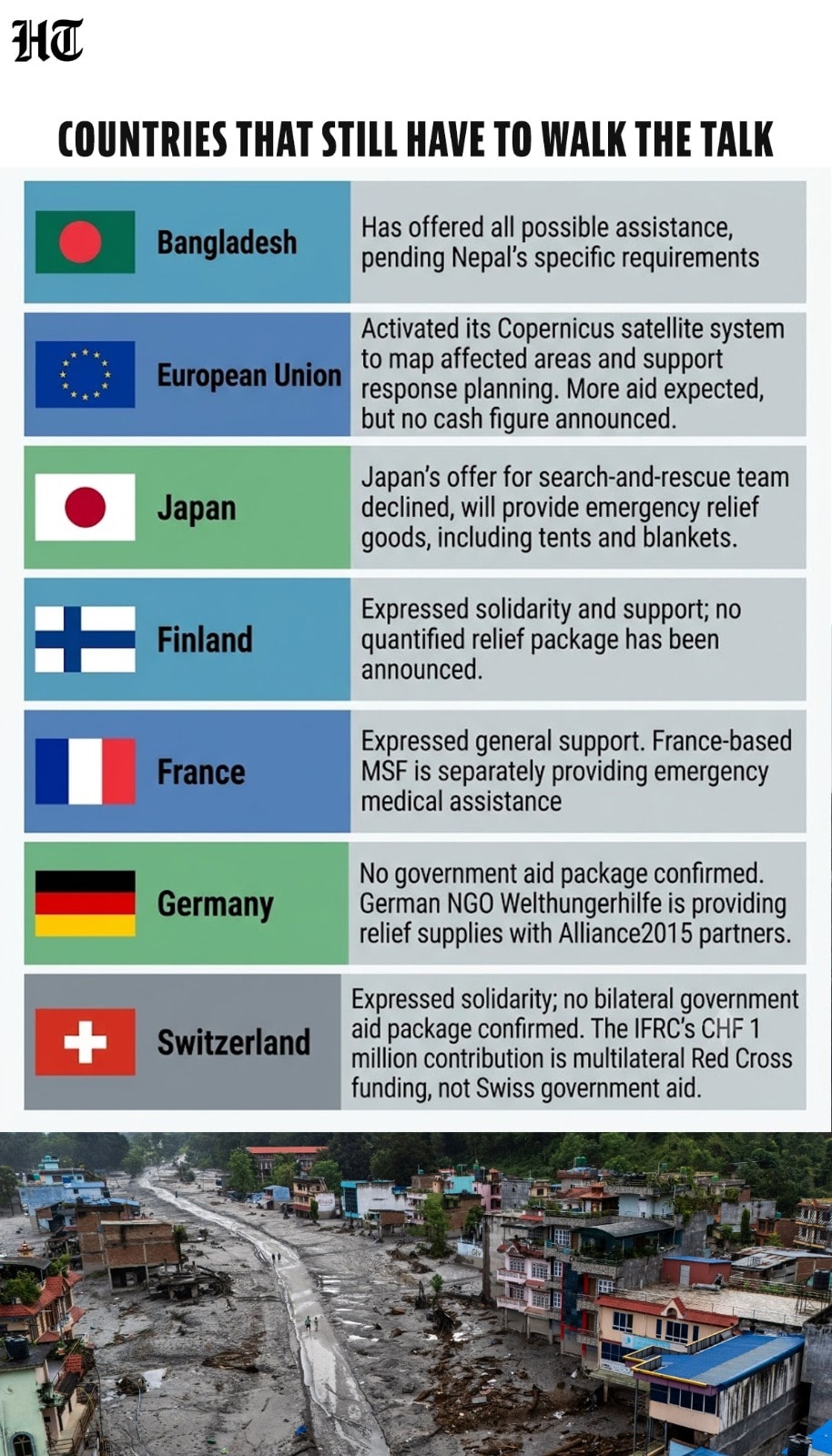
Countries which have expressed solidarity, but yet to announce aid packages
While many countries have pledged support and already rushed out aid packages to Nepal, many are yet to send in relief material despite pledging solidarity.
NGOs, international organisations come to Nepal's aid
World Bank: The World Bank's country director has informed Nepal's Finance Ministry that up to ₹25 billion (approximately $163.6 million) in emergency aid could be mobilised to support rescue and reconstruction efforts.
European Union: The European Union has allocated €2 million (USD 2.32 million) in humanitarian aid to support affected communities. This emergency funding will help address immediate needs, including food, healthcare, clean water and sanitation. EU-funded partners are already providing help on the ground.
UN Central Emergency Response Fund (CERF): The UN has released $2.5 million in emergency funds to support medical care, shelter and water needs for affected communities.
International Federation of Red Cross and Red Crescent Societies (IFRC): The IFRC has released an initial 1 million Swiss francs (about $1.24 million) in emergency funding to support the Nepal Red Cross Society's response, and has separately launched a larger Emergency Appeal for CHF 25 million (approximately $31 million) to sustain the Society's relief operations.
Welthungerhilfe (Germany): This German humanitarian organisation is providing €100,000 (approximately $110,000) from its emergency relief fund.
World Health Organisation (WHO): WHO has dispatched essential emergency medical supplies, including medicines and multipurpose tents - an in-kind contribution not assigned a specific dollar value.
Médecins Sans Frontières (MSF): This French humanitarian organisation has an emergency medical team already on the ground in Nepal, providing immediate care, and also an in-kind contribution without a quantified dollar figure.
On August 26, the Nepal-China border region saw devastating flash floods that are believed to have been triggered by a glacial collapse—some reports point to an avalanche of ice and rocks—that sent a torrent of water, mud and debris down Himalayan river systems, destroying villages and sweeping away roads, bridges and other infrastructure. Officials and scientists are continuing to assess the precise sequence of events.
As of Sunday morning, the combined toll in Nepal and Tibet rose to 750 dead and over 3,000 people missing. As per Nepal’s disaster agency, the death toll had climbed to 734 with 2,498 people missing, while Chinese authorities reported 16 deaths and 546 missing, including over a hundred Nepalis and people from over a dozen countries.


