E-Paper



Covid-19: All 18+ can get booster doses from April 10
Till now, India has allowed only people above the age of 60 or those in high-risk jobs to take their third doses – which the government refers to as precaution doses.

 Prefer HTon Google


Adult citizens will be able to take their third shot of a Covid-19 vaccine from April 10 as long as their second shot was administered at least nine months earlier, the Union government announced on Friday but added that these will need to be paid for and will be available only at private centres.
_1643438110556.jpg "According to government data, so far about 96% of all 15+ population in the country has received at least one Covid-19 vaccine dose while about 83% of 15+ population has received both the doses. (PTI)")
Till now, India has allowed only people above the age of 60 or those in high-risk jobs to take their third doses – which the government refers to as precaution doses. Friday’s expansion comes at a time where there has been a widespread rollout of such booster doses across the world, with many countries making it a precondition for international arrivals.
“Adding an extra layer of safety! Precaution Dose to be available to 18+ age group from 10th April, 2022, at Private Vaccination Centres. All 18+ who have completed 9 months after administration of 2nd dose, would be eligible for Precaution Dose,” Union health minister Mansukh Mandaviya tweeted after the announcement.
Third doses will continue to be free for the elderly and those in health care or frontline jobs at government centres and the rules that apply to them will also apply to the ones who become eligible on April 10. In other words, this means there needs to be a mandatory 9-month gap since the second dose and the third dose can only be of the same vaccine that was used for the first two.
A senior official in the ministry of health ministry denied that the decision was taken mostly from an international travel perspective. “It has got nothing to do with international travel as it is a very small category of people; we, on the other hand, opened it for the entire population. The logic does not hold,” said this person.
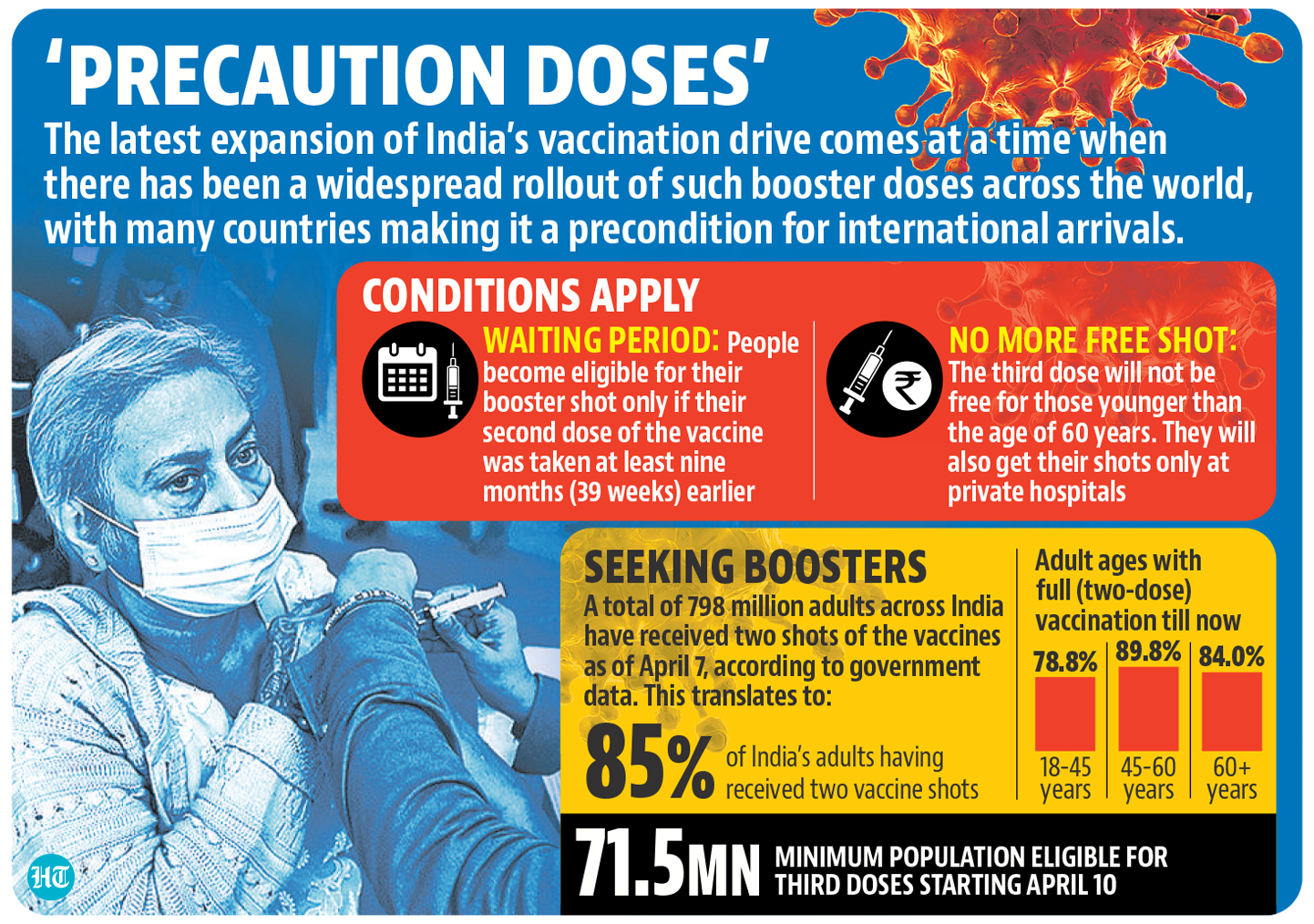
The European Union, one of the biggest destinations for leisure foreign travel during summer from India, is among regions that require people from other countries to have taken a dose in the last nine months.
Adar Poonawalla, the chief executive of Serum Institute of India, which manufactures the Covishield vaccine, announced that the booster dose will cost ₹600 (plus taxes) for those who get the shot at private centres.
“Looking at how a lot of countries are again witnessing virulent waves and with the emergence of new Covid variants, I think it is a step taken in the right direction at the right time. This announcement helps us target our demographic dividend — the workforce which powers India’s economic growth. All studies do show the benefits of vaccination as this will prevent critical illness and hospitalisation. The New England Journal of Medicine articles have clearly shown the benefits of third dose. The precautionary dose will safeguard people above 18 and most importantly the ones who have co-morbidities from infectious stages of the disease,” said Dr Bishnu Panigrahi, group head, medical strategy and operations, Fortis Healthcare.
A second expert, however, said the decision needed more study. “Elderly or those with compromised immunity require assistance but how much boosting is required in healthy adults needs more scientific evidence. We do not have enough data currently to back this move. We need to invest in research, especially in India,” said Dr Gagandeep Kang, senior vaccine expert, and faculty, Christian Medical College, Vellore.
There have been no studies or analyses of vaccine protection waning in India, but in real-world studies from abroad, there is growing consensus that vaccines begin losing their ability to prevent symptomatic disease six months after the primacy (two-dose) vaccination course. The protection from severe disease or the risk of death is more durable, most studies have found.
According to an editorial titled in JAMA published in January, this year, “… providing another vaccine dose following a 2-dose initial series is associated with both improvement in the immunological response to the vaccine antigen and reduction in the risk of symptomatic and asymptomatic infection.”
But the decision on whether to offer third doses has been complicated by varying degrees of vaccine coverage, both globally as well as within the country. The World Health Organization earlier this year dropped its opposition to booster doses – it had till then called on countries to first address vaccine inequity – and advised countries to take a decision based on their own circumstances. In a guidance released on January 21, the world health body said countries with “moderate-to-high rates of primary” vaccination should prioritise available resources to first achieve high booster dose coverage in higher priority-use groups, such as the elderly, before doses are opened to other younger groups.
This largely appears to have been the approach India has followed, where the precaution doses for the elderly was opened up on January 10.
The government official cited above said that the technical group’s recommendations were to first let all adults with co-morbidities become eligible, but the administration made everyone – irrespective of if they have comorbid illnesses – eligible from a public health perspective.
“The scientific recommendations by National Technical Advisory Group on Immunisation (NTAGI) were in favour of opening precaution dose for all adults (18+) with co-morbidties as they are at an equal risk of developing severe disease as those aged 60 and above. However, to choose those with comorbidities in such a large cohort of people is not easy from the point-of-view of public health as people are hassled when asked to get certificates made; and face all kinds of extortions. Therefore, it was decided to open it for everyone who thinks they need it by paying for it at private vaccination centres.”
According to government data, so far about 96% of all 15+ population in the country has received at least one Covid-19 vaccine dose while about 83% of 15+ population has received both the doses. At least 24 million precaution doses have been administered to the group that became eligible on January 10 .
An analysis by HT on March 22 had shown than a little over a third (36%) of all Indians above the age of 45 received their second dose of the Covid-19 vaccine at least six months ago – a time threshold that according to many studies causes significant waning of immunity — highlighting the need for the country to make available booster shots to a wider population. Several global studies, both in laboratory setting as well as those that looked at real-world data, have shown that vaccine effectiveness against severe Covid-19 starts decreasing after a certain time period – widely believed by experts to be around four-to-six months after people were administered the second dose of the vaccine.