
 E-Paper



Anthrax kills five rhinos at nor Bengal’s Jaldapara National Park
The National Park spreads over more than 200 sq km in the foothills of the eastern Himalayas and is known for its one-horned rhino. It has the highest rhino population after the Kaziranga National Park in Assam.


Anthrax, an infectious bacterial disease, has already killed at least five one-horned rhinoceroses at Jaldapara National Park (JNP) in north Bengal.
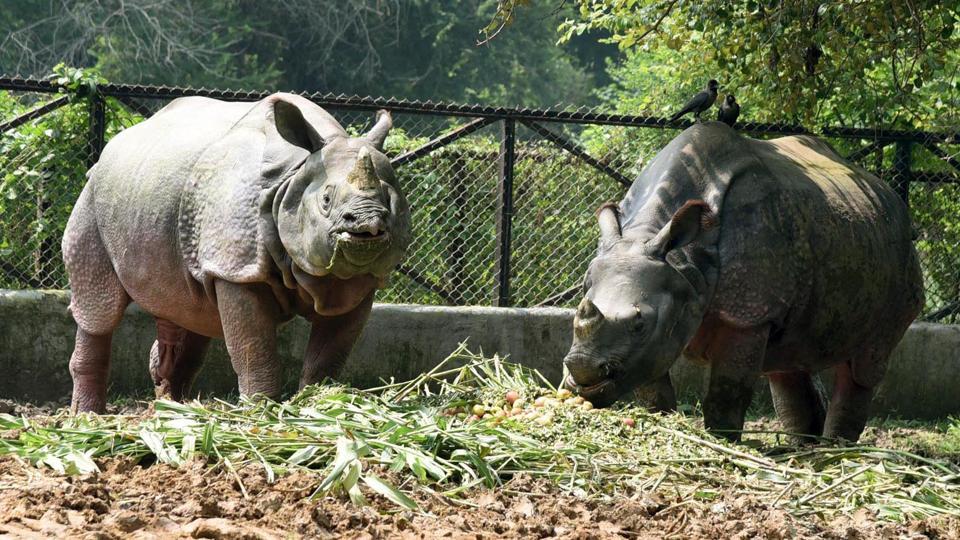
The National Park spreads over more than 200 sq km in the foothills of the eastern Himalayas and is known for its one-horned rhino. It has the highest rhino population after the Kaziranga National Park in Assam.
“We had sent blood and tissue samples of the carcasses to government laboratories for testing. The samples have tested positive for anthrax,” said a top forest official, who didn’t wish to be named.
Following the confirmation from the lab about the disease, the state forest department has started vaccinating all rhinos in the area, where the disease has spread.
“We have identified a seven square kilometer area in the core zone of the park where the disease has spread. There are around 13 rhinos in that area. We have started vaccinating all the 13 rhinos. Till Saturday morning five have been vaccinated,” said the official.
The rhino population in West Bengal had shot up from 22 in 1986 to more than 280 at present. While Jaldapara has more than 230 of these animals, the Gorumara National Park also in north Bengal, has around 50 rhinos. Forest officials said that there is no need to vaccinate all rhinos in the park.
“Till date five rhinos have died. We are taking all measures to contain the disease that is killing the rhinos,” said Ravi Kant Sinha, chief wildlife warden of West Bengal.
As forest officials are using kunki elephants (trained captive elephants) to reach the affected area and vaccinate the rhinos from a distance with the help of dart guns, the elephants are also being vaccinated. There are around 78 captive elephants at Jaldapara National Park, which are used by forest officials for patrolling.
Forest officials, however, said that the national park’s tourism won’t be affected as the infected zone lies in the core area, which is deep inside the park and far away from the tourist zone.
“It is too early to say how the disease spread. We are yet to ascertain whether the source was cattle from adjoining villages which often goes into the park for grazing,” said another forest official.
In 1993, a few rhinos had died when there was an outbreak of anthrax at Jaldapara National Park.
“The local panchayat, animal resources development department and the district administration should join hands to vaccinate cattle in the adjacent villages before the problem takes a serious shape,” said Animesh Bose, program coordinator of Himalayan Nature and Adventure Foundation, a NGO.
Anthrax is primarily a disease of herbivores. Humans almost invariably contract the natural disease directly or indirectly from animals or animal products. It is caused by the bacterium Bacillus anthracis.


