
 E-Paper



Art of drafting legislation fading, workshops needed to enhance skills: Amit Shah
He also mentioned that judicial interventions occur where gray areas are lacking clear legal interpretations; therefore, laws should be made clear


Union home minister Amit Shah on Tuesday reiterated the importance of clear legislative drafting pointing out that judicial intervention arises when lawmakers leave ambiguities in the laws.
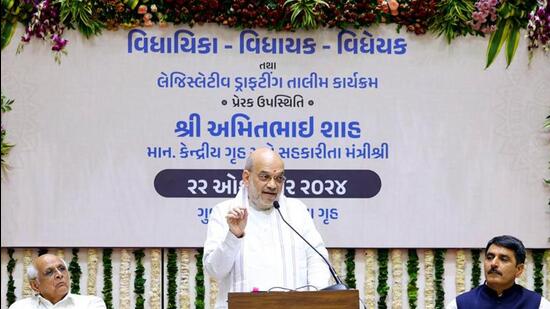
“The judiciary will intervene only when you leave any grey area in drafting the legislation. More clarity in the legislation, less the intervention of courts”, Shah said while speaking at the Gujarat legislative assembly during a ‘Legislative Drafting Training Workshop’.
Citing the example of Article 370, Shah explained that its clear description as a “temporary provision” allowed for its abrogation by a simple parliamentary majority.
“If it had been described as a constitutional provision, a two-thirds majority would have been necessary,” he noted, stressing that well-defined laws minimise the scope for judicial interpretation.
In August 2019, the Centre revoked the special status granted under Article 370 to Jammu and Kashmir.
Shah added that poor drafting has led to a blurring of roles between the legislature, executive, and judiciary.
“Our Constitution is clear about these roles, but bad drafting has caused confusion between them”, he said.
Shah expressed concern that the “art of drafting legislation” is gradually fading and encouraged more workshops to enhance drafting skills. He urged legislative staff to be trained in distinguishing which provisions belong in the Act itself, and which should be left to the rules.
Also Read:‘Tremendous mental pressure’: RG Kar victim’s father writes to Amit Shah
Shah underlined the need to draft laws with both national and international perspectives while ensuring that they remain accessible to the common man.
He pointed to the new criminal laws—the Bharatiya Nyaya Sanhita, Bharatiya Nagarik Suraksha Sanhita, and Bharatiya Sakshya Adhiniyam—as examples of legislation designed with an Indian perspective under Prime Minister Narendra Modi’s direction. These laws, which replaced British-era statutes like the Indian Penal Code (IPC) and CrPC, aim to provide faster justice.
“Once these laws are fully implemented, within the next three to four years, people will receive justice within three years, from the filing of a first information report (FIR) to the conclusion of a case in the Supreme Court,” Shah said, calling this reform one of the world’s most significant in terms of judicial efficiency.
(with inputs from PTI)


