
 E-Paper



As kin try to pick up pieces, mob violence finds place in manifestos
Ansari’s was among 20 lynching cases recorded in the tribal-dominated state since 2016, the highest number of lynching cases for any state in the country, according to civil society group Human Rights Watch


The fight for survival is still on for Mariam Khatun, 51, the lynching of whose husband, meat trader Alimuddin Ansari, in Jharkhand’s Ramgarh on June 17, 2017 resulted in the sentencing to life imprisonment, on March 21, of 11 members of a Hindu rightwing group, the country’s’ first sentencing in a case of this kind.
Ansari’s was among 20 lynching cases recorded in the tribal-dominated state since 2016, the highest number of lynching cases for any state in the country, according to civil society group Human Rights Watch . Data collated by the group showed that all the victims were from the marginalized sections -- Dalits, poor Muslims and tribals. They also showed that the mob attacks took place because of rumours of child lifting or suspicion that those attacked were carrying beef.
Civil society activists claim lynching deaths have continued in Jharkhand because the state government has failed to implement the Supreme Court guidelines to control mob violence, including holding police officers accountable. However, the state government has implemented some of the guidelines, such as deputing a nodal officer and lodging first information reports promptly.
Jharkhand chief secretary Devendra Kumar Tiwari said: “I held a video conference with all deputy commissioners and superintendents of police (SPs) in which they were categorically told that responsibility would be fixed in case any such incident took place in the areas falling under their jurisdiction.”
Mob violence has found mention in manifestos of almost all parties in the state. The opposition alliance of Jharkhand Mukti Morcha (JMM), Congress and Rashtriya Janata Dal has promised a law for lynchings like one in Rajasthan if it comes to power, and the Bharatiya Janata Party (BJP) has pledged effective steps to prevent mob violence without getting into specific details.
“We would put an end to this ugly cycle of mob killing in the state. We are committed to bring a law to deal with lynching cases and there would be death penalty for deaths in mob violence,” said JMM president Hemant Soren, who is also face of the opposition campaign in Jharkhand.
The ruling BJP said that chief minister Raghubar Das instructed police officials in all the cases that strict action should be taken against the accused irrespective of their party or religious affiliations. “We set up fast-track courts to hear lynching cases and because of this convictions have happened in three cases and other cases will also be decided soon,” said BJP state spokesperson Pratul Shahdeo.
Meanwhile, the families are trying to pick up the pieces even as they continue to push for justice.
Khatum is unhappy with the government:
“Except for a house and Rs. 2 lakh compensation, the government has done nothing. I was assured that the government will provide me a source of livelihood and also take care of my family. This has not happened so far,” she said.
Ansari, a meat trader in the Muslim neighbourhood of Ramgarh, is survived by Khatun and six children. Of them, the eldest, Sehjat Akhtar, 23, died in 2018 and Khatun said now there is no earning member in the family. “We are surviving on the compensation I got after his death. The money is almost exhausted. If my 19-year-old second son gets a job, even for Rs 5,000 per month, my family will be able to get two meals a day. I urge political parties who came (to express support) after my husband’s death to help,” she said.
A district official said the administration will try to do this after the elections are over and the model code of conduct is lifted. “Let the election process get over and I will look into it,” said Ramgarh district collector Jugnu Minj.
Convictions have happened in three cases.
In Seraikela, a fast-track court in July 2018 sentenced 12 accused to four years’ rigorous imprisonment in the mob lynching of two young men in Shobhapur in Seraikela-Kharsawan district while acquitting three accused for lack of evidence.
On May 18 2017, a violent mob caught hold of Mohammed Haleem and Mohammed Nayeem in Shobhapur over child lifting rumours and thrashed them to death. Sajjad alias Raju Seikh and Siraz Khan managed to flee but were tracked down about 20 km away in Padnamsai village of the district and allegedly beaten to death. Trial is still pending in the Padnamsai case, officials said.
In Latehar in western Jharhand, a fast-track court on December 19, 2018 convicted eight persons for their involvement in the murder of Mazloom Ansari (32) and Imtiaz Khan (11) – who were lynched on March 18, 2016 in a forest in Latehar district. Vinod Prajapati, named the prime accused, is still absconding. While Ansari was beaten to death, Khan was hanged from a tree, according to the police charge-sheet.
“Trial is moving at a slow pace in other lynching cases in the state,” said Shahbad Ansari, a lawyer, who has been tracking mob violence cases in the state.
In East Singhbum district, Uttam Verma is fighting to get justice for the lynching of his brothers Gautam and Vikas Verma and their friend Ganesh Gupta, all beaten to death by a mob over child lifting rumours on May 18, 2017. His grandmother, Ramsakhi Devi, was badly injured in the mob attack.
“Nine of the accused have still been absconding while police have arrested two dozen accused. Some of the accused are JMM leaders while the BJP government too didn’t act to deliver justice. We have now written to home minister Amit Shah seeking a CBI {Central Bureau of Investigation} probe,” Uttam said.
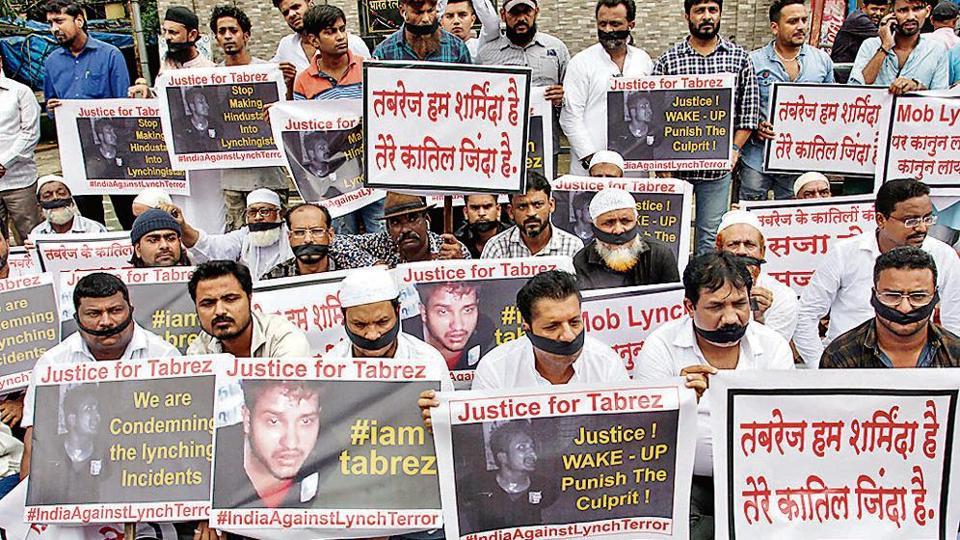
In Saraikela Kharswan district, Shahsita Parveen had a hard time trying to register a murder case over the death, allegedly from beating, of her husband Tabrez Ansari, when he was caught attempting to burgle a house on the intervening night of June 17-18, 2019. He was thrashed badly and then handed over to the police by the villagers on June 18 and was sent to jail same day. He died in hospital eight days later. Two of Tabrez’s associates Numair Ali and Sheikh Irfan managed to escape and are absconding.
On September 18, Jharkhand police reimposed section 302 of the IPC (murder charge) in a supplementary charge-sheet against all the 13 accused in the case after Parveen staged a protest over dropping of the murder charge in the initial charge-sheet and booking the accused under section 304 of the IPC (culpable homicide not amounting to murder).
“There is no one for us,” said Parveen, claiming that none of the political party leaders or the state government has helped her so far. “All the leaders think about their vested interests and exploit common people, even the victims of such heinous crimes. We have only hope from the court and want death sentence for the killers of my husband at the earliest.”
(With inputs from Debashish Sarkar in Jamshedpur)


