
Sign in

Bihar Poll trends: Grand Alliance falters despite Tejashwi’s promises; NDA dominates

It appears that Yadav’s Rashtriya Janata Dal (RJD), which is expected to get fewer seats compared to the 2020 elections, failed to expand its vote base

Published on: Nov 14, 2025, 11:25:14 IST
Share
Share via
  • facebook
  • twitter
  • linkedin
  • whatsapp
Copy link
  • copy link

New Delhi: The Tejashwi Yadav-led Grand Alliance (GA) has failed to make a decisive mark, with the National Democratic Alliance (NDA) heading for a thumping majority in the 243-member state assembly, trends showed.
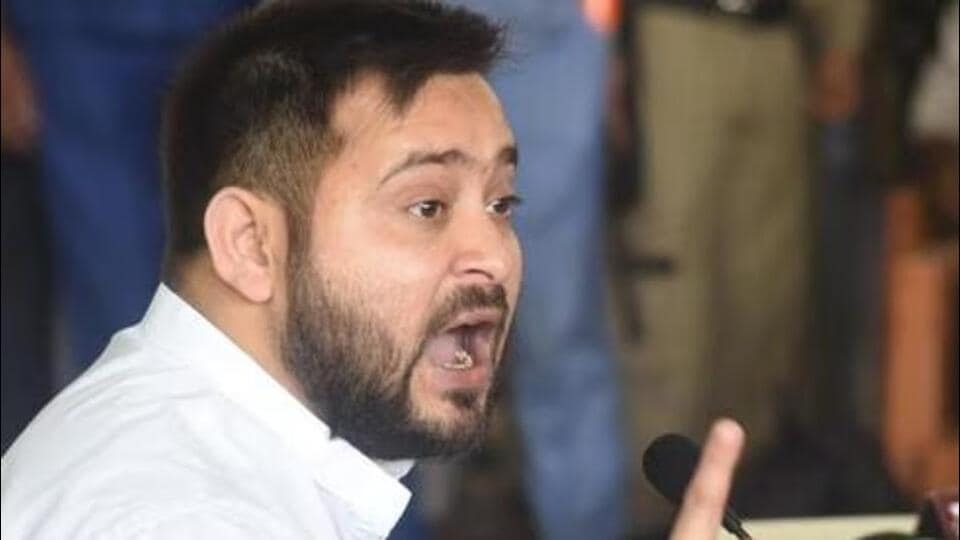
Tejashwi Yadav tried to expand his social base by wooing Kushwaha and Koeri voters by giving them a good number of tickets, but counting trends show the experiment failed. (Santosh Kumar/ Hindustan Times)

It appears that Yadav’s Rashtriya Janata Dal (RJD), which is expected to get fewer seats compared to the 2020 elections, failed to expand its vote base beyond its traditional Muslim–Yadav (MY) support, which constitutes about 34% of the state’s population.

Tejashwi tried to expand his social base by wooing Kushwaha and Koeri voters by giving them a good number of tickets, but counting trends show the experiment failed. The GA’s vote share was about 37%, compared to 48% for the NDA, which appears to have secured the majority of votes from all castes other than MY.

During the elections, Tejashwi tried to woo voters with a host of promises such as a government job for every family, 2,500 per month for every woman in the state, 30,000 as monthly salary to Jeevika Didis, and 30,000 one-time assistance to women to counter Nitish’s 20,000 seed money scheme for new businesses. To broaden his caste base, he also promised a 5 lakh interest-free loan to deprived castes such as barbers, potters, and carpenters.

These promises were countered by the NDA, which claimed they were impossible to implement, and it appeared that people had more trust in Nitish Kumar’s delivery of schemes than in Tejashwi’s lofty promises.

Even though Tejashwi addressed more than 100 rallies across the state, there was no other leader in the party to complement his effort. His father and former chief minister (CM), Lalu Prasad, had limited presence in the polls, with just one roadshow in the Danapur assembly constituency in Patna district.

There was also some chagrin on the ground over differences within Lalu Prasad’s family. Tejashwi’s elder brother Tej Pratap was expelled from the party before the polls, and his sister, Rohini Acharya, posted cryptic messages about party decisions during the elections, apparently expressing her discontent against Tejashwi’s trusted lieutenant, Sanjay Yadav, the party’s Rajya Sabha MP.

The NDA leaders made full use of the political fodder provided by Lalu’s family during the campaign and repeatedly reminded voters about the “jungle raj” during Lalu’s tenure as chief minister. This resonated with voters, especially those above 40 years of age, who had faced law-and-order issues during his rule.

Moreover, the GA was not able to create a narrative against chief minister Nitish Kumar on the ground, even though Tejashwi remained popular among MY voters. GA voters, including Yadavs and Muslims, rarely spoke ill of Nitish Kumar, indicating that there was no anti-incumbency against the CM.

Many political commentators felt that Tejashwi lacked the energy he had shown in the 2020 polls during the 2025 campaign. He was missing from the ground for a long period when the Grand Alliance partners were squabbling over ticket distribution, while rivals were busy campaigning. The RJD’s social media push for its promises was considered weak, and it was also unable to counter the pre-poll money distributed by the Bihar government on the ground.

  • Chetan Chauhan
    ABOUT THE AUTHOR
    Chetan Chauhan

    Chetan Chauhan is the National Affairs Editor looking into all aspects of news and features from across India. A Chevening scholar with over three decades of experience in reporting and news management, Chetan has extensively covered all important aspects of the social sector, political economy, environment and climate change nationally and internationally. He did a journalism course at the Reuters Institute of Journalism in Oxford and Digital Media training at Nanyang Technological University in Singapore. He started as a reporter with The Statesman in 1996 and joined the Hindustan Times in 2000 in the metro bureau covering environment, crime and Delhi politics. He covered hot local news, from the Jessica Lal murder case to the rebellion of Delhi Congress MLAs against then Chief Minister Sheila Dikshit, to the replacement of toxic vehicle fuel with cleaner compressed natural gas (CNG) in the national capital. Some of his stories on air pollution became part of the Supreme Court’s landmark MC Mehta versus Government of India case in the National Capital Region (NCR), forcing the government to take corrective measures. As part of the national political bureau since 2004, he covered important central sectors such as environment, education, social justice, labour, rural development, water resources, renewable energy, agriculture, broadcasting and the Planning Commission for more than a decade producing several exclusive and investigative breaking stories. His specialisation is the environment, having covered at least a dozen United Nations global conferences on climate change, biodiversity and wildlife including climate summits in Paris, Copenhagen and Bali. He also covered India’s two five-year plans ---11th and 12th and reported on drafting and execution of right based laws such as Right to Education, Right to Information and rural job guarantee law, MG-NREGA, now being introduced in new format as VG-RAM-G Act. He has in-depth knowledge of social sector issues. He was one of the first to report on tigers vanishing from Sariska and Panna wildlife reserves in 2004 and 2008, respectively, leading to the setting up of the National Tiger Conservation Authority (NTCA) and the introduction of stringent penal provisions for poaching. He has written extensively on the rising human-animal conflict in India and the degradation of India’s biodiversity hotspots because of mining and other activities. Since 2004, Chetan has covered Parliament comprehensively and participated in training on the nuanced coverage of Parliament proceedings. He has travelled extensively across India to cover national and provincial elections since 1998, especially in the Hindi heartland states, considered India’s road to power. He writes a regular column for Hindustan Times, Ecostani, on important national politics, economy, Himalayan ecology and environmental issues. His other responsibilities include providing inputs for edits and edit page articles for the publication, apart from managing news flow from across India.Read More

Follow India news real-time updates and the latest news covered on Hindustan Times, featuring today's critical updates on Sonam Wangchuk LIVE and more across India.