
Sign in

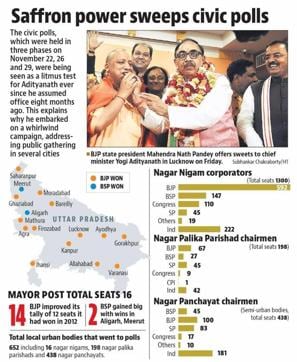
BJP sweeps UP civic body polls, wins 14 out of 16 mayoral seats

Meanwhile, the Congress was trounced in two nagar palika parishads at Jayas and Gauriganj in Amethi, the party’s pocket borough.

Updated on: Dec 2, 2017, 07:47:36 IST
Hindustan Times, Lucknow | By
Share
Share via
  • facebook
  • twitter
  • linkedin
  • whatsapp
Copy link
  • copy link

The ruling BJP captured 14 out of 16 mayoral seats as it swept the urban body polls on Friday but it is the Mayawati-led Bahujan Samaj Party (BSP) which made stunning gains in the local elections in Uttar Pradesh.

Uttar Pradesh chief minister Yogi Adityanath, deputy CM Keshav Prasad Maurya and BJP state president Mahendra Nath Pandey celebrate the victory of the party in the state civic body elections at the party office in Lucknow on December 1. (PTI Photo)

The BJP’s success came months after the party stormed to power in India’s most populous state with a thumping victory in the assembly polls.

The Samajwadi Party and Congress – which fought the assembly polls in alliance – were trounced once again in the urban body elections with the BJP taking most of the seats in the nagar nigams, nagar palika parishads and nagar panchayats.
Article image

For the Congress especially, the poor show will hurt as it comes a few weeks before the crucial assembly polls in Gujarat where it is trying to regain power after 22 years.

Uttar Pradesh chief minister Yogi Adityanath, who campaigned extensively ahead of the three-phase polls last month, attributed the “historic” victory to the people who reposed their faith in the party and the government.

“Now the BJP will look forward to achieving the goal of hundred per cent success in the 2019 Lok Sabha polls,” he added. The civic polls were seen as his first major test since he assumed office eight months ago.

The only blemish for the chief minister came in Gorakhpur’s ward no. 68 -- called Purana Gorakhpur – where an independent Muslim candidate defeated the BJP nominee. The ward houses the Gorakhnath temple which is headed by Adityanath, who was a Lok Sabha member from Gorakhpur for five consecutive terms since 1998.

The BSP’s successes came in Aligarh and Meerut, considered BJP strongholds, where the party won the mayoral posts. The party also won 19 nagar palika chairpersons posts besides 144 corporators’ seats.

The BSP’s penetration in the cities after its rout in the Lok Sabha and assembly polls showed signs of revival earlier than expected, political analysts said. The BSP, unlike the BJP, had had kept its campaign a low-key affair.

The Congress, on the other hand, was trounced in two nagar palika parishads at Jayas and Gauriganj in Amethi, the party’s pocket borough.

The polls also made history with BJP’s Sanyukta Bhatia set to be Lucknow’s first woman mayor in 100 years since the Uttar Pradesh Municipalities Act was enacted in 1916.
  • Brajendra K Parashar
    ABOUT THE AUTHOR
    Brajendra K Parashar

    Brajendra K Parashar is a Senior Journalist with the Hindustan Times, based in Lucknow, with nearly three decades of experience covering governance, public policy, politics and development in Uttar Pradesh. Over the years, he has reported extensively on key sectors, including energy and renewable power, mobility and transport, road safety, agriculture and allied sectors and issues related to farmers, rural development, taxation under the Goods and Services Tax (GST) and public administration. A seasoned political correspondent, Parashar closely tracks the Bharatiya Janata Party (BJP) and has covered every major election in Uttar Pradesh right from three-tier panchayat elections and urban local body polls to Assembly and Lok Sabha elections. He also reports regularly on the proceedings of the Uttar Pradesh Legislature, bureaucracy, governance, policy decisions and administrative developments with focus on their impact on public life. His reporting is known for its strong analytical approach, extensive use of official data. His areas of interests include investigative journalism, long-form political and policy analysis, data-driven reporting, elections and institutional reforms. Parashar holds a postgraduate degree in Political Science with First Division from Aligarh Muslim University (AMU), followed by a Diploma in Journalism and Mass Communication from the same university. His inclination towards journalism began during his student days, when he regularly contributed letters to editors and articles to newspapers and magazines. In the mid-1990S, his essay, “Should India Switch Over to the Presidential Form Of Government?”, published in Politics India magazine edited by noted constitutional expert Subhash C Kashyap, was adjudged the best entry in a national competition. His work has received professional recognition, including the Hindustan Times Journalist of the Month Award for an impactful series on drinking water issues during the 2010 Lok Sabha election campaign. Originally from Kasganj in western Uttar Pradesh, Parashar is currently based in Lucknow where continues to report on politics, governance and public policy.Read More