Sign in

C Gopalan, who championed India’s public health programme, dies

Dr Gopalan’s research on the nutrition status of the Indian population laid the foundations for several national nutrition programmes, including those for anaemia control, vitamin A supplementation, integrated child development services (ICDS), the goitre control through universal salt iodisation.

Updated on: Oct 4, 2019, 04:28:56 IST
Share
Share via
  • facebook
  • twitter
  • linkedin
Copy link
  • copy link
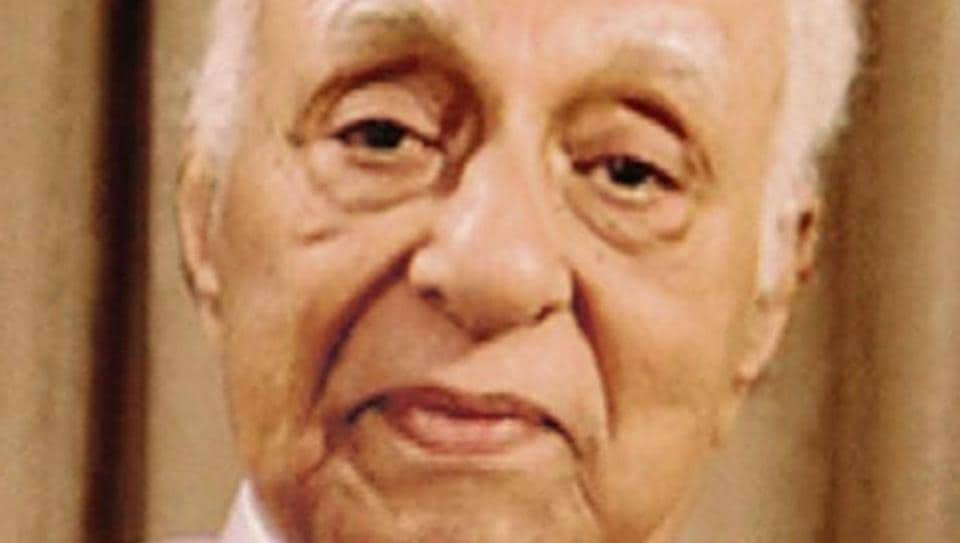
Dr Coluthur Gopalan passed away on Thursday
Dr Coluthur Gopalan passed away on Thursday at his Chennai home over a month before his 101st birthday on November 28. A former director of the National Institute of Nutrition (NIN), director general (DG) of Indian Council of Medical Research (ICMR), and the founder-president of the Nutrition Foundation of India (NFI), he is widely regarded as the Father of Nutrition Science in India.
Dr Gopalan’s research on the nutrition status of the Indian population laid the foundations for several national nutrition programmes, including those for anaemia control, vitamin A supplementation, integrated child development services (ICDS), the goitre control through universal salt iodisation.
He was awarded Padma Bhushan in 2002, recognised as a Living legend in nutrition by the International Union of Nutrition Sciences in 2013 and the Federation of Asian Nutrition Societies in 2018.
Born in Salem in Tamil Nadu, Dr Gopalan completed his MD from Madras Medical College in 1943 and did his PhD in nutrition in the UK in 1949. He began his career in nutrition at the Nutrition Research Laboratory in Coonoor, which soon shifted to Hyderabad, where Dr Gopalan took over as the director in 1962. Under his leadership, NRL evolved from an institute with just six scientists into the National Institute of Nutrition (NIN), which has become India’s nodal institute for scientific research on nutrition and allied sciences.
I first met Dr Gopalan when he was the DG of ICMR and I was a senior research officer. He asked me to move from ICRM Delhi to NIN Hyderabad to look after the clinical component of a WHO-ICMR collaborative study on the impact of hormonal contraceptives on undernourished women. I told Dr Gopalan that while I had experience in clinical trials of contraceptives, all I knew about nutrition was what I learned as an undergraduate in medical college. He said, “NIN needs a person with experience in clinical trials; you will initially get help in the nutritional aspects, but you’ll have to quickly acquire expertise in nutrition.”
That was the beginning of my journey in what for me was uncharted seas. A year later, he asked me to undertake a community-based study on the impact of early-childhood undernutrition on reproductive health in rural girls. I was taken aback and said I had never done community-based studies. The answer was, it was high time to start. The study was completed two years later.
I am one of the many researchers who benefitted from Dr Gopalan’s ability to spot potential and push people to challenging tasks to hasten their professional development. After a decade at NIN, I came back to ICMR in Delhi and then joined the erstwhile Planning Commission as an adviser (health, family welfare, and nutrition). The day after my superannuation, I joined Dr Gopalan at the NFI.
Dr Gopalan had a huge role to play in the universal salt iodisation programme. Dr Rajan Sankar, who is now a senior specialist at TATA Trusts but began his career at the Army Medical Corps, followed his advice in directing focus to salt iodisation in Sikkim, which paved the way for the universal salt iodisation programme in India, and ensured that 92% of households now consume salt iodine fortification.
Universal salt iodisation, along with the many supplementation and fortification programmes in India championed by Dr Gopalan, are nothing short of public health triumphs.
Dr Ramachandran is the Director, Nutrition Foundation of India
  • HT News Desk
    ABOUT THE AUTHOR
    HT News Desk

    Follow the latest breaking news, major developments and agenda-setting stories from India and around the world with the newsdesk at Hindustan Times. Operating round the clock, the desk brings together experienced editors, reporters and correspondents to deliver fast, accurate and contextual reporting across subjects that influence public policy, governance, business, society and international affairs. The HT News Desk covers politics, elections, government policies, the economy, business and markets, science and technology, the environment, law and order, infrastructure, education, climate issues and geopolitics, while closely tracking developments across states, institutions and global capitals. The team also leads coverage of major breaking news events, policy announcements, court proceedings, natural disasters, public emergencies and significant international developments. Reports published by the newsdesk are based on information gathered from reporters on the ground, official statements, government agencies, court records, regulatory filings, recognised institutions and other authoritative sources. Stories undergo editorial scrutiny and verification processes to ensure accuracy, fairness and relevance, and are updated as events evolve and additional information becomes available. Whether covering a key political decision in New Delhi, an economic policy shift affecting millions, a landmark court ruling or a major global event, the HT News Desk aims to provide readers with reliable, fact-based journalism that delivers not only the latest developments but also the context and analysis needed to understand their wider implications.Read More