
 E-Paper



Cabinet clears relief package for struggling telecom sector
The steps are expected to benefit Vodafone Idea and Bharti Airtel, saddled with large AGR dues.


India on Wednesday took several steps to offer relief to telecom companies burdened by large regulatory dues and attract foreign capital into the telecom sector.

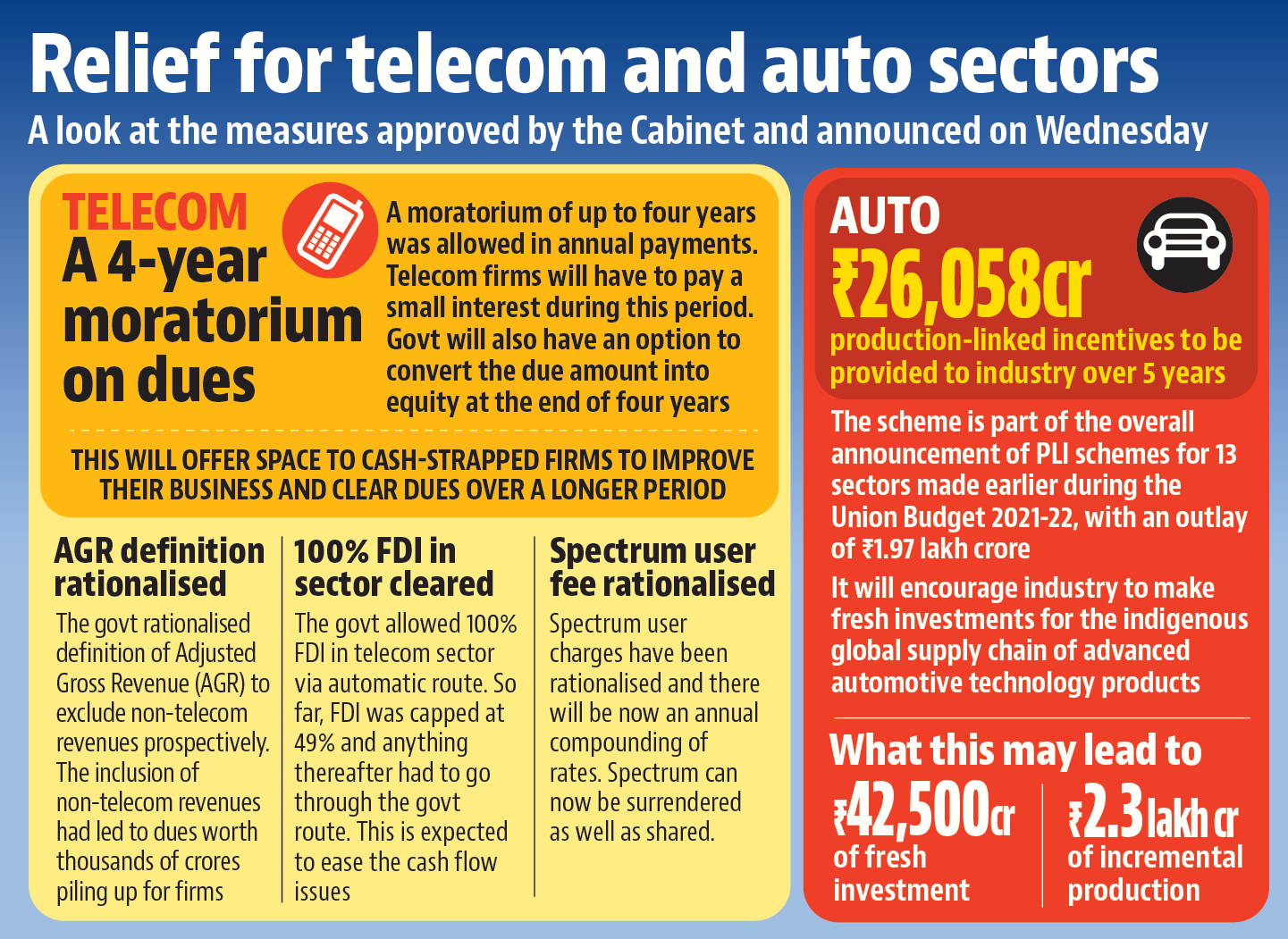
Relief on computing dues relating to AGR, adjusted gross revenue, a four-year moratorium on dues, and the option for the government to convert dues into equity after the moratorium period expires are key elements of the relief package approved by the Union Cabinet.
The cabinet also liberalised foreign ownership rules by allowing 100% foreign direct investment through the automatic route with safeguards. Currently, 100% FDI is allowed in the telecom sector, but only 49% was on the automatic route, and any investment above that limit required government approval.
The steps are expected to benefit Vodafone Idea and Bharti Airtel, saddled with large AGR dues. The relief is likely to ease their financial burden, help save jobs in the sector and ensure much-needed competition in the industry, and comes at a time of concerns that the sector could become a duopoly and scuttle investment in customer service and new technology.
Telecom minister Ashwini Vaishnaw said AGR dues were a contentious and highly litigated issue. “It has been decided to rationalise the AGR definition. Non-telecom revenue will be removed from AGR. This resolves this contentious issue,” Vaishnaw said.
Vodafone Idea had in August approached the Supreme Court for a review of its July 23 order rejecting a plea from companies to allow the government to correct errors in the computation of AGR dues.
After the four-year moratorium, the government will have the option to convert the remaining dues into equity in the companies. “Whatever instalment is left after four years, if it is felt that dues are to be converted to equity, the government will have that option. It is not the company’s option,” Vaishnaw told reporters after the cabinet meeting.
He said the cabinet approved nine structural changes and five reform measures that are expected to change the framework of the telecom sector and bring qualitative change.
To protect government revenues, companies availing of the moratorium will have to pay interest. This would be at the rate of marginal cost of funds based lending rate (MCLR) plus 2%. This moratorium would resolve the cash flow problem faced by the industry, and the improved cash flow can be utilised to upgrade technology, the minister said.
The other structural reform is about spectrum user charges, and license fees and other charges. The minister said that heavy interest, penalty and interest on penalty have been levied so far on these charges.
“This regime was an undue burden on the industry participants. Today, it has been rationalised. Monthly compounding of interest has been changed to annual compounding. A very reasonable interest rate of MCLR plus 2% has been approved, and the penalty has been eliminated completely. These two decisions open up the way for big investments into the telecom sector,” Vaishnaw said, adding that fresh investments will also create more jobs.
The cabinet also approved the removal of spectrum usage charges in future telecom auctions. In such auctions, spectrum allocation would be of 30 years instead of 20 years. Also, businesses could surrender spectrum after a 10-year lock-in period after paying a defined surrender charge.
Asked whether the policy measures would facilitate new investors in the telecom industry, Vaishnaw said the government believes that there should be healthy competition in the sector. “For that, there will be further reforms when 5G spectrum is auctioned…so that more and more players can get into the sector. More players, healthy competition and more choices to customers is the stated commitment of the government,” the minister said.
Industry leaders Bharti Airtel chairman Sunil Bharti Mittal, Reliance Industries chairman Mukesh Ambani, Aditya Birla Group chairman Kumar Mangalam Birla and Vodafone Group chief executive officer Nick Read welcomed the move.
Birla said the measures “will go a long way in unshackling the telecom sector” and “demonstrate the government’s commitment to ensuring healthy growth of the industry”. “The measures also reflect the decisiveness of the Prime Minister, the telecom minister, and the government to address long-standing issues. These reforms will bring alive the digital aspirations of 1.3 billion people and accelerate India’s journey to be a digitally powered economy as envisaged by the honourable Prime Minister,” a Vodafone Idea statement quoted him as saying.
Mittal described the policy steps as seminal reforms to lift an industry that is at the core of Prime Minister Narendra Modi’s Digital India vision. “The latest reforms ensure that the industry is able to invest fearlessly and support India’s digital ambition. Bharti Airtel is fully committed to responding to the call by the Honourable Prime Minister to invest in and accelerate India’s growth,” Mittal said in a statement.
Reliance Jio Infocomm Ltd, in a statement, described the policy as timely steps towards strengthening the telecom sector, which will accelerate India’s transformation to a digital society.
“The telecom sector is one the prime movers of the economy and the key enabler for making India a digital society. I welcome the government of India’s announcement of reforms and relief measures that will enable the industry to achieve the goals of digital India,” said chairman Mukesh Ambani, according to a statement from RIL. Ambani termed the policy steps as a bold initiative.
Nick Read commended the government’s resolve to find a comprehensive solution “that would support a competitive and sustainable telecom sector in India”.
The cabinet also decided to simplify KYC norms by eliminating physical paperwork for customers and simplified the process of setting up telecom towers. Also, customs procedures have been changed to make it easier for telecom companies to import equipment.


