
 E-Paper



Delhi’s Covid-19 tally crosses 5,000 after 206 new infections
Delhi accounts for 10.3% of the total cases in the country, with chief minister Arvind Kejriwal saying recently that his government was prepared to tackle a spike in infections.

 Prefer HTon Google


Delhi reported another big jump of 206 cases on Tuesday, with the total infections doubling to 5,104 in 11 days, even as the national capital ramped up testing amid concerns of a surge in the number of coronavirus disease (Covid-19) cases nudged by a graded exit from the ongoing lockdown.
About 1,500 cases have been added to the Delhi tally in the last five days. The Capital accounts for 10.3% of the total cases in the country, with chief minister Arvind Kejriwal saying recently that his government was prepared to tackle a spike in infections.
After the first three Covid-19 cases were reported in India in January and were contained, a second wave of infections emerged on March 2, as Delhi and Telangana reported one case each.
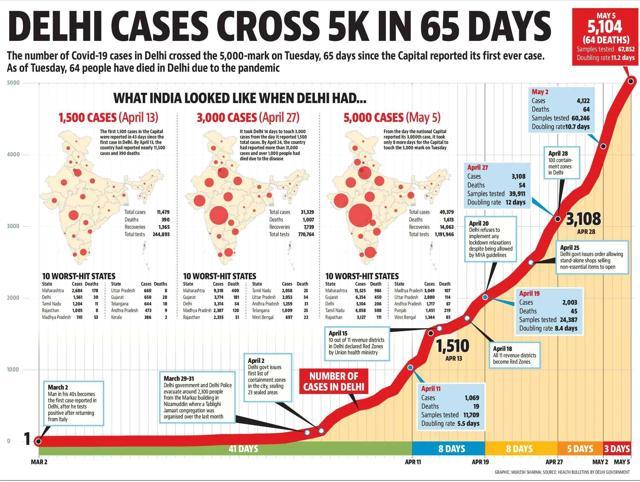
A 45-year-old man who returned from Italy to his house in Mayur Vihar was the first reported infection in the Capital. Since then, it took more than a month for Delhi to record its first 1,000 cases till April 11. The numbers in early April were driven up largely by those evacuated from a religious gathering at Nizamuddin.
After the emergence of the cluster – 16,500 people who attended the gathering have so far been identified – it took only eight days for Delhi to add another 1,000 cases to its tally. The last 2,000 cases in Delhi have been reported in just eight days, with the highest number of infections – 427 in a day – being recorded on Sunday. The previous highest single-day tally was on Saturday, with 384 cases.
“Delhi saw the first spike in cases in early April after over 2,300 people from Nizamuddin Markaz were evacuated in March-end. Many of them tested positive subsequently, driving up the numbers. However, once the cases from Markaz and those who had come in contact with them came down, many of the new cases were being reported in health care workers and their families,” a district health official said on condition of anonymity.
Several clusters of infections have been reported from hospitals. At the Babu Jagjivan Ram Memorial Hospital in Jahangirpuri, 75 health care workers have so far tested positive. At the state government-run Baba Saheb Ambedkar hospital, at least 45 people have been confirmed of having contracted the disease. The first cluster of infections from a hospital, however, was reported at the Delhi State Cancer Institute in the first week of April – 26 health care workers, four cancer patients and a two-year-old child were among those who tested positive.
An official from Delhi’s health department, who asked not to be named, said: “Now, the concern is with the government relaxing the lockdown norms. More and more people will go out and be exposed to the infection. There will be a spike in cases around two weeks from now.”
Delhi chief minister Arvind Kejriwal said on Sunday that a complete lockdown has affected the economy and livelihoods, and that relaxations were important to ensure life is not completely thrown out of gear. He said that people will have to learn how to live with the disease in their midst and that the Delhi government was prepared to tackle the surge in cases.
When the first Covid-19 case was reported in Delhi in March, there was only one sample collection centre, located at Dr Ram Manohar Lohia Hospital, and the tests were being conducted by the National Institute of Virology in Pune. On Tuesday, 3,744 samples were collected at about 42 centres and tested at 24 centres in the city.
“It is possible that we are detecting more cases now that we are testing more. Earlier, only those who were symptomatic were being tested. However, now we know that around 80% people either have no symptoms or very mild symptoms. So we might have missed many cases who have now spread the infection in the community,” said another district official, asking not to be named.
“Now, most people from the community – many without any symptoms – are being tested positive. This could be the second generation of transmission from the travellers that we might have missed and soon we will see the third generation of transmission, with the relaxation in norms,” said the district official.


